Halkidiki Shakes Off Wildfire Fears as Its Tourist Mix Undergoes a Quiet Revolution
Usagevpn.com – The smoke from the Siviri wildfire still hung over the first peninsula of Halkidiki when hotel managers in the affected stretch checked their booking systems and found, to their relief, that not a single reservation had been pulled. Visitors who had planned trips in the days immediately following the blaze went ahead as scheduled. In the weeks since, the numbers have held steady, and the current season is tracking at levels comparable to — or in some metrics exceeding — those recorded across all of 2025, when more than one million foreign visitors, overwhelmingly from European countries, passed through the region.
For the residents of Thessaloniki, the nearest major city roughly 40 kilometres to the north, Halkidiki has never been a distant exotic destination. It is the weekend escape, the midweek reset, the family tradition passed down through generations. Locals in the port town and its surrounding villages have long maintained a simple conviction:
“There’s nowhere like Halkidiki.”
That sentiment, once confined to Greek holiday calendars, now appears to resonate across the continent. The peninsula’s three slender arms — often called its “legs” — stretch southward into the Aegean, offering a coastline of remarkable variety: sheltered coves for families, windswept headlands for sailors, and stretches of sand so fine and the water so transparent that they rival anything in the Mediterranean. It is precisely this combination of accessibility from a major urban centre and natural quality that has made the area a perennial fixture in Greek domestic tourism, available not merely in July and August but across the full calendar year.
A Wildfire That Changed Nothing
The Siviri blaze, one of the larger fires to strike the area in recent memory, consumed vegetation along the first leg — the section closest to Thessaloniki and the one most directly exposed to the flames. Yet the economic ripple was, by every measure available to operators, negligible. No cancellations were logged. No visible dip in occupancy followed in the days after the fire was contained. The second and third legs, untouched by the blaze, continued operating at full capacity throughout the episode.
What has shifted, however, is not the volume of visitors but the shape of their stays. Hoteliers report that the average length of a foreign tourist’s visit has contracted compared with previous seasons. Guests are arriving for shorter trips — perhaps three or four nights rather than a full week — yet they are allocating a larger share of their budget to dining, excursions, and on-property experiences during those compressed days. The result is a higher per-night revenue figure even as total guest-nights tick down slightly.
The Russian Exodus and Its Replacement
Perhaps the most consequential structural change in Halkidiki’s visitor profile over the past several years has been the steep decline in arrivals from Russia. Before the war in Ukraine reshaped European aviation and trade, Russian tourists formed a substantial slice of the peninsula’s summer trade. Many of them paired a Halkidiki beach holiday with a pilgrimage to Mount Athos, the monastic peninsula on the first leg that draws Orthodox visitors from across the former Soviet space. European sanctions, among other things, eliminated direct air links between Greek and Russian airports, making the journey longer, costlier, and logistically more complex.
That particular market has largely migrated to neighbouring Turkey, where flight connections remain dense and the overall travel experience for Russian nationals is less constrained. The vacancy it left in Halkidiki’s booking books, however, has not persisted. Two streams have closed the gap.
The first is familiar: the Balkan neighbours — Serbia, Bulgaria, and North Macedonia — have long treated the Greek coast as a default summer option. Their visitors return season after season, drawn by proximity, shared cultural references, and established package-tour infrastructure.
The second stream is newer and, in the eyes of local operators, more strategically significant. British, German, French, Swiss, and Italian travellers are arriving in growing numbers, many for the first time, lured by the clarity of the water, the relative affordability compared with the Balearic Islands or the French Riviera, and the straightforward flight connections from major Western European hubs. Crucially, these visitors exhibit a high repeat-visit rate. They come once, find the experience meets their expectations, and book again the following year.
Sani and the Visitor Experience
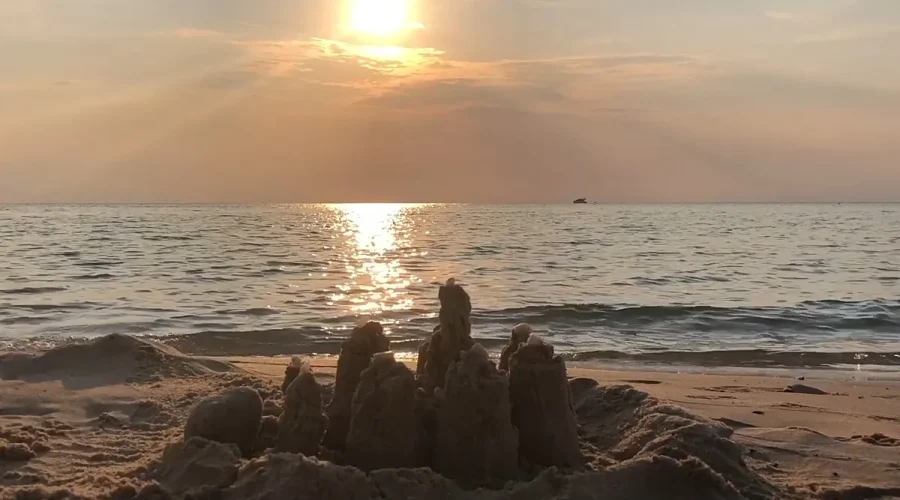
At Sani, one of the most recognised beaches on the second leg, the summer scene in recent weeks has been a mosaic of nationalities. Families from Belgrade share sun loungers with couples from Munich; a group of teenagers from Milan occupies the shallow end while Swiss retirees read at the waterline. The beach’s infrastructure — restaurants, water-sports rentals, shaded promenades — has been built over decades to absorb exactly this kind of mixed international traffic.
The practical implication for the local economy is straightforward: the revenue base is broadening. Where Halkidiki once leaned heavily on a single foreign market whose size could swing with a currency fluctuation or a diplomatic friction, it now draws from at least six or seven distinct nationalities, each with its own seasonal rhythm and spending pattern. That diversification, combined with the shorter-stay/higher-spend trend, positions the peninsula to weather future shocks — whether climatic, geopolitical, or economic — with considerably more resilience than a decade ago.
For the residents of Thessaloniki who have treated the peninsula as their backyard for generations, the shift is less dramatic than it sounds. The weekend break, the Sunday lunch by the sea, the autumn walk along the headland — these habits persist regardless of which passport is stamped in the passport-control queue at Thessaloniki Airport. What has changed is that the rest of Europe is now doing, on a larger scale, what the locals have always done: treating Halkidiki not as a destination to be discovered once, but as a place to return to, year after year.
Related Reading
Frequently Asked Questions
What is No place like Halkidiki?
No place like Halkidiki is the main topic of this guide. The article explains the context, practical details, and next steps readers should understand.
Why does No place like Halkidiki matter?
No place like Halkidiki matters because readers are looking for a useful answer, not just a short summary. Good content should match search intent and help them decide what to do next.