Spain’s “Wolf Boy” Marcos Rodríguez Pantoja Dead at 80
Usagevpn.com – The man who spent twelve years living alone among wolves in the Spanish mountains has died. Marcos Rodríguez Pantoja passed away on Saturday, 15 August, aged eighty. His death closes a chapter in Spanish cultural memory that stretched from the aftermath of two devastating wars to the modern era of environmental advocacy and cinema.
A Childhood of Neglect in Post-War Andalusia
Rodríguez was born in 1946 in Añora, a small village in Andalusia, at a moment when Spain was still reeling from the twin shocks of civil war and global conflict. The household into which he was born offered little warmth. His father struggled to put food on the table, and his stepmother subjected him to cruelty. By the age of six, his father had sold him to a goatherd who deposited the boy in a remote valley, instructing him to tend livestock alongside an elderly shepherd.
That arrangement proved short-lived. The old herdsman, who had initially taught the child how to navigate the terrain and exploit whatever resources the landscape provided, died within a brief period. What followed was a solitude that would define the rest of Rodríguez’s formative years.
Twelve Years Without Human Contact
From roughly 1952 to 1964, Rodríguez existed outside the bounds of settled society. He turned the wild into his dwelling and regarded the animals around him as kin. Over those years he developed his own communicative systems, learning to replicate birdsong, the cry of deer, and other vocalisations of the mountain fauna. He was certain he could converse effortlessly with foxes, wolves, and even snakes.
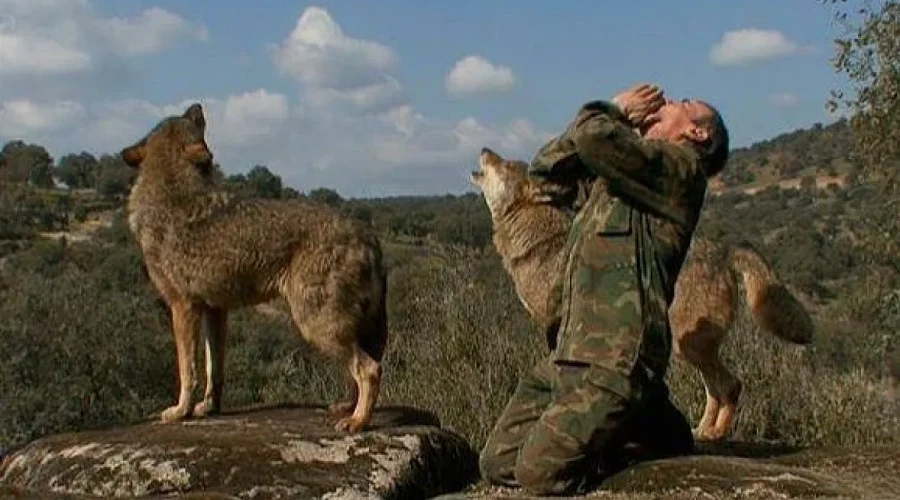
Human voices in the mountains triggered flight or concealment. Civilisation held no pull for him. Yet within the animal world he forged genuine bonds. A wolf pack accepted him after he fed its young and raised his voice in alarm whenever he perceived a threat. What emerged, over time, resembled a symbiotic relationship.
“If I wanted fish, I went to the river and fished; if I wanted a rabbit, I caught one; if I wanted a deer, I called my parents, the wolves, let out a howl, hid in the river and the wolves drove the animals down to me.”
Discovery and the Long Road Back
In 1965, at nineteen years old, members of the Guardia Civil located him in the mountains. The transition back into human society proved arduous and protracted. Rodríguez repeatedly emphasised that his genuine suffering did not begin in the wilderness but at the moment he was compelled to reintegrate. Those who knew him later described a man who retained a childlike quality, displayed what they called “naivety” about social conventions, and never achieved fully fluent Spanish.
His post-discovery life moved through a sequence of institutional placements: a priest’s household in Jaén, a convent in Madrid, compulsory military service, and eventually work in hotels and restaurants on the island of Mallorca.
The Anthropological Record
Between November 1975 and April 1976, Professor Gabriel Janer Manila, an anthropologist attached to the Faculty of Philosophy at the University of Palma de Mallorca, conducted months of structured interviews with Rodríguez as part of a social-science investigation. The two became friends. Janer’s doctoral thesis mapped the successive phases of Rodríguez’s existence: his gradual absorption into the wolf community, his acquisition of its behavioural rules and vocal “language,” and his treatment of animals as peers rather than subjects.
“I cried and they jumped up onto me… then they showed me the way to their cave, the wolves’ den.”
Janer recounted how the wolf cubs circled him playfully and leapt at him in greeting. The study was subsequently published in Spain under the title He jugado con lobos (“I Have Played with Wolves”).
Public Life, Film, and Environmental Messaging
In 2010, a crew from the TVE programme Informe Semanal visited Rodríguez in Añora, where he was making his first return to the town in sixty years. Addressing the camera, he reflected on his mountain years:
“I was very well. I didn’t know what money was, but I always had enough to eat.”
His life story reached a wider audience through the feature film Entrelobos (released in Germany under the title Wolfsbrüder). The Spanish premiere took place on 26 November 2010; the German release followed on 7 June 2012.
Rodríguez framed his public storytelling as an act of ecological advocacy. His stated aim was “protecting nature and promoting a better understanding of it, because we have become so distanced from it.” He directed a particular appeal to young audiences:
“Show more affection to your pets, because devices only need to be plugged in, but pets need love.”
A Final Home in Galicia
From 2001 onward, Rodríguez settled in the village of Rante, within the province of Ourense in Galicia. The municipality of San Cibrao das Viñas, to which Rante belongs, issued a farewell statement upon his death:
“Marcos came to Rante with a story the whole world knew. He leaves behind a story that has become ours too.”
His passing removes one of the most singular human narratives of the twentieth century — a life shaped by abandonment, wilderness, and an improbable kinship with predators that ultimately became a vehicle for environmental reflection and cultural memory across Spain and beyond.
Related Reading
Frequently Asked Questions
What is Raised in the wild?
Raised in the wild is the main topic of this guide. The article explains the context, practical details, and next steps readers should understand.
Why does Raised in the wild matter?
Raised in the wild matters because readers are looking for a useful answer, not just a short summary. Good content should match search intent and help them decide what to do next.