Pope Leo XIV Returns to San Marino After 15 Years, Carrying a Peace Appeal to a Microstate and a Mass Gathering in Rimini
Usagevpn.com – For the first time in more than fifteen years, a reigning pontiff set foot on the territory of San Marino this Saturday, stepping into one of Europe’s smallest sovereign states to deliver what he framed as a renewed call for diplomatic cooperation and multilateral restraint. The visit, which also carried the pontiff to the nearby Romagna city of Rimini, marked a deliberate return to two venues that have shaped papal engagement with Italian civil society since the early 1980s.
A Microstate as a “Laboratory of Good Politics”
San Marino, home to roughly 35,000 residents, traces its republican origins to the fourth century AD, though the legal framework governing its present-day institutions dates to 1243. It ranks as the third-smallest country in Europe and has long been cited among the oldest continuously existing republics on the continent. Its executive power rests with two Captains Regent who serve as the highest authorities of the state.
Addressing the assembled authorities in the chamber of the Grand and General Council, Leo XIV offered a pointed observation about the microstate’s potential role in contemporary governance:
“The Republic of San Marino can be a laboratory of good politics, where, without compromising the secular nature of the State, it is possible to draw on the principles of Catholic social doctrine: the pursuit of the common good, the universal destination of goods, the harmony between subsidiarity and solidarity, social justice.”
The remark positioned the tiny republic not merely as a ceremonial stop but as a conceptual model — a place where Catholic social teaching might inform secular policy without eroding the state’s non-religious character. The Pope then pivoted to broader geopolitical concerns, renewing his opposition to what he called the “power politics of our time” that “trample” international humanitarian law, and reaffirming his insistence on “esteem for diplomacy and multilateralism.” These themes have anchored his public messaging since his election just over a year ago.
Historical Echoes on the Balcony
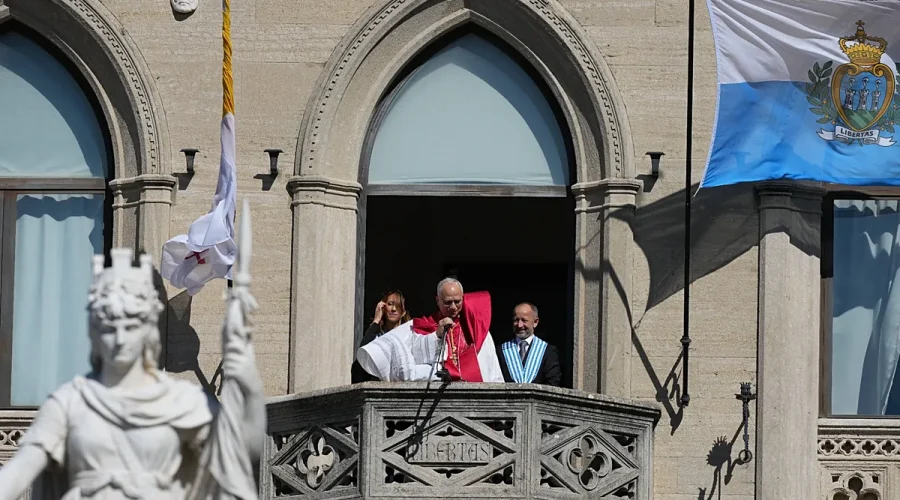
After his formal address in the Sala del Consiglio dei XII, the pontiff appeared on the balcony of the Palazzo Pubblico — the seat of San Marino’s government — to greet crowds gathered in the central Piazza della Libertà. The image recalled a moment frozen in institutional memory: 29 August 1982, when John Paul II became the first head of the Catholic Church to visit the Republic. Benedict XVI later undertook a pastoral journey linking San Marino with other Italian communities within the same diocese in 2011, but no pope had returned to the enclave until now.
“I am truly happy to be here with you, to greet you, to savour the beauty, history, tradition and faith of this people of San Marino. Always remain united in this welcoming spirit.”
The papal helicopter touched down on Mount Titano at approximately nine in the morning. Military honours were rendered, followed by a private audience with the two Captains Regent before the public proceedings began.
Monaco Precedent and the Microstate Circuit
The San Marino stop follows a pattern Leo XIV established last March when he travelled to the Principality of Monaco — another European microstate of roughly two square kilometres, second in size only to Vatican City’s half-square-kilometre footprint in the heart of Rome. That Monaco visit came after nearly five centuries without a papal presence, underscoring a broader pattern of the pontiff engaging with small sovereign entities as sites of symbolic and doctrinal significance.
Freedom, Encounters, and the EU Threshold
In the body of his San Marino speech, the Pope drew a sharp distinction between genuine liberty and its instrumentalised imitations:
“Freedom is fulfilled in encounter and dialogue.”
He warned that the world too often confronts “political and economic projects that present themselves in the name of freedom, but in reality are enslaved to idols and to power.” The Pope also acknowledged a practical inflection point for the republic: its Association Agreement with the European Union was on the verge of becoming operational, placing San Marino in what he described as a “stable, if particular, relationship” with a complex supranational order from which it could “draw great benefit.”
The two Captains Regent, Alice Mina and Vladimiro Selva, responded with a statement framing the visit in terms of continuity:
“Your Holiness, your presence rests upon our ancient history as a sign of light, renewing the deep bonds that, over time, have united the Holy See and our Republic.”
Rimini: The Communion and Liberation Gathering
Just twenty-five kilometres from San Marino, the city of Rimini hosted the next phase of the itinerary. The Pope addressed the 47th edition of the Communion and Liberation Meeting, an annual gathering for friendship among peoples that has convened since 1980. Organised by Communion and Liberation — a lay movement of Catholic inspiration founded by Father Luigi Giussani — the event draws participants from across the Italian and international Catholic landscape.
Leo XIV’s presence at the Rimini gathering is itself a historical marker. The last pope to attend was John Paul II in 1982, whose itinerary that year linked San Marino and Rimini in a single journey. Forty-four years later, Leo XIV repeated that combined route, collapsing two decades of institutional distance into a single Saturday.
Thousands queued from early morning at the gates of the city’s exhibition centre, where the event’s main sessions were held. The hall’s capacity of 20,000 seats was supplemented by large external screens for those unable to secure a place inside. Last year’s edition recorded attendance of 800,000 people across its programme, a figure that signals the scale at which the gathering now operates within Italian civil and religious life.
The convergence of a microstate audience and a mass civic assembly in a single day gave the visit an unusual breadth: from the intimate chamber of a four-century-old republic to a hall engineered for tens of thousands, the Pope’s Saturday moved between scales of governance and community that few other European capitals could replicate in one itinerary.
Related Reading
Frequently Asked Questions
What is Leo XIV in San Marino and Rimini?
Leo XIV in San Marino and Rimini is the main topic of this guide. The article explains the context, practical details, and next steps readers should understand.
Why does Leo XIV in San Marino and Rimini matter?
Leo XIV in San Marino and Rimini matters because readers are looking for a useful answer, not just a short summary. Good content should match search intent and help them decide what to do next.