The Dolomites’ Frozen Foundation Is Crumbling, and the Consequences Reach Far Beyond the Summit
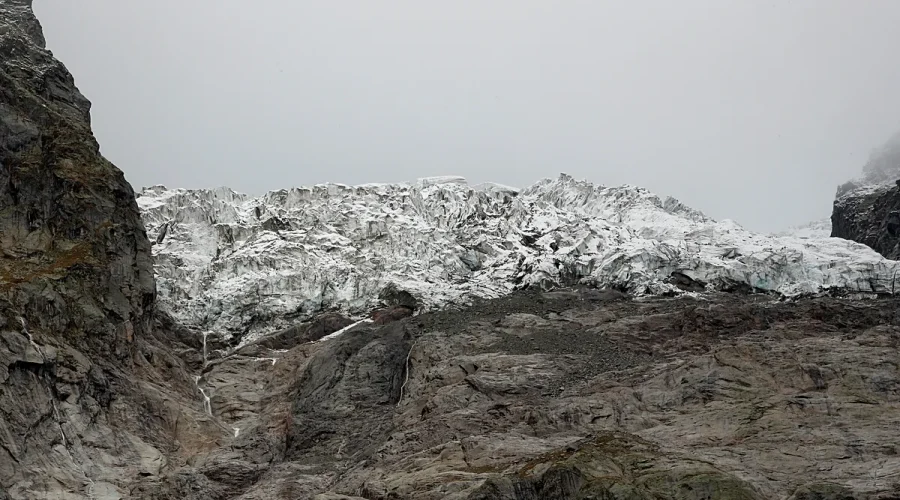
Usagevpn.com – Grey streaks of meltwater now carve deep channels across what was once a pristine white expanse. The perimeter of the Marmolada glacier — the largest ice body in the Italian Alps — continues to contract under the weight of consecutive heatwaves, and the visual evidence of its decay has become impossible to ignore. What was, until recently, a slow seasonal retreat has accelerated into something that local environmental groups describe as a structural transformation of the mountain itself. The implications extend well past the ice: permafrost that has anchored slopes for millennia is thawing, water reserves that sustain summer communities are draining, and the geological stability of an entire range is being called into question.
A Glacier Under Visible Stress
The seventh iteration of the Glacier Caravan, an international awareness campaign that departs annually from France and traverses the Alpine arc, has once again placed the Dolomites at the centre of its messaging. For the Veneto-based environmental organisation Legambiente, Marmolada stands alongside Adamello and Mont Blanc as a defining indicator of how rapidly the Alpine environment is being reshaped. Recent weeks of extreme heat have pushed the glacier’s mass balance further into deficit. Observers note that the ice surface has taken on a dull grey colouration, deeply incised by braided meltwater channels, while the glacier’s margins retreat measurably each season.
The meteorological backdrop makes the acceleration unsurprising. In June 2026, recorded temperatures across the Veneto region ran more than three degrees Celsius above the 1991–2020 climatological norm. By July, the situation at altitude had become exceptional: the freezing level climbed above 4,000 metres, a threshold that effectively eliminates the cold-air layer that normally sustains high-elevation ice through the warm months. For a glacier already operating near its survival limit, such conditions represent not a seasonal anomaly but a new operating regime.
Permafrost Thaw and the Slope Instability Problem
The loss of surface ice is only one dimension of the crisis. Beneath the visible landscape, permafrost — ground that remains frozen for years or decades and acts as a structural glue binding talus, scree, and bedrock together — is warming and degrading. Data from the Arpav regional environmental agency, updated through 31 July, show that on Piz Boè in Trentino the active layer (the seasonally thawed zone above permanently frozen ground) has exceeded 7.4 metres in depth. While that measurement does not map directly onto the Belluno Dolomites, Legambiente treats it as a leading indicator of a process now active across the range.
The practical consequence is a measurable increase in slope failure events. Figures cited by the organisation indicate that the province of Belluno contends with between 150 and 200 rockfalls, collapses, and landslides every year. Recent rockfalls recorded on the north-west face of Pelmo have sharpened the urgency of the issue. In response, Legambiente is pressing for the extension of permafrost monitoring networks to the Pelmo, Antelao, Sorapiss, Civetta, and Tofane massifs — peaks where infrastructure, hiking routes, and populated valleys sit directly beneath potentially unstable terrain.
Water Scarcity at Altitude
A less visible but equally concrete consequence of the warming trend is the erosion of high-altitude water availability. Alpine glaciers and snowpacks have historically functioned as natural reservoirs, releasing meltwater gradually through summer and autumn to replenish aquifers, streams, and municipal supply systems. As the ice volume shrinks, that seasonal buffer weakens. Aquifer recharge diminishes, reservoir levels drop earlier in the season, and the water that mountain communities depend on for drinking, agriculture, and tourism becomes less predictable.
The effect is already reaching the mountain huts that serve as waypoints for hikers and climbers. High-altitude water, Legambiente explains, can no longer be taken for granted. In direct response, the province of Belluno and CAI Veneto (the regional chapter of the Italian Alpine Club) have launched a dedicated protocol to secure water supply for mountain refuges — a measure that signals how quickly operational planning must adapt to conditions that were stable for generations.
Policy Lag and the Call for Accelerated Action
Against this backdrop, Legambiente Veneto is urging the regional government to expedite final adoption of the Regional Strategy for Adaptation to Climate Change, a document initiated in 2021 but still awaiting formal approval. The delay, the organisation argues, leaves municipalities and mountain communities without a coherent framework for managing slope risk, water allocation, and infrastructure resilience in a climate that is already shifting.
“The Veneto Dolomites are not just a postcard backdrop, but a living system that is changing faster than public planning can keep up with,” stresses Fabio Tullio, spokesperson for the Glacier Caravan in Veneto.
The message carried by this year’s campaign is unambiguous: passive observation of retreating ice is no longer sufficient. Slope stability requires systematic, continuous monitoring. Water availability must be modelled and anticipated season by season. Mountain infrastructure — from refuges to valley towns — must be prepared for a climate trajectory that is already in motion, not one still projected decades ahead.
Marmolada, in this framing, is far more than a single retreating glacier. It functions as a concentrated, visible signal of how quickly the Alpine environment is being restructured — and of how little time remains to adjust the systems, policies, and expectations that depend on a stable mountain climate.
Related Reading
Frequently Asked Questions
What is Marmolada shrinking ice and weaker permafrost?
Marmolada shrinking ice and weaker permafrost is the main topic of this guide. The article explains the context, practical details, and next steps readers should understand.
Why does Marmolada shrinking ice and weaker permafrost matter?
Marmolada shrinking ice and weaker permafrost matters because readers are looking for a useful answer, not just a short summary. Good content should match search intent and help them decide what to do next.