Chambord’s Iconic Gardens Turn Brown as Back-to-Back Heatwaves Reshape a Five-Century Landscape
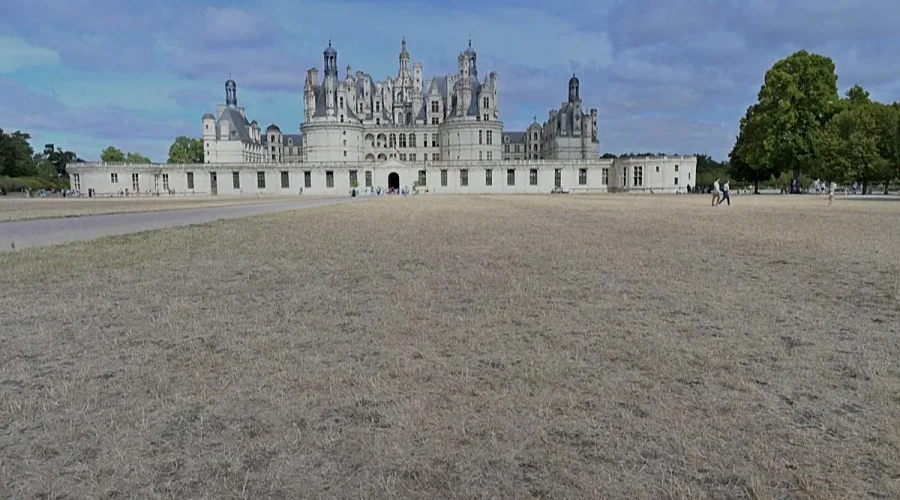
Usagevpn.com – The manicured lawns and geometric flowerbeds that have defined the grounds around Chambord Castle for centuries are now streaked with yellow and brown. What visitors once encountered as a sea of saturated green has, in the summer of 2026, become a patchwork of stressed vegetation. Multiple successive heatwaves, compounded by prolonged drought, have left the soil around the Loire Valley château exceptionally parched, and the plants are visibly failing to bounce back between episodes of extreme warmth.
The damage is no longer confined to the shallow-rooted ground cover and ornamental shrubs that typically show the first signs of water stress. This year, even the mature trees planted within the formal French-style parterres are exhibiting clear indicators of physiological distress — wilting, leaf scorch, and reduced vigor that gardeners have not previously observed at this scale.
What the Head Gardener Sees in the Canopy
Julien Billon, who leads the horticultural team at the Domaine national de Chambord, describes a troubling shift in where the damage is appearing.
“At first, we didn’t really see it on the trees; it was mainly the low vegetation with shallow roots. Now we can see that this heatwave has started to affect the trees’ root systems (…) and I think we are going to see damage, but it will be delayed over time. In fact, some trees may take two or three years to decline. But the impact of this year’s heatwave is very, very severe.”
That delayed timeline is itself a cause for concern. A tree that appears healthy in autumn can be quietly losing root function through the winter, only to collapse or die back in the following spring. For a site where individual specimens may be centuries old, a two- to three-year lag between stress event and visible mortality means that the full cost of this summer’s extremes has yet to be tallied.
A Strategic Pivot in Garden Management
The aesthetic loss, while striking, is only the most visible consequence. Deeper still is the philosophical and operational overhaul now underway at Chambord. The château’s gardens were laid out in the formal French tradition — a style built on precise geometry, dense planting, and an assumption of reliable summer rainfall. That assumption is eroding. As climate projections for the Loire Valley point toward more frequent and more intense summer heat episodes, the traditional horticultural playbook no longer fits the conditions on the ground.
The management team has therefore launched a comprehensive review of the plant palette used across the estate. The guiding principle is resilience: selecting species that tolerate sustained high temperatures and endure extended dry periods without losing structural form. Xerophilous plants — species naturally adapted to arid conditions — are being prioritized for beds and borders that previously relied on thirsty annuals and moisture-loving perennials. More robust, drought-tolerant tree species are entering the rotation for future planting cycles.
The challenge, however, is not purely botanical. Chambord’s gardens carry a specific visual identity: sweeping axial vistas, sculpted hedges, and the layered parterre patterns that make the site a UNESCO-listed landmark of French landscape architecture. Any substitution of species must preserve that grandeur, symmetry, and seasonal rhythm while simultaneously shrinking the estate’s water footprint to a degree that conventional irrigation cannot sustain. It is, in effect, a design problem as much as a horticultural one.
Five Centuries of Human Shaping Meet a New Variable
Since the mid-sixteenth century, when the château was commissioned under Francis I and its surrounding grounds began to take shape, generations of gardeners, engineers, and artists have imposed order on the terrain around Chambord. Every hedge line, every clipped topiary, every formal water feature reflects deliberate human intention layered over nearly five hundred years. The gardens were conceived as expressions of prestige, mathematical symmetry, and royal ambition.
That narrative is now being interrupted by a force no landscape architect can negotiate with: the accelerating frequency of extreme-heat events. The gardens are entering a phase in which climate dictates the terms of design. Species choices, irrigation schedules, soil amendments, and even the timing of pruning and replanting will all be recalibrated around the expectation that summer drought is no longer an anomaly but a recurring condition.
For visitors who arrive expecting the postcard image of unbroken green geometry, the 2026 season offers a stark reminder that historic landscapes are living systems, not frozen tableaux. What Chambord’s gardeners face is not a single bad summer but the first clearly visible chapter in a longer adaptation story — one in which the five-century tradition of human ingenuity must now contend, season after season, with a climate that no longer cooperates with the original design brief.
Related Reading
Frequently Asked Questions
What is At Chambord repeated heatwaves force gardens?
At Chambord repeated heatwaves force gardens is the main topic of this guide. The article explains the context, practical details, and next steps readers should understand.
Why does At Chambord repeated heatwaves force gardens matter?
At Chambord repeated heatwaves force gardens matters because readers are looking for a useful answer, not just a short summary. Good content should match search intent and help them decide what to do next.