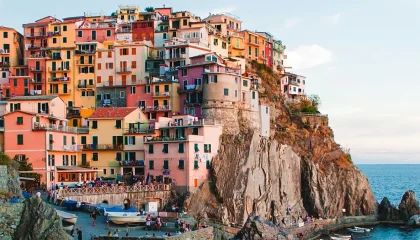
Revealed: Europe’s Most Tourist-Saturated Destinations
Usagevpn.com – Revealed through Eurostat’s 2024 overnight-stay statistics, the gap between visitor volumes and local populations across the EU is wider than most travellers ever suspect. The metric at issue — total tourist nights divided by the permanent resident count of each region — strips away the romance of a Mediterranean holiday and exposes a blunt arithmetic problem. A handful of Greek island territories, in particular, absorb so many visitor-nights that their ratios eclipse every other area on the continent by a factor of two or more.
What the Data Revealed About Greece’s Island Regions
The South Aegean region, home to Santorini, Rhodes, and Kos, posted 127.2 tourist nights per resident in 2024. In absolute terms that translates to more than 41.5 million overnight stays against a permanent population of roughly 326,000. No other EU region comes anywhere near that figure. The Ionian islands — Corfu, Zakynthos, and their smaller neighbours — followed at second place with 102.6 nights per resident, accumulating approximately 20.5 million stays on a population of around 200,000. The two regions sit so far above every other entry that no third area approaches either number.
Crete, Greece’s largest island, ranked sixth overall at 55.6 nights per resident, confirming that the saturation extends well beyond the two most famous island clusters. Even the North Aegean region, at a comparatively modest 14.9 nights per resident, still placed 24th in the EU-wide ranking — a reminder that Greek geography and climate command an outsized share of the continent’s seasonal demand.
Other Hotspots and the Wider EU Picture
Outside Greece, the next tier clusters around familiar alpine and Mediterranean locales. Bolzano, the Italian province serving as the primary gateway to the Dolomites, registered 68.9 nights per resident. Croatia’s Adriatic coastline, where Dubrovnik and Split draw enormous summer crowds, came in at 67.5. The Spanish Balearic islands — Ibiza, Mallorca, and their smaller neighbours — recorded 60 nights per resident.
These figures, while high by continental standards, pale beside the Greek island numbers. The distinction matters structurally: small, geographically isolated island territories with narrow seasonal economies are far more vulnerable to demand shocks than a diversified alpine province or a broad coastal strip.
For the overwhelming majority of EU regions, the ratio sits well below 15 nights per resident. Once the full picture is revealed, the contrast between a region at 127 and one at 8 or 10 is not merely statistical. It translates into housing pressure, seasonal labour shortages, strain on water and waste infrastructure, and a fundamental question about who a place is “for” during peak months.
At the opposite extreme, the Mazowieckie region surrounding Warsaw in Poland logged just 0.7 tourist nights per resident. Mayotte, a French island territory in the Indian Ocean that counts within the EU statistical perimeter, recorded a mere 0.5 — placing it last in the ranking. Comparing a French overseas island with Santorini on a single scale illustrates both the breadth of Eurostat’s coverage and the limits of any one-number summary.
Practical FAQ
What exactly does the “nights per resident” metric measure? It divides total overnight tourist stays recorded in a region during a calendar year by that region’s permanent resident population. A figure of 127 means each local resident “hosts” the equivalent of 127 visitor-nights over the year.
Which Greek regions appear in the top of the 2024 ranking? The South Aegean (Santorini, Rhodes, Kos) leads at 127.2, the Ionian islands (Corfu, Zakynthos) follow at 102.6, and Crete ranks sixth at 55.6. The North Aegean sits at 24th with 14.9.
Where can I find the underlying Eurostat data? The figures derive from Eurostat’s 2024 tourism statistics release, which publishes overnight-stay counts and resident populations at NUTS-2 regional level for all EU member states and associated territories.
Does a high ratio automatically mean a destination is “bad” to visit? Not necessarily. The ratio signals structural vulnerability — housing inflation, infrastructure strain, seasonal labour gaps — rather than a judgement on quality. Travellers can still enjoy these destinations while choosing shoulder-season dates or less-centralised islands to ease local pressure.
Related Reading
Frequently Asked Questions
What is Revealed?
Revealed is the main topic of this guide. The article explains the context, practical details, and next steps readers should understand.
Why does Revealed matter?
Revealed matters because readers are looking for a useful answer, not just a short summary. Good content should match search intent and help them decide what to do next.