Seven Killed When Scenic-Flight Helicopter Plunges Into Mount Ololokwe in Northern Kenya
Usagevpn.com – All seven occupants of a twin-engine tourist helicopter were killed on Wednesday when the aircraft crashed into the slopes of Mount Ololokwe in Kenya’s Samburu County. The disaster, which unfolded in the early morning hours, marks one of the deadliest aviation incidents in the country’s northern wilderness in recent years and has prompted an immediate multi-agency rescue and investigation response.
The Crash and Its Immediate Aftermath
The Kenyan Civil Aviation Authority confirmed that the accident took place at approximately 9:13 a.m. local time. At the moment of impact, the aircraft had been en route from the Loisaba wildlife conservancy toward the banks of the Ewaso Nyiro river, a major waterway that carves through the arid landscape of northern Kenya. The helicopter involved was identified as a Eurocopter EC130 B4, a twin-engine rotorcraft widely employed across East Africa for passenger transport, utility work, and sightseeing operations.
Footage circulating on social media within hours of the crash captured thick columns of black smoke rising from the base of the mountain, underscoring the severity of the impact. Local residents and conservation staff in the Samburu region reported hearing the rotor blades before the aircraft disappeared behind the ridge, though the exact sequence of events remains under investigation.
Official Confirmation and Passenger Manifest
Fredrick Kabunge, who heads the Aircraft Accident Investigation Department within the Kenyan aviation authority, addressed the press shortly after the crash. He confirmed the full complement aboard and the nature of the flight.
“There were 7 people on board the helicopter, one pilot and six passengers,” Kabunge stated. He added that the “helicopter was transporting tourists for a scenic flight” and confirmed that there were no survivors.
The six passengers were described as tourists participating in a sightseeing circuit that typically offers aerial views of Samburu’s savannah, its elephant and rhino populations, and the dramatic topography of the Ololokwe massif. Such flights have become a staple of Kenya’s premium wildlife tourism product, drawing visitors from across Europe and North America who seek perspectives unavailable from the ground.
Rescue and Recovery Operations
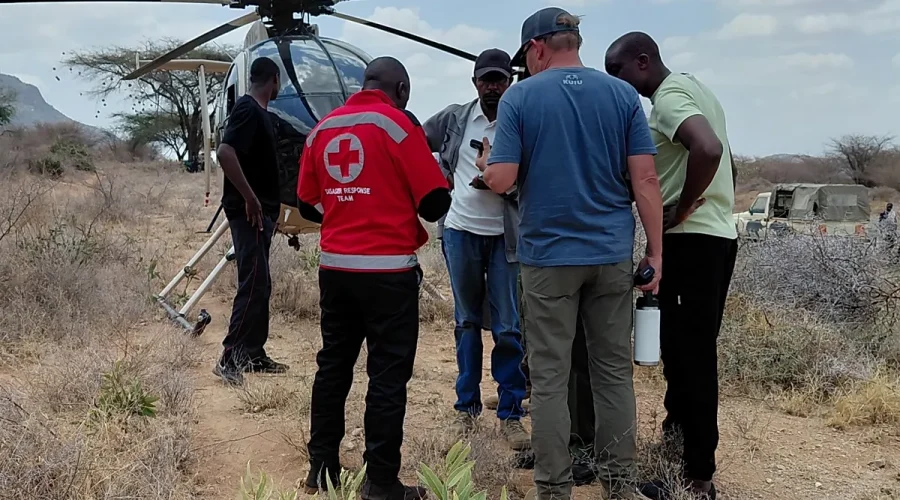
The Kenya Red Cross activated its emergency response protocol within minutes of receiving the crash alert. Teams were dispatched to the scene in Samburu County and began coordinating with county government officials, the Kenya Police, and other state agencies to establish access routes to the wreckage.
“Search and recovery efforts are ongoing, hampered by difficult terrain access and an active fire at the crash site,” the Red Cross said in a public update later on Wednesday. “An additional team has been dispatched from Isiolo to reinforce the operation.”
Isiolo, a logistics town roughly 130 kilometres south of the crash site, serves as a staging point for many northern-operations deployments. The dispatch of a second team from that location signals that authorities anticipated a prolonged recovery effort given the remoteness of the Ololokwe slopes and the ongoing blaze at the impact zone.
Mount Ololokwe and the Samburu Flight Corridor
Mount Ololokwe, rising to nearly 2,000 metres above the surrounding plains, is one of the most visually striking landmarks in the Samburu ecosystem. Its sheer granite faces and the dense acacia woodland at its base make it a focal point for aerial tours departing from conservancies such as Loisaba, which sits along the Ewaso Nyiro’s upper reaches. The river itself, flowing southward from the Ethiopian highlands before emptying into Lake Turkana, forms a natural corridor that guides flight paths through some of the most remote and sparsely populated terrain in Kenya.
The combination of rugged topography, limited road access, and the speed at which a helicopter can descend into a valley makes crash-site access in this region exceptionally challenging. Rescue teams often must approach on foot or by light fixed-wing aircraft, and active fires at the wreckage can delay recovery of remains and black-box data for hours or days.
The EC130 and Kenya’s Light-Aviation Landscape
The Eurocopter EC130 B4 is a twin-engine, eight-seat helicopter manufactured by Airbus Helicopters (formerly Eurocopter). It is a workhorse of Africa’s light-aviation sector, used for everything from oil-field transport to medical evacuation to the scenic flights that were the purpose of this particular sortie. Its twin-engine configuration provides redundancy in case of a single-engine failure, though it does not eliminate the risk posed by terrain, weather, or mechanical malfunction at low altitude.
Kenya’s aviation regulator oversees a growing fleet of rotorcraft operating out of airstrips and helipads scattered across the country’s national parks and private conservancies. The authority’s Aircraft Accident Investigation Department is tasked with determining the cause of every incident, and its findings typically feed into safety recommendations that may affect operator licensing, maintenance schedules, or flight-corridor designations.
What Happens Next
Authorities have not yet released a preliminary cause assessment. The investigation will examine flight data, cockpit voice recordings, maintenance logs, weather conditions at the time of departure, and witness testimony from the conservancy and riverbank areas. The Kenya Red Cross and county emergency services are expected to continue recovery operations through the night and into Thursday, depending on fire containment and terrain conditions.
For the families of the seven victims, consular assistance will be coordinated through the respective embassies in Nairobi. The Kenyan government has indicated that it will provide full support to next-of-kin during the investigation period.
This remains a developing situation. Further details on the identities of those aboard, the precise point of impact, and the preliminary findings of the investigation are expected in the coming days.
Related Reading
Frequently Asked Questions
What is Seven dead after tourist helicopter crashes?
Seven dead after tourist helicopter crashes is the main topic of this guide. The article explains the context, practical details, and next steps readers should understand.
Why does Seven dead after tourist helicopter crashes matter?
Seven dead after tourist helicopter crashes matters because readers are looking for a useful answer, not just a short summary. Good content should match search intent and help them decide what to do next.