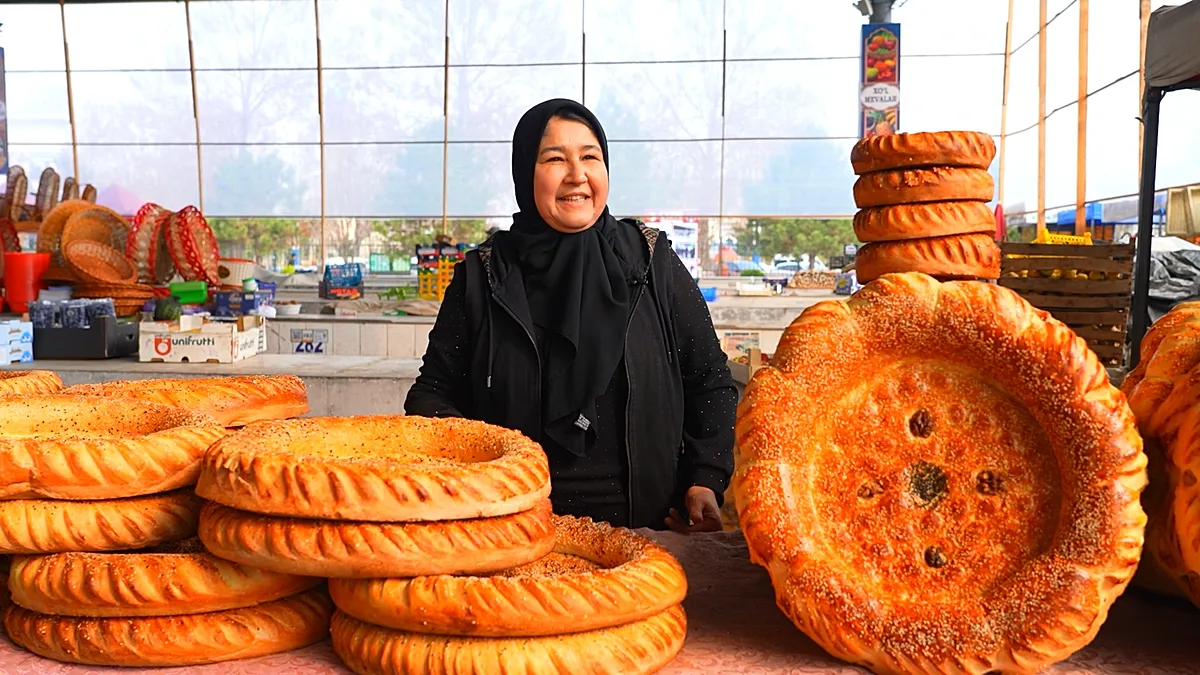
Bread, from Dough to Table – Tracing a Living Tradition
Bread from dough to table – Across Uzbekistan, bread holds a unique place in the cultural fabric, embodying more than just sustenance—it is a vessel of tradition, a symbol of community, and a staple that connects generations. In every home and market, the presence of bread signifies readiness for a meal, celebration, or even the simplest act of hospitality. Its preparation is a meticulous process, rooted in centuries-old practices that remain alive today. From the dense, slow-rise loaves of Khiva to the delicate, short-ferment varieties of Samarkand, each region’s bread tells a story shaped by its environment, techniques, and the hands that shape it.
The Heart of Khiva’s Bread Culture
Khiva, a city steeped in history, preserves its bread-making heritage with a reverence that feels almost sacred. The Khorezm bread, a hallmark of the region, is more than a food item—it is a cultural artifact. Known for its thick, substantial texture and deep, earthy flavor, it is baked in a tandir, a traditional clay oven that has been in use for millennia. This method, passed down through generations, ensures that the bread retains its unique qualities, even as modern tools begin to influence the process.
“The process has several stages. First we prepare the dough, then divide and shape it. After that we stamp the pattern and bake it in the tandir,” says Ayshajan Rakhmanova, a local baker. She emphasizes that the bread should never be sliced with a knife, but rather broken by hand—a ritual that symbolizes unity and shared joy. “Our bread is large and has its own taste. Recipes are different everywhere. We don’t add milk or oil inside, our method is different,” she adds, highlighting the regional specificity of the craft.
Rakhmanova’s explanation underscores the deep connection between technique and identity. While some steps, like mixing, have been streamlined by machinery, the final shaping and baking remain entirely manual. The dough, fermented with care, is stamped with intricate patterns before entering the tandir. This attention to detail ensures that each loaf carries the imprint of its maker, blending artistry with sustenance. Despite these modern adaptations, the core of the tradition endures, as bakers like Manzura Masharipova attests.
“Tourists come specifically to try our bread. Its taste is unique,” says Masharipova, who has operated her bakery for decades. She notes that the traditional methods not only define the flavor but also the texture, which is both chewy and resilient. “We prepare the dough using fermentation, butter, and sometimes milk. That’s why it tastes different,” she explains, illustrating how ingredients and time interact to create something irreplaceable.
Samarkand’s Artisanal Approach
Heading east to Samarkand, the bread-making landscape reveals its own distinct character. Here, the craft is shaped by the interplay of technique and environment, with bakers like Hamza Haydarov emphasizing the importance of local conditions. As a fourth-generation artisan, he describes how the climate and soil influence the final product. “Climate is very important. People try to replicate this bread elsewhere, but the taste is never quite the same,” he says, reflecting on the challenges of maintaining authenticity in a globalized world.
Haydarov also highlights the role of water in the baking process, a detail often overlooked. “We apply water so the bread absorbs it and develops a shine. This helps create layers inside and improves the taste,” he explains. The result is a bread that remains soft even after several days, a testament to the patience and precision required in its creation. Unlike in Khiva, where the process has evolved to incorporate gas-powered tandirs, Samarkand’s bakers still rely on time-honored methods, though they are increasingly adapting to meet contemporary demands.
“Our bread has a special taste. Even after two or three days, it stays soft,” says Haydarov, who runs a small family bakery. He adds that production often runs nonstop, beginning late at night and continuing through the day. “At a single location, more than 1,000 loaves can be produced daily,” he notes, underscoring the scale of this enduring tradition. Yet, the heart of the craft remains in the hands of skilled artisans, who are becoming fewer as younger generations opt for more modern professions.
Bread as a Social Anchor in the Fergana Valley
Further east, in the Fergana Valley, bread continues to anchor daily life and communal rituals. In cities like Andijan, patir bread—a large, rich loaf—plays a central role in family gatherings and ceremonies. Often weighing several kilograms, this bread is baked in tandir ovens and prepared in advance, sometimes overnight. Its presence at the table is a declaration of abundance and togetherness, a tradition that remains unbroken despite the passage of time.
“We sell large, medium, and small loaves,” says Shoira Sharipova, a seasoned seller in the local bazaar. “Customers choose bread based on its colour, taste, and quality,” she says, revealing how the market thrives on the reputation of these artisanal products. Sharipova’s words highlight the demand for quality, which drives bakers to uphold rigorous standards. “People take it to others because of its taste,” she explains, emphasizing the bread’s role as a social currency.
Patir bread, while similar to Khorezm bread in its use of traditional ovens, differs in its size and preparation. Some variations include milk and butter, which add a creamy richness to the flavor. However, the most defining feature is the slow fermentation process, which allows the dough to develop depth and complexity. “Training a baker takes time. It’s a profession that requires experience and responsibility,” says Masudakhon Egamberiyeva, a seller who has worked in the trade for decades. Her insight underscores the generational knowledge that sustains these practices.
Beyond its taste and texture, bread in Uzbekistan is a marker of cultural pride. In Khiva, where bakeries line nearly every street, the bread is not just sold—it is celebrated. “For our people, bread is sacred. I cannot imagine life without it,” says Masharipova, her voice tinged with nostalgia. This sentiment echoes across the country, where bread remains a symbol of hospitality, even in the face of modernization. While gas-powered tandirs have replaced firewood in some areas, the essence of the craft—its care, its artistry, its connection to the land—remains unchanged.
The resilience of Uzbek bread traditions is a reflection of their deep cultural roots. Each step of the process, from fermentation to stamping, is a ritual that bridges past and present. As demand for these loaves grows, so does the need to preserve the skills that keep them alive. In a world where convenience often takes precedence, the bakers of Uzbekistan continue to honor the labor and love behind every loaf, ensuring that this living tradition endures for future generations.