EU Lawmakers Blocked from Fully Inspecting Albania’s Migrant Detention Center
EU lawmakers say they were blocked from fully inspecting Italy’s migrant detention center in Albania during a recent visit. The inspection, which took place in late June 2026, highlighted concerns about transparency and conditions at the facility in Gjadër. Tineke Strik, a Greens/EFA member of the European Parliament, expressed frustration, stating that staff members actively hindered access to key areas. “Today’s visit was very disappointing. The staff created significant obstacles for us,” she remarked, underscoring the challenges faced by the delegation.
The Offshore Migration Scheme in Albania
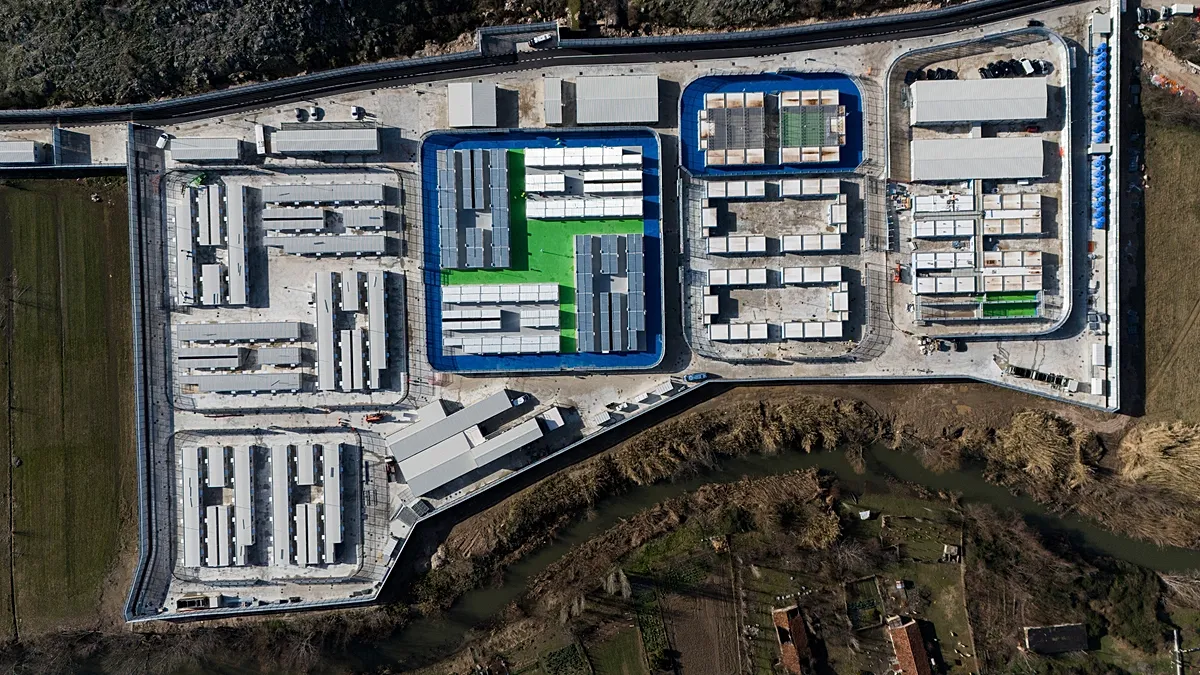
The facility, part of Europe’s controversial offshore migration experiment, has been designated as a critical hub under the Italy-Albania Protocol. Signed in November 2023 and ratified in 2024, the agreement establishes Gjadër as a primary site for asylum processing and pre-return detention. Migrants intercepted by Italian vessels are first disembarked at Shëngjin port, where initial screenings occur. From there, they are transferred to Gjadër for further evaluation. However, EU lawmakers say they were denied full access to detention areas, limiting their ability to assess conditions firsthand.
Legal Challenges and Delegation Access
EU lawmakers say they were also restricted in their ability to gather data on the facility’s operations. The delegation reported minimal interaction with staff and no opportunity to enter cells or observe daily routines. Strik emphasized that the lack of transparency raised questions about the treatment of detainees. “We didn’t get any data, they didn’t answer any questions, and we were not allowed to truly investigate the situation,” she said. The Italian government has maintained that the center functions as an extension of EU territory, with Albanian authorities responsible only for perimeter security.
The offshore scheme has faced scrutiny from Italian courts, which argue that countries like Bangladesh and Egypt cannot be uniformly classified as safe under EU law. This legal challenge has slowed the deportation process, leading to delays in the system. In August 2025, the European Court of Justice issued a ruling that further complicated the scheme’s implementation. Despite initial targets of 3,000 migrants per month, only a few dozen have been detained in Gjadër as of mid-2025, raising doubts about its effectiveness.
The cost of operating the center in Albania has sparked debate. A study by an Italian university found that each facility in the country costs over €153,000 to establish, compared to €21,000 for similar centers in Sicily. EU lawmakers say they were concerned about the economic viability of the model, which critics argue shifts financial burdens onto host countries. Meanwhile, the Gjadër center now primarily serves as a detention site for individuals ordered for deportation, holding approximately 620 people since its repurposing in mid-2025.
Detainees in Gjadër have reported mental health struggles, including feelings of isolation and despair. The International Rescue Committee (IRC), which visited the center earlier this month, noted that phone confiscation upon arrival limits communication with loved ones. EU lawmakers say they were alarmed by these conditions, which they believe could become a blueprint for broader EU policies. The visit coincided with the adoption of a new Return Regulation, which aims to expand offshore “return hubs” beyond EU borders.
The new regulation, approved on 17 June 2026 by a margin of 418 votes to 218, introduces offshore processing as a key component of Europe’s migration strategy. While proponents claim it streamlines deportations, critics like Greens/EFA MEP Mélissa Camara called it “a shameful agreement” that entrenches xenophobia. EU lawmakers say they were left questioning whether the policy prioritizes efficiency over human rights, as the Gjadër center continues to serve as a symbol of the bloc’s evolving approach to managing migration flows.