Significant Bronze Chariot Discovery in Guareña Unveils Insights into Ancient Tartessos
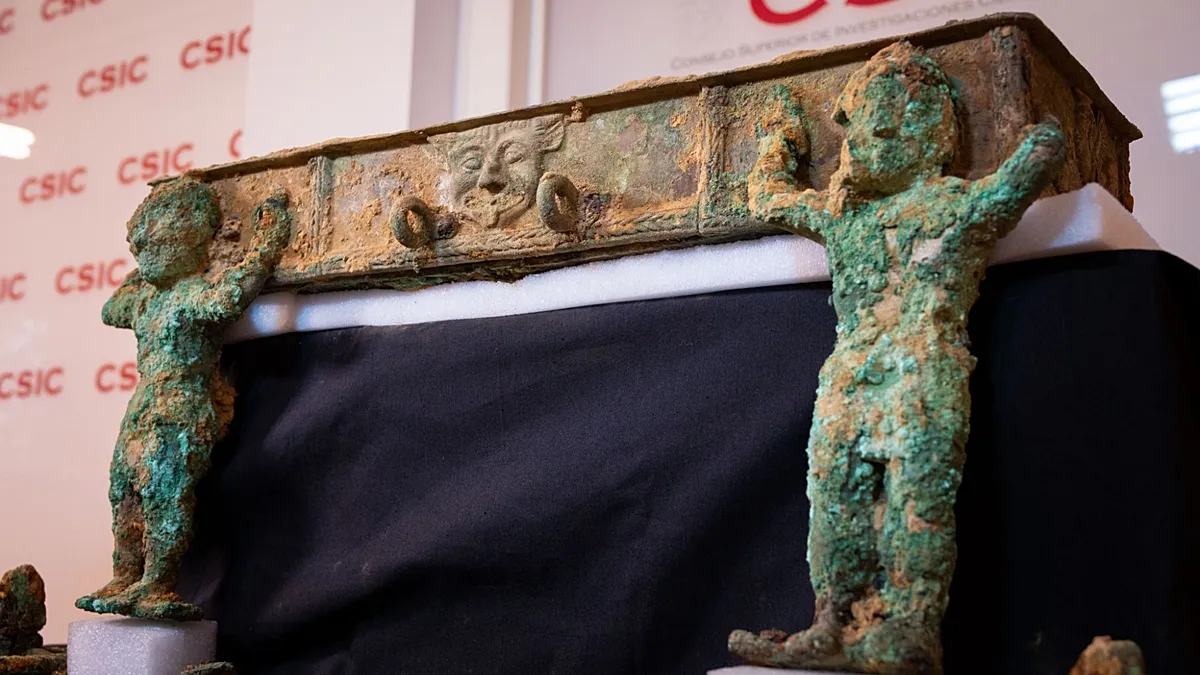
Archaeologists uncover 2 500 year old bronze – In the eighth phase of the Building Tartessos project, archaeologists working at the Casas del Turuñuelo burial mound in Guareña, Badajoz, have uncovered a bronze chariot that offers unprecedented clues about the ancient Tartessian civilization. Located in the Vegas Altas del Guadiana region, this site has become a focal point for understanding pre-Roman Iberian cultures. The chariot, discovered in the southern portion of the main structure, stands as a unique artifact with no known counterpart in the region’s archaeological record. Its intricate design and symbolic elements highlight the sophistication of Tartessian craftsmanship and their connections to distant cultures.
A Masterpiece of Tartessian Artistry
The chariot’s central compartment is adorned with sculptural reliefs depicting a range of symbolic imagery. At the front, a figure resembling Achelous, the mythological river god linked to the underworld, dominates the design. Along the sides, two griffins—creatures with eagle heads and lion bodies—appear to guard the structure. At the ends, two human figures with outstretched arms are positioned to support the framework, which is anchored by wheels embellished with elaborate patterns. These details suggest a blend of mythological storytelling and artistic innovation, reflecting the cultural richness of Tartessos.
“This chariot represents one of the most pivotal discoveries in our decade-long study of the site,” remarked Esther Rodríguez, co-director of the excavations. “Its presence not only highlights the region’s advanced metallurgical skills but also points to broader cultural exchanges.”
The artifact was unearthed during the 2026 campaign, which spanned April and May. The project’s team, comprising researchers from the Institute of Archaeology of Mérida—a collaborative initiative between the Spanish National Research Council (CSIC) and Extremadura’s regional government—has long focused on unraveling the mysteries of Tartessos. The chariot’s placement near the room believed to have hosted the final banquet of the Turuñuelo community suggests it may have played a ceremonial role in their rituals. This theory is supported by its proximity to a space thought to have been used for communal gatherings before the building was deliberately sealed around the end of the 5th century BC.
Linking Tartessos to the Mediterranean World
The discovery has sparked renewed interest in the trade networks that connected the Tartessian heartland to other Mediterranean civilizations. According to Sebastián Celestino, co-director of the project, the chariot’s design bears striking similarities to artifacts from the Etruscan culture, which thrived in central Italy between the 8th and 5th centuries BC. This correlation implies that Tartessos may have been part of a wider economic and cultural exchange system, with objects and ideas traveling across vast distances.
“The parallels with Etruscan workmanship underscore the interconnectedness of ancient societies,” Celestino added. “It’s clear that these exchange routes were vital to the development of Tartessian identity and technology.”
Alongside the chariot, researchers recovered a collection of imported goods that further illuminate the site’s role in regional trade. These items include pottery from Greek Attica, an alabaster vessel traced back to Egypt, and ivory carvings featuring warrior scenes alongside depictions of animals and plants. Such finds indicate a network of workshops and suppliers spanning the eastern Mediterranean, offering tangible evidence of Tartessos’s external interactions.
Progressive Unearthing of Tartessian History
The 2026 campaign also deepened knowledge of the mound’s physical layout. Stretching 90 metres in diameter and six metres in height, the structure has been a subject of study since 2015. Excavations in both the northern and southern sections revealed additional chambers and pathways, expanding the site’s known architecture. Notably, the northern sector yielded two braziers and a bronze cauldron, which may have been used for ritual or domestic purposes.
While the volume of pottery found this year was lower than in previous campaigns, the researchers attribute this to the less defined function of the areas explored. Nonetheless, the combination of artifacts and architectural elements continues to refine our understanding of Tartessos’s social and economic structures. Over the past decade, the site has produced a series of groundbreaking findings, including the remains of the largest animal sacrifice documented in the western Mediterranean in 2017, the first human figures of the culture in 2023, and a slate plaque with warrior scenes and an early form of the Iberian alphabet in 2024. The 2025 campaign even uncovered the oldest Greek marble altar in the region, solidifying Tartessos’s place in Mediterranean history.
From Field to Laboratory: The Next Phase of Discovery
With the current excavation complete, the Building Tartessos project is shifting focus to its laboratory phase. At the Service for Conservation, Restoration and Scientific Studies of Archaeological Heritage (SECYR) in Madrid, experts are meticulously analyzing the recovered materials. This phase is critical for interpreting the chariot’s full significance and its place within the broader context of Tartessian culture.
“The laboratory stage is where the true story of these artifacts begins to take shape,” said Rodríguez. “We’ll be examining not just the chariot itself but also how it fits into the daily lives, beliefs, and trade practices of those who lived here.”
The project’s collaborative nature is a key factor in its success. It involves approximately thirty institutions and over a hundred researchers from across the globe, with support from the Provincial Council of Badajoz and the Guareña Town Council. The CSIC and Extremadura’s regional government have also provided institutional backing, ensuring the continuity of this multidisciplinary effort. As the team delves deeper into their work, the goal remains to reconstruct the lives of Tartessian people and their interactions with neighboring civilizations.
The chariot’s discovery adds another layer to the narrative of Tartessos. Its presence in the burial mound, alongside other imported materials, suggests that the site was not only a center of local production but also a hub for cultural and commercial exchange. The Etruscan parallels, in particular, raise intriguing questions about the movement of ideas and goods between the Iberian Peninsula and the Italian peninsula. Researchers believe these connections may have been facilitated by sea routes or overland trade paths, with Tartessos serving as a key node in the network.
As the chariot is cleaned and studied, its symbolic meaning and functional use will be explored in greater detail. The placement of the artifact near the banquet room supports the hypothesis that it was used in ceremonial contexts, possibly as a vehicle for transporting offerings or as a focal point in ritual processions. The design elements, such as the Achelous figure and griffins, may have carried religious or mythological significance, reinforcing the idea that Tartessian art was deeply rooted in their worldview.
The Building Tartessos project exemplifies how modern archaeology bridges the gap between ancient and contemporary understanding. By combining fieldwork with advanced scientific analysis, the team is building a more comprehensive picture of this enigmatic civilization. The chariot, with its unique blend of aesthetics and symbolism, is a testament to the ingenuity of Tartessian artisans and their ability to incorporate foreign influences into local traditions. As more artifacts are examined, the story of Tartessos is becoming richer and more detailed, offering insights into a culture that thrived over 2,500 years ago.