The Best Scenery Under Heaven: Why Guilin Should Feature on Your China Travel List
The best scenery under heaven – Throughout history, landscapes have inspired artistic masterpieces that shape how the world perceives a place. In Britain, JMW Turner’s romanticized depictions of coastlines and castles in *Picturesque Views in England and Wales* captured the essence of the nation’s natural beauty. Similarly, Japan’s Katsushika Hokusai immortalized Mount Fuji through his *Thirty-six Views of Mount Fuji*, turning the stratovolcano into a global icon. In China, the legacy of shanshui paintings—those delicate ink-wash landscapes of mountains and rivers—has long influenced the country’s cultural perception of nature. Today, Guilin, nestled in the Guangxi region of South China, continues this tradition with its otherworldly karst formations, which feel like scenes straight out of ancient Chinese art.
Though it lies far from the towering skyscrapers of Shanghai, Guilin is only a three-hour flight away. This distance, however, is deceptive: the city’s terrain is a vivid contrast to the urban sprawl of its eastern neighbor. Looming peaks draped in mist, winding rivers, and lush green valleys create a visual tapestry that rivals the elegance of traditional ink paintings. The region’s karst landscape has been a magnet for travelers for centuries, with its beauty cemented in history by the words of Wang Zhenggong, who declared it “the best under heaven” over 800 years ago. This sentiment has endured, drawing both domestic and international visitors who still echo his admiration for Guilin’s natural grandeur.
Despite its timeless allure, Guilin has occasionally slipped from the spotlight. In the 1980s, it was one of the first areas in China to welcome foreign tourists, but recent years have seen its popularity wane. This shift might be attributed to the rise of Zhangjiajie, a neighboring region whose limestone karsts were famously showcased in *Avatar*. Yet, even as Zhangjiajie gains prominence, Guilin remains a unique destination. Its scenery, while perhaps less hyped, offers an unrivaled blend of natural wonder and cultural depth. Whether you’re embarking on your first trip to China or your fiftieth, Guilin deserves a place on your itinerary.
Exploring Guilin’s Iconic Landmarks
Guilin’s charm is amplified by its location, which is shaped by the very karst formations that define the region. The city’s architecture reflects this influence, with buildings designed to harmonize with the surrounding topography. This thoughtful integration means that the landscape remains visible from nearly every corner, as if the city itself is a continuation of the natural world. Among the most recognizable features is the Elephant Trunk Hill, a monolithic rock formation that resembles an elephant drinking water from the Li River. While the name is literal, the hill’s prominence has made it a symbol of Guilin’s character.
Another standout attraction is the Solitary Beauty Peak, often considered Guilin’s most iconic sight. Part of the Jingjiang Princes’ Palace complex, this peak was shaped during the Ming Dynasty and later became a focal point of the area’s historical and cultural narrative. The nearby karst clusters are said to bow to it, a metaphor that underscores its towering presence. The palace, built around the peak, served as a residence for the Jingjiang princes before transitioning into an imperial examination compound during the Qing Dynasty. Today, it stands as a dual-purpose site: a historical landmark and a campus for Guangxi Normal University. Climbing the peak offers a panoramic view of the city’s layout and the vast karst expanse beyond.
“The best under heaven” — a phrase that has echoed through centuries, yet it feels as fresh today as the mist clinging to the peaks.
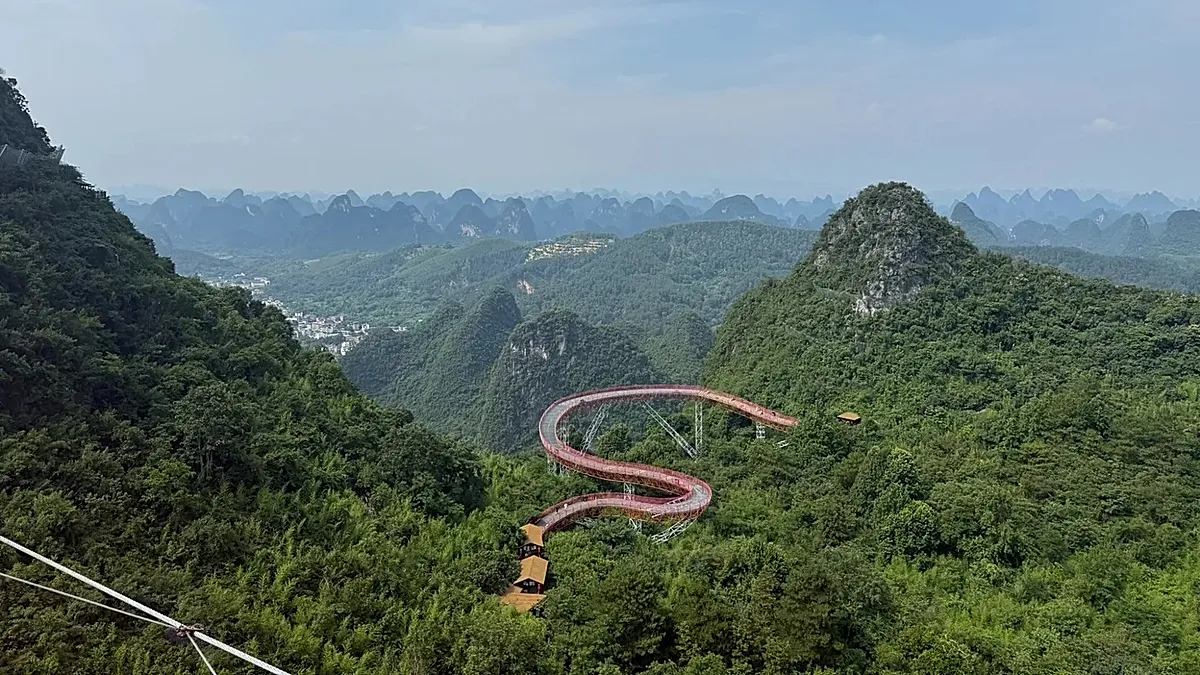
While the Li River cruise is a highlight, the views from Ruyi Peak are nothing short of breathtaking. After a thrilling ride on a cable car, a tense crossing of a suspension bridge, and a climb up steep steps, the karst formations unfurl in a stunning display. The landscape appears endless, evoking comparisons to the Phang Nga Bay in Thailand—a location that also inspired the planet Kashyyyk in *Star Wars: Episode III – Revenge of the Sith*. These geological wonders, both in Guilin and Phang Nga, are a testament to nature’s ability to shape storytelling and imagination.
Hidden Gems and Seasonal Beauty
Guilin’s allure extends beyond its dramatic peaks and rivers. The Longji Rice Terraces, located just an hour’s drive from the city, offer a striking example of human ingenuity meeting natural beauty. These stepped fields, resembling the scales of a dragon, are a seasonal marvel. Our visit coincided with early June, a time when the terraces were waterlogged and workers prepared for the next planting season. Despite the dampness, the sight was mesmerizing—a patchwork of green and blue that seemed to defy the laws of physics. Whether you come in spring or autumn, the terraces transform with the changing seasons, ensuring a unique experience each time.
The karst terrain also gives rise to an abundance of caves, with over 3,000 believed to be scattered throughout the region. These subterranean marvels, carved by millennia of water erosion, are a key part of Guilin’s geological story. Exploring them provides a glimpse into the earth’s ancient processes, as well as a chance to experience the city’s natural wonders from a different perspective. While some caves are accessible by guided tours, others remain hidden, waiting to be discovered by those who venture deeper into the region’s wilderness.
Guilin’s scenery is not just a spectacle; it’s a living, evolving entity. Even on overcast days, the landscape manages to captivate. The Li River, with its gentle currents and reflective waters, is a serene backdrop to the city’s charm. The Solitary Beauty Peak, with its historical layers and natural grandeur, is a reminder of how places can be both ancient and ever-renewing. The Longji Rice Terraces, meanwhile, offer a sense of timelessness, where human labor and nature’s artistry coexist in perfect harmony.
What makes Guilin exceptional is its ability to maintain its allure despite the passage of time. While Zhangjiajie may have stolen the limelight in recent years, Guilin’s quiet majesty remains unmatched. Its landscapes, shaped by centuries of geological activity, have inspired artists, writers, and travelers alike. The city’s beauty is not just in its visual appeal but in its cultural resonance—a place where every peak, river, and cave tells a story. As the saying goes, “the best scenery under heaven” is more than a phrase; it’s a reality that continues to draw visitors seeking a connection to the natural world and its timeless beauty.
Guilin’s appeal lies in its balance of natural and cultural elements. The city’s skyline is modest compared to Shanghai’s skyscrapers, but this limitation allows the landscape to dominate. The view from Ruyi Peak, in particular, is a masterclass in scenic grandeur, where the karst formations stretch endlessly into the horizon. For those who find themselves captivated by such vistas, Guilin is a destination that lingers in the memory long after the trip ends. Its landscapes are not just a backdrop but an active participant in the experience, shaping the way visitors perceive and appreciate the beauty of China’s southern region.