UK Court Affirms Lawfulness of Pro-Palestinian Group’s Terrorist Designation
Proscribing pro Palestinian group as terrorist – In a landmark decision, the UK Appeals Court on Monday confirmed the lawfulness of the government’s ban on the pro-Palestinian activist group Palestine Action, which was enacted under the country’s Terrorism Act on July 5, 2025. The ruling upheld the designation, making membership or support of the group a criminal offense punishable by up to 14 years in prison. This legal action has led to the arrest of approximately 3,000 individuals, ranging from students to an 83-year-old retired vicar, during protests where police intervened to detain participants.
The Legal Basis of the Ban
The ban, which classifies Palestine Action as a terrorist organization, was justified by the UK government as a necessary measure to combat acts of violence against Israeli targets. The Appeals Court’s decision cited the group’s alleged covert operations, distinguishing it from openly operating civil disobedience movements like the suffragettes. Judge Sue Carr emphasized that the group’s structure and activities render it “not a direct action civil disobedience protest group,” but rather an organization with secret cells designed to evade detection.
“It is a covert organisation operating with secret cells to avoid the detection and prosecution of those using violence to destroy the property of third parties,” said Judge Sue Carr during the court’s deliberation.
The ruling overturned the High Court’s earlier decision in February 2025, which had found the proscription “disproportionate” and criticized its impact on human rights. Palestine Action had argued that the designation unfairly criminalized its supporters, who were unaware of the group’s alleged ties to violence. However, the Appeals Court sided with the interior ministry, reinforcing the government’s position that the group’s actions justify its classification under terrorism legislation.
From Protests to Prosecution
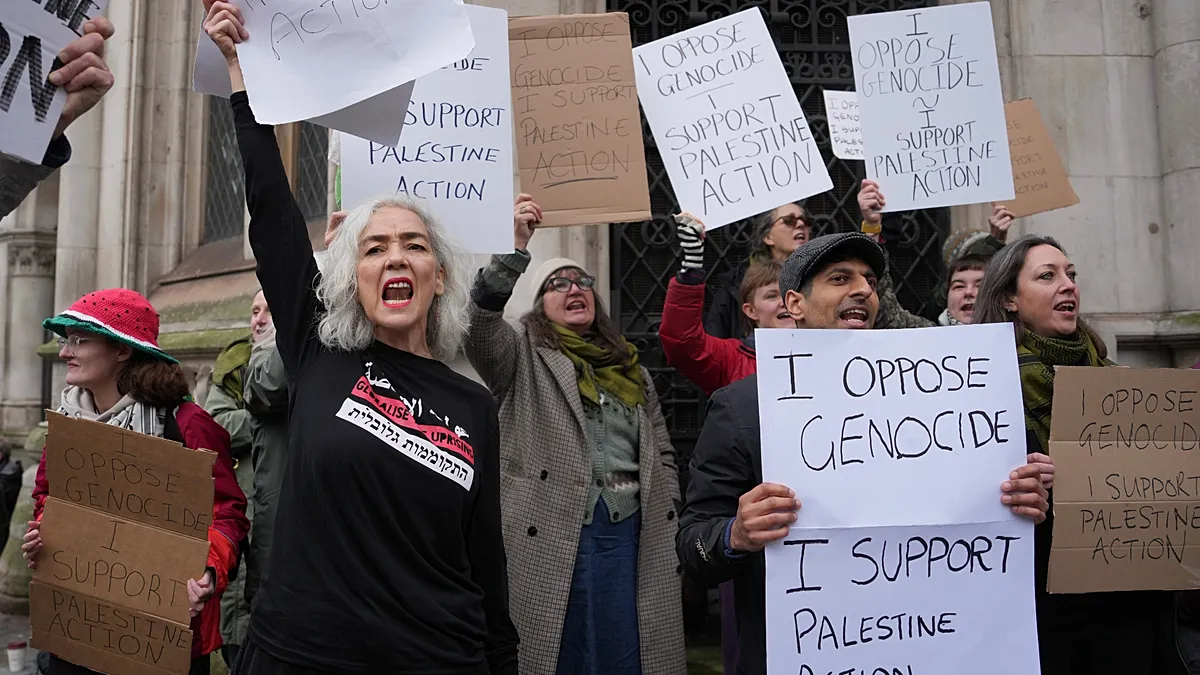
Since the ban took effect, Palestine Action has become a focal point of legal action, with protests frequently resulting in arrests. The group’s primary targets have been weapons factories in the UK, particularly those linked to the Israel-based defense company Elbit. Demonstrators have held rallies with signs reading “I oppose genocide, I support Palestine Action,” underscoring their stance against Israel’s military actions in Gaza. These protests have drawn both public and media attention, highlighting the group’s role in the broader conflict.
Formed in 2020, Palestine Action’s website—a blocked resource for UK internet users—declares its mission to end “global participation in Israel’s genocidal and apartheid regime.” The group gained international prominence following the Hamas attack on southern Israel on October 7, 2023, which triggered the Gaza war. Its activities have intensified since then, with a focus on disrupting Israeli military infrastructure through direct action.
Covert Tactics and Legal Defense
According to the court’s findings, Palestine Action’s methods involve covert operations that blur the line between protest and terrorism. The ruling highlighted the group’s alleged use of secret cells to coordinate attacks, such as the August 2024 raid near Bristol, where four activists were jailed for damaging an Elbit facility. During the incident, the demonstrators smashed computers, drones, and other equipment, leading to over a million pounds in property damage. One individual struck a police officer twice with a sledgehammer, causing a fractured spine.
“It’s really important that no one is in any doubt that this is not a non-violent organisation,” stated Foreign Secretary Yvette Cooper in defense of the ban, noting the group’s potential to incite violence.
The four activists, who received sentences ranging from four years and eight months to seven years and eight months, claimed their actions were aimed at dismantling drones and weaponry they believed would be used to kill civilians in Gaza. Despite their defense, the court deemed the proscription justified, citing the group’s capacity to orchestrate attacks while maintaining a facade of peaceful activism.
International Implications and Ongoing Cases
The UK’s decision to label Palestine Action as a terrorist group has drawn attention in the context of the international response to Israel’s military actions in Gaza. The International Court of Justice (ICJ) is currently investigating claims that Israel committed “genocide” during its campaign in the territory, a case that has intensified since the Hamas attack. The court has already acknowledged a “plausible risk” of genocide, linking the group’s activities to the broader conflict.
While the UK’s focus has been on domestic enforcement, the case reflects growing global scrutiny of Israel’s actions. Palestine Action’s inclusion in the government’s blacklist, alongside Palestinian militants Hamas and the Lebanon-based Hezbollah, underscores its perceived threat to national security. The group’s legal challenge argued that the ban disproportionately affected human rights, but the Appeals Court dismissed these concerns, prioritizing the prevention of violence over individual freedoms.
Public and Political Reactions
The ban has sparked debate among UK citizens and activists, with some defending it as a necessary step to safeguard against extremist violence, while others criticize it as an overreach that stifles dissent. The government maintains that the decision is consistent with the Terrorism Act, which allows for the designation of groups that engage in activities endangering public safety.
Since the ban was implemented, the group has faced challenges in mobilizing supporters, as its name and activities are now associated with terrorism. Nevertheless, its presence in protests and rallies demonstrates its resilience. The legal victory for the UK government signals a shift in the balance of power, with the interior ministry asserting control over the group’s operations and ensuring its alignment with broader counterterrorism strategies.
As the case continues to shape public perception, the ruling may influence future proscriptions of similar organizations. The judgment also highlights the tension between peaceful protest and violent action, raising questions about the boundaries of civil disobedience. For Palestine Action, the decision marks a significant setback, but its supporters remain committed to challenging the designation through further legal and public campaigns.