EU-South Korea Summit Focuses on Trade and Defence Collaboration
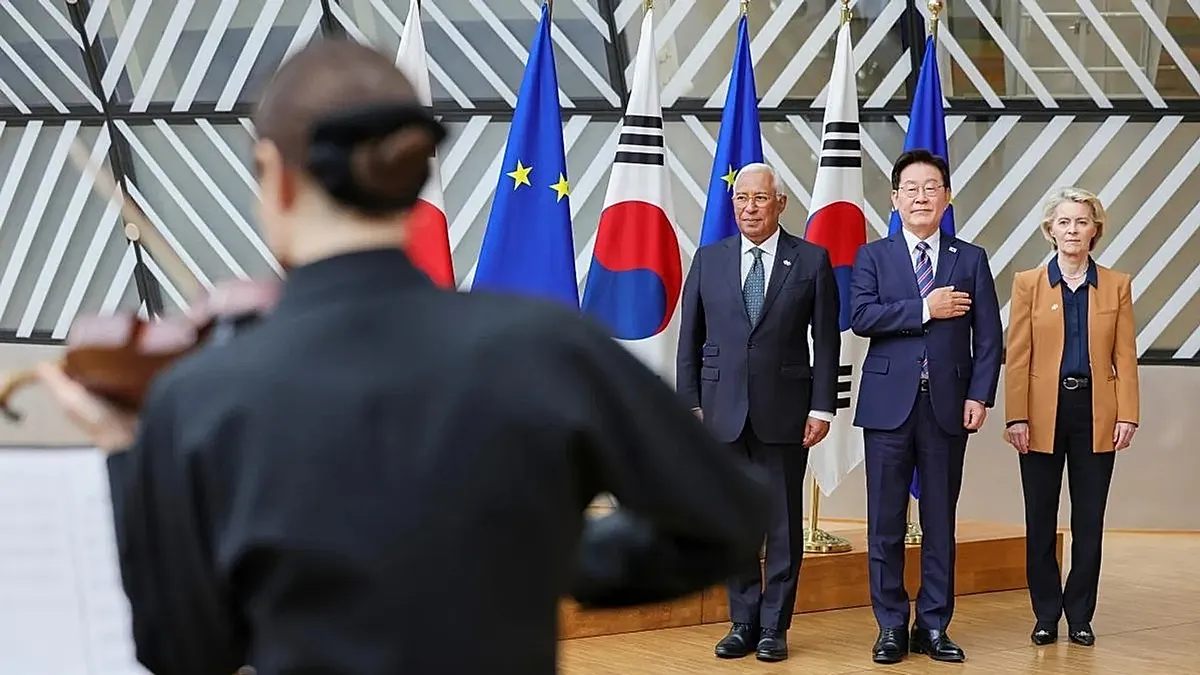
Partners and friends – Brussels hosted a significant EU-South Korea summit on Wednesday, where leaders emphasized strengthening ties through economic and security cooperation. European Commission President Ursula von der Leyen, European Council President Antonio Costa, and South Korean President Lee Jae-myung were present for the ceremonial signing of a new digital trade agreement, marking the 11th such meeting between the bloc and the Republic of Korea. This summit, held in a period of geopolitical uncertainty, highlighted the importance of mutual trust and partnership in navigating global challenges.
A Strategic Partnership in the Indo-Pacific
Speaking at the event, von der Leyen underscored South Korea’s role as a key ally in the Indo-Pacific region and beyond. “Korea is one of Europe’s closest partners, both regionally and on the global stage,” she stated. “In today’s unpredictable world, partnerships like ours are essential for stability and shared progress.” The leaders also announced a joint statement reaffirming their commitment to fostering a strong, cooperative relationship. The document emphasized the value of multilateralism and the need for a predictable, rules-based economic system.
“We reaffirm our shared commitment to effective multilateralism, and to a stable and predictable rules-based free and fair economic order,” the joint statement read.
Trade Diversification Amid Global Tensions
With rising tensions between the EU and China, as well as the US, both sides are seeking to expand their trade networks. The recent digital trade agreement is a major step in this direction, following a landmark free trade deal signed over a decade ago. Since 2015, EU-South Korea trade has seen substantial growth, reaching approximately €124.25 billion in goods in 2025, according to the European Commission. This increase reflects the deepening economic integration between the two entities.
South Korea’s growing presence as an investor in Europe is another key focus. The country is now a major player in strategic industries such as batteries, electric vehicles, and semiconductors. For the EU, securing semiconductor supply chains and attracting further Korean investment are critical objectives. An EU official noted, “Korea has a global leadership position in semiconductors, making this a vital area for collaboration.”
Enhancing Digital Trade and Economic Security
The digital trade agreement, finalized at the summit, aims to reduce barriers to cross-border commerce and create legal certainty for businesses. It will streamline data flows while prohibiting the mandatory transfer of source code, ensuring flexibility for companies operating in both markets. Additionally, the deal seeks to establish robust consumer protection rules online, though each side will retain its own standards for personal data and privacy.
Economic security was a central theme, with leaders agreeing to launch a high-level dialogue on supply chain resilience. This initiative comes after China’s export restrictions on rare earths and other strategic materials, which are crucial for green technologies and the defense sector, placed pressure on global supply chains. The EU and South Korea also addressed challenges in the chip industry, which underpins automotive manufacturing and other key sectors.
Security Agreements and Regional Challenges
Despite progress on trade, a proposed security of information agreement did not gain final approval. EU officials had previously highlighted the deal as a means to enhance classified communication between Brussels and Seoul. “I hope the security of information agreement will be adopted soon, so Korea and the EU can exchange confidential data securely,” President Lee said. This would support joint industrial and research efforts, particularly in the defense and technology sectors.
The summit also addressed broader regional concerns, with North Korea and Russia identified as major issues. North Korea’s nuclear arsenal, though smaller than that of other nuclear powers, remains a point of concern for the EU. The bloc is prepared to share information on its support for Ukraine with South Korea, aligning with a shared stance against Russia’s ongoing conflict in the region. The joint statement condemned both Russia and North Korea for their role in sustaining aggressive actions against Ukraine, urging them to halt such activities immediately.
Building on Past Agreements
The new digital trade pact builds on the EU-South Korea Free Trade Agreement, which was ratified in 2011 and has since proven to be one of the bloc’s most successful economic partnerships. A senior EU official noted that the summit discussions will further explore this legacy, with nuclear non-proliferation emerging as a key topic. The agreement with South Korea in 2024 on security and defense cooperation also served as a foundation for current discussions, covering areas like maritime security, hybrid threats, and foreign information interference.
While the summit achieved several milestones, the absence of the security of information agreement leaves room for future negotiations. This deal, though not adopted, was seen as a potential tool to deepen collaboration between the EU and South Korea. The summit’s agenda underscored the strategic importance of the relationship, as both sides work to address challenges ranging from trade dynamics to global security.
Looking Ahead: A Path of Shared Goals
As the EU and South Korea move forward, the focus remains on leveraging their partnership to drive economic growth and security. The digital trade agreement is expected to serve as a catalyst for further collaboration, particularly in the technology sector. With South Korea’s investments in strategic industries, the EU aims to secure critical supply chains while fostering innovation.
Analysts suggest that the summit’s outcomes reflect a broader strategy to diversify economic alliances and reduce reliance on China and the US. The discussions on nuclear non-proliferation and supply chain resilience highlight the EU’s dual priorities: economic stability and geopolitical influence. South Korea’s commitment to maintaining its role as a key trading partner and investor is likely to shape future negotiations and policy decisions.
With the conclusion of the summit, both the EU and South Korea have reaffirmed their dedication to a strong, mutually beneficial relationship. The joint statement emphasized the importance of cooperation in an era of rapid technological change and shifting global power dynamics. As the two sides continue to align on trade and defense initiatives, the partnership is positioned to play a pivotal role in shaping the future of international relations and economic strategy in the Indo-Pacific region.