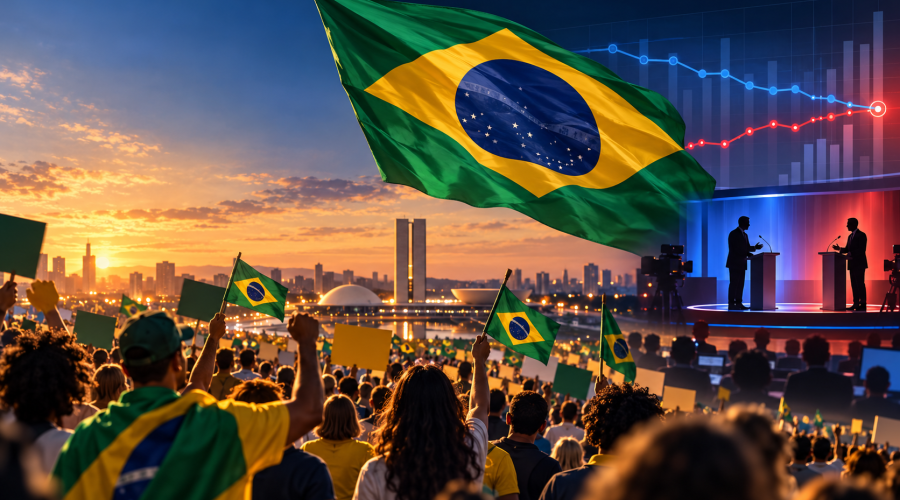
Brazil heads into decisive presidential runoff
Usagevpn.com – Brazil’s presidential race reaches its final hours with President Luiz Inacio Lula da Silva and right-wing Senator Flavio Bolsonaro making their last appeals to voters ahead of Sunday’s closely contested runoff. The two candidates are expected to bring supporters together on Rio de Janeiro’s beaches on Saturday, ending a tense three-week stretch of campaigning that followed an exceptionally tight first round.
Bolsonaro led that opening vote with 47%, narrowly ahead of Lula’s 45%. Since then, the incumbent has appeared to recover some support as the campaign sharpened divisions over public safety, prices, economic management, the Amazon and Brazil’s relationship with the United States. The result will shape not only the country’s domestic direction, but also its standing in a region where several governments have recently moved closer to US President Donald Trump.
A contest between contrasting political legacies
Lula enters the runoff as a veteran of Brazilian politics and the country’s first president from a working-class background. Before his political rise, he worked in the trade-union movement. His earlier periods in office coincided with economic expansion supported by high commodity prices and social initiatives, including direct cash transfers that helped millions leave poverty behind.
That history created deep loyalty among many supporters, yet Lula’s current term has also brought significant pressure. Concerns about violent crime and the rising cost of living have weighed on his popularity, with his approval rating at times dropping to 24%. His past remains an important part of the campaign narrative as well: Lula spent more than a year in prison on corruption convictions that were later annulled before returning to win a third term in 2022.
Former US President Barack Obama once described Lula as “the world’s most popular politician.” The current race, however, is testing whether that longstanding personal appeal can still overcome voters’ immediate concerns about household budgets and security.
Flavio Bolsonaro, meanwhile, is trying to extend the political project associated with his father, former President Jair Bolsonaro. He began his own career early, becoming Rio de Janeiro’s youngest elected state lawmaker at the age of 21. With Jair Bolsonaro barred from contesting the presidency while serving a 27-year sentence under house detention for staging an attempted coup after his 2022 loss to Lula, his eldest son became the right’s standard-bearer.
The senator has broadly embraced his father’s ultra-conservative approach while seeking a more measured public style aimed at winning centrist voters. Security is central to his message. He has pledged to address Brazil’s crime problems, add 500,000 prison places and reduce government spending. Polling has indicated that his tougher law-and-order proposals resonate with voters.
Final debate puts experience and living costs at the centre
Friday’s final live television debate was less explosive than the candidates’ first encounter, which had deteriorated into personal attacks and produced little substantive discussion. The calmer tone did not erase the sharp differences between the two men.
Lula questioned Bolsonaro’s readiness for the presidency and contrasted his own working-class story with that of his opponent. Bolsonaro focused on the financial strain felt by many Brazilians and argued that the president had failed to leave the country in good condition.
“He doesn’t know what hunger is,” Lula said of Bolsonaro.
“Why are things so expensive?” Bolsonaro asked the incumbent.
Those exchanges capture the campaign’s central tension. Lula is asking voters to value his experience and the social gains associated with his earlier governments. Bolsonaro is presenting himself as the candidate of public order, spending restraint and a break from what he calls a “broken country.”
Amazon policy and international ties carry major consequences
Environmental policy has also underscored the distance between the candidates. Brazil has a crucial role in efforts to limit global warming because protection of the Amazon rainforest affects the climate far beyond its borders. Deforestation reached a record high during Jair Bolsonaro’s presidency, while Flavio Bolsonaro has also rejected the view that climate change is caused by human activity. His stated commitment is limited to ending illegal deforestation.
Under Lula, new forest clearances have fallen to a record low in recent years. His government expanded satellite surveillance and strengthened enforcement efforts, making the reduction in deforestation a prominent part of its record. For voters, the choice carries practical meaning beyond environmental diplomacy: it concerns how Brazil will balance development, law enforcement and stewardship of its most important natural region.
Foreign policy has become another campaign flashpoint. Lula has repeatedly warned Washington against intervening in Brazil’s election and has made national sovereignty, including concerns over foreign social-media interference, a core issue. His administration has objected to Trump’s designation of Brazil’s largest drug-trafficking organisations as foreign terrorist groups, seeing the move as a possible justification for outside intervention.
Trump announced 50% tariffs on Brazilian goods last year, citing several reasons that included the trial of Jair Bolsonaro. This year brought another set of US tariffs, justified by alleged unfair trade practices despite the United States running a trade surplus. The terrorist designations came shortly after Senator Bolsonaro visited Trump at the White House, adding to the political weight of the relationship.
Questions hanging over Bolsonaro’s campaign
Bolsonaro’s push for the presidency has also been clouded by his admission that he accepted millions of dollars from disgraced banker Daniel Vorcaro to make a film about his father’s life. He is being investigated in connection with allegations of corruption, money laundering and tax evasion tied to the matter.
Sunday’s vote will therefore decide more than which candidate occupies the presidential palace. A Lula victory would keep Brazil among the region’s left-leaning governments. A Bolsonaro win would place the country alongside Latin American states including Argentina, Chile, Costa Rica and Peru, where Trump-friendly governments have been elected in recent years.
After a campaign marked by narrow margins, personal histories and competing visions of Brazil’s future, the final decision rests with voters. The first-round figures showed how little separates the two camps. The runoff will reveal whether Lula’s recovery can carry him over the line or whether Bolsonaro can convert the right’s initial advantage into a new political era.
Related Reading
Frequently Asked Questions
What is Rallies opinion polls and a final?
Rallies opinion polls and a final is the main topic of this guide. The article explains the context, practical details, and next steps readers should understand.
Why does Rallies opinion polls and a final matter?
Rallies opinion polls and a final matters because readers are looking for a useful answer, not just a short summary. Good content should match search intent and help them decide what to do next.