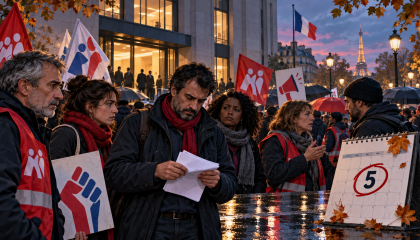
Spanish and Portuguese unions consider joint action across Iberian Peninsula
Usagevpn.com – Trade union leaders in Spain and Portugal are exploring whether a general strike planned in Spain for 11 November could become a wider mobilisation across the Iberian Peninsula. The prospect depends on whether Portuguese organisations decide to call their own national stoppage for the same day.
Unai Sordo, secretary-general of Spain’s Comisiones Obreras, known as CCOO, said contacts were under way between unions in both countries. Portugal’s unions are weighing a general strike on 11 November, while Spain’s two largest trade union confederations, CCOO and the General Workers’ Union, or UGT, have already set that date for industrial action.
A coordinated strike would bring workers in the two neighbouring countries into a shared protest over pressures that have become increasingly visible on both sides of the border, particularly housing costs and the broader cost of living.
A possible historic mobilisation
Sordo said the idea was to turn the two national movements into an “Iberian general strike,” but he made clear that the decision lies with trade union organisations in Portugal. Spanish unions cannot determine whether a Portuguese strike will be held, even if they are seeking to align their plans.
“It is up to the Portuguese to decide whether, in the end, we join forces in a mobilisation across the Iberian Peninsula that would also be historic.”
The possibility of simultaneous action would give the 11 November protests a significance beyond either country’s domestic political calendar. Portugal and Spain have separate labour systems and union structures, yet many of the issues raised by demonstrators have clear parallels: access to affordable homes, rent pressures in major cities and the sense that employment alone no longer guarantees a secure place to live.
Sordo also invoked Portuguese Nobel Prize-winning author José Saramago when discussing the proposed joint action. Saramago spent nearly two decades living in Lanzarote in Spain’s Canary Islands and remained closely associated with progressive movements during his lifetime.
“If they hold [the strike] in Portugal, we are going to call it the Saramago strike.”
Spain’s strike date already set
In Spain, the 11 November general strike has been anticipated for several weeks. It was scheduled for a date 18 days before snap elections called by Prime Minister Pedro Sánchez after parliament rejected government measures intended to address the housing crisis.
That timing places the stoppage close to a major political moment. A general strike can extend public debate beyond party campaigns by focusing attention on workplace conditions, household budgets and the availability of housing. The planned action also reflects how housing has become a central concern for workers and younger residents in large urban areas.
The unions’ planned mobilisation is part of a wider wave of public pressure. Demonstrations have taken place in both countries in defence of the right to housing and in opposition to rising living costs. Protesters have argued that the gap between earnings and rent is making it increasingly difficult to remain in the cities where they work.
Housing protests spread between cities
Recent demonstrations in Portugal drew inspiration from protests that began in late September at Puerta del Sol, one of Madrid’s best-known public squares. The movement in the Spanish capital highlighted the frustration of people who say stable employment no longer ensures they can afford to rent a home in major urban centres.
Similar scenes then emerged in Portugal. Thousands of people spent several nights camping in central areas of Porto and Lisbon, bringing housing demands into some of the country’s most prominent city spaces. Their message closely mirrored that heard in Spain: decent homes should be available at prices ordinary workers can pay.
The common demands help explain why union leaders see an opening for cooperation. Although a joint strike would require separate decisions by Portuguese and Spanish organisations, it would connect labour action to a broader social movement already visible in both countries.
For workers, the debate is not limited to whether rents are rising. It concerns the practical effect of housing costs on daily life: how far people must travel to work, whether they can live independently, and whether jobs in major cities provide enough income to cover basic needs. Protesters in Spain and Portugal have placed those questions at the centre of their calls for change.
What happens next
The immediate question is whether Portuguese unions will choose 11 November for a general strike. If they do, the date could mark a rare coordinated mobilisation spanning the Iberian Peninsula, with CCOO and UGT already committed to action in Spain.
If Portugal does not join, the Spanish strike will still proceed as planned. But the discussions themselves underline the extent to which housing affordability and living costs are no longer being treated as isolated national problems. Across Portugal and Spain, unions and protesters are pressing the same central point: having work should make it possible to secure a decent, affordable home.
Related Reading
Frequently Asked Questions
What is Portuguese and Spanish unions in talks?
Portuguese and Spanish unions in talks is the main topic of this guide. The article explains the context, practical details, and next steps readers should understand.
Why does Portuguese and Spanish unions in talks matter?
Portuguese and Spanish unions in talks matters because readers are looking for a useful answer, not just a short summary. Good content should match search intent and help them decide what to do next.