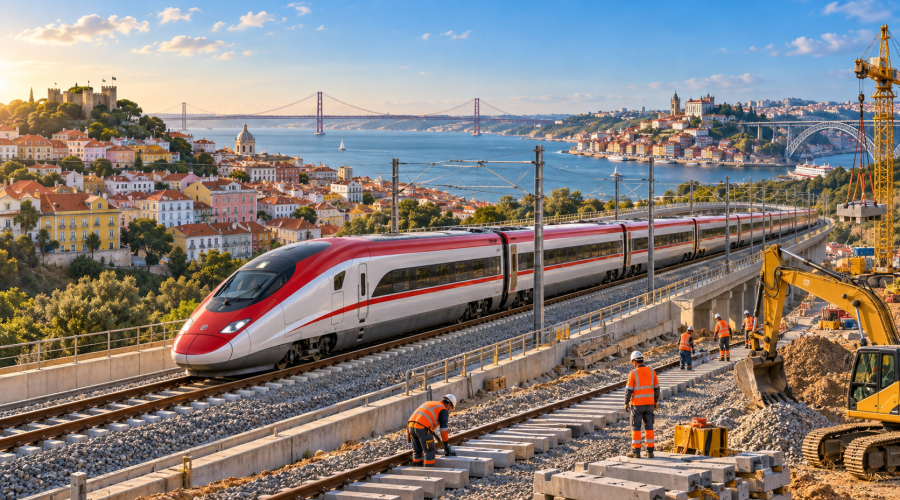
Portugal Starts Building Lisbon–Porto High-Speed Rail Line
Usagevpn.com – Portugal begins construction of high-speed rail infrastructure for a new line between Lisbon and Porto, starting with the Porto-Campanhã to Oiã section in the Aveiro district. The project is intended to transform travel between Portugal’s two largest cities and reinforce the role of rail in the country’s transport network.
Once the full Lisbon–Porto connection is completed, the planned journey time is 1 hour and 15 minutes. Officials see the route as part of a long-term strategy to improve intercity mobility, increase rail capacity and support more sustainable transport choices.
First works begin in northern Portugal
The initial Porto–Oiã section will include 71 kilometres of high-speed track. It is the first construction phase of the wider Lisbon–Porto high-speed railway, which is expected to provide faster connections between major Portuguese urban centres.
The works include more than a new rail alignment. Plans cover a road-and-rail bridge over the Douro River, a new station at Vila Nova de Gaia-Santo Ovídio, and the expansion and redesign of Porto-Campanhã Intermodal Station.
Portugal begins construction of high-speed rail with a project designed to improve links at Porto-Campanhã, already one of northern Portugal’s key rail hubs. The redevelopment is expected to help the station accommodate future high-speed services while supporting connections with other modes of transport.
Funding and wider transport plans
The Porto–Oiã section is being delivered through a Public-Private Partnership. The concession contract was signed on 29 July 2025, and the section is estimated to cost about €2 billion.
Portugal’s government has said the project will receive €875 million in funding from the European Investment Bank and €480 million from the Connecting Europe Facility. The Ministry of Infrastructure and Housing describes the scheme as a structural project for the region and an important part of the public passenger transport network.
The new railway is also connected to Portugal’s wider infrastructure planning, including the national airport strategy and plans surrounding the new Lisbon airport. The government considers high-speed rail and airport development complementary investments for domestic, international and long-distance travel.
“Alongside the new Lisbon airport, high-speed rail lines represent the largest infrastructure projects the country will undertake this century,” said Miguel Pinto Luz, Portugal’s minister of infrastructure and housing.
“It is therefore crucial that there be — as I know there is — a strong national consensus regarding high-speed rail and, more generally, the importance of investment in the railway system,” he added.
Faster links to Lisbon, Porto and Spain
For travellers, the Lisbon–Porto high-speed line is designed to make journeys between the country’s main metropolitan areas quicker and more convenient. A 1 hour and 15 minute journey could make rail a stronger option for work, education, leisure and onward transport connections.
The programme is intended to complement Portugal’s conventional rail network rather than simply replace it. Existing lines will continue to serve intermediate communities and support other passenger and rail services, while the high-speed route focuses on rapid intercity travel.
Portugal begins construction of high-speed rail as it also seeks stronger connections with Spain. The government’s stated objective is to support a Lisbon-to-Madrid journey of around three hours by 2034, improving rail links across the Iberian Peninsula.
The Ministry of Infrastructure and Housing has linked the project to wider European objectives, including the European Commission’s ambition to double passenger rail traffic. European funding underlines the line’s importance for strategic and cross-border transport connections.
Frequently Asked Questions
Where does construction begin?
Construction begins on the 71-kilometre section between Porto-Campanhã and Oiã, in the Aveiro district.
How long will the Lisbon–Porto trip take?
When the full route is complete, the planned travel time between Lisbon and Porto is 1 hour and 15 minutes.
What will be built in the first phase?
The first phase includes high-speed track, a road-and-rail bridge across the Douro River, a station at Vila Nova de Gaia-Santo Ovídio, and upgrades to Porto-Campanhã Intermodal Station.
Will conventional rail services continue?
Yes. The high-speed line is planned to complement the existing conventional rail network, which will continue serving intermediate communities and other rail users.