Solar power strengthens Europe’s defences against fossil fuel shocks
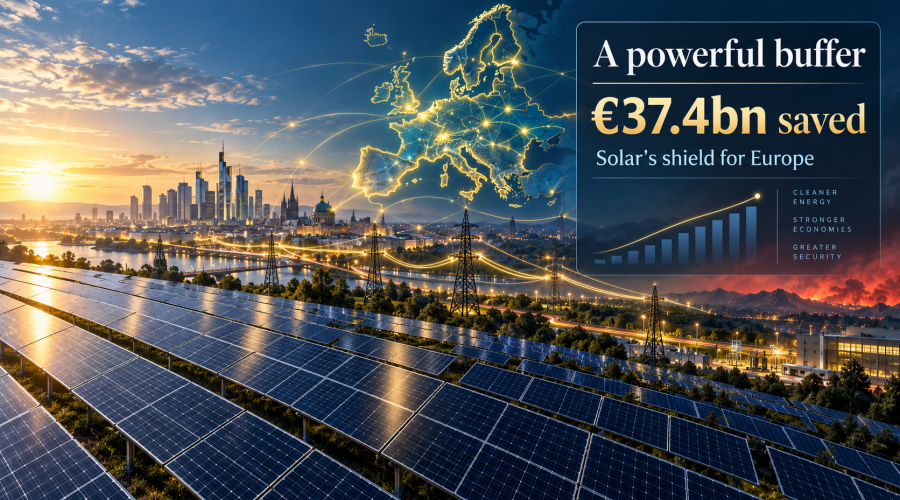
Usagevpn.com – Solar generation has helped Europe avoid an estimated €37.4 billion in fossil fuel import costs since the war on Iran began, providing an important buffer as gas markets remain under severe pressure.
Seven months into the conflict, the effective blockade of the Strait of Hormuz has disrupted a shipping route normally responsible for roughly one-fifth of global liquefied natural gas supplies. The consequences have extended well beyond the region, leaving the European Union exposed once again to volatile energy prices and concerns over fuel availability.
The Dutch TTF benchmark, a key reference price for European natural gas, stood at about €31.96 per MWh on 27 February, the day before the war started. By 30 September, it had climbed to €72.35 per MWh — a rise of 126.5 per cent.
SolarPower Europe says the expansion of solar electricity has reduced the need for imported gas, cushioning households, businesses and power systems from part of that increase. Electricity produced from domestic renewable resources can displace fossil-fuel generation at the point it is needed, reducing the volume of gas Europe must buy on international markets.
“Every megawatt-hour generated by solar power reduces our dependence on imported fossil fuels and makes Europe safer,” says Walburga Hemetsberger, CEO of SolarPower Europe.
Solar reaches a major milestone
The savings come after solar became the EU’s largest individual source of electricity in June, accounting for 25 per cent of the bloc’s power supply that month. The milestone illustrates how investment in locally available renewable energy can produce financial as well as strategic benefits during periods of international instability.
“This news follows solar becoming EU’s largest single source of electricity in June, supplying 25 per cent of the bloc’s power. It’s a demonstration of the returns on Europe’s investment in abundant, homegrown renewable energy resources. We can go further and faster,” Hemetsberger says.
More electrification, additional renewable capacity and flexibility technologies that do not rely on fossil fuels could further limit Europe’s exposure to future price spikes. Battery storage is particularly relevant because it can retain electricity generated during sunny or windy periods for use when output is lower, helping balance the grid without turning immediately to gas-fired plants.
Hemetsberger says electrification, increased renewable output and non-fossil flexibility solutions such as battery storage can become the “route to long-term energy security”.
Spain shows how renewables can affect prices
Several European countries had already begun reshaping their energy systems before the Iranian conflict. Spain is among the clearest examples: since 2019, it has doubled its combined wind and solar capacity, adding more than 40GW to its electricity mix.
For scale, a power plant with 1GW of capacity could supply approximately 876,000 homes for a year if each household used the average 10,000 kWh annually. The growth in Spanish renewable capacity therefore represents a substantial change in the available supply of lower-cost electricity.
Energy think tank Ember said Spain’s wind and solar expansion had cut the influence of costly fossil-fuel generators on electricity prices by 75 per cent since 2019. It also noted that the reduction in hours when gas costs were tied to wholesale power prices had happened faster in Spain than in other gas-dependent markets, including Italy and Germany.
That distinction matters because European wholesale electricity markets generally use marginal pricing. The final generator needed to meet demand sets the hourly price, and that generator is often powered by fossil fuels. When wind and solar output is high, they can push gas and coal plants out of the generation mix. Fossil fuels then set the market price less frequently, easing pressure on electricity costs.
Record wind output offers another example
Britain has seen a similar effect from strong wind generation. On 26 March, UK wind power reached a record 23,880 megawatts, enough electricity to meet the needs of 23 million homes.
“Wind provided more than half of Britain’s electricity during this record period, and it’s highly significant that earlier in the day low-cost wind and solar squeezed expensive gas off our energy system – with gas falling to its lowest level of generation for nearly two years, providing just 2.3 per cent of our electricity,” says RenewableUK’s Tara Singh.
“That’s what the energy transition looks like in practice, and it shows why we need to continue to build out an ambitious pipeline of new clean energy projects now and in the years ahead.”
The record underscores that renewable energy is not only a long-term climate measure. During periods of costly gas imports, high domestic wind and solar generation can directly change which power stations operate and how often expensive fuels influence electricity prices.
Gas dependence remains a challenge
Despite rapid solar growth, the EU has not yet eliminated its dependence on gas. Eurostat figures show renewables supplied 54.1 per cent of electricity generated across the EU during the second quarter of 2026, slightly below the 54.3 per cent recorded in the same period a year earlier.
Total electricity production increased by 3.2 per cent year on year in the quarter. Gas-fired generation rose by 3.9 per cent, while renewable output grew by 2.8 per cent. Solar continued to expand strongly, representing 41.6 per cent of renewable electricity generation, up from 37 per cent the previous year.
The figures point to the importance of a broad clean-energy mix rather than dependence on a single technology. Solar production naturally changes with daylight and seasons, while wind and hydropower can help supply different parts of the demand cycle. Together with storage, stronger grids and electrification, those sources can make it less likely that a fossil-fuel shortage overseas becomes an electricity-price crisis at home.
For Europe, the €37.4 billion saved through solar generation is therefore more than an accounting figure. It reflects the value of having energy resources that are produced within the region, insulated from shipping disruptions and available whenever sunlight can be converted into power.
Related Reading
Frequently Asked Questions
What is A powerful buffer?
A powerful buffer is the main topic of this guide. The article explains the context, practical details, and next steps readers should understand.
Why does A powerful buffer matter?
A powerful buffer matters because readers are looking for a useful answer, not just a short summary. Good content should match search intent and help them decide what to do next.