Middle East oil flows recover, but Hormuz disruption continues to weigh on LNG trade
Usagevpn.com – Crude exports from the Middle East climbed in September to their strongest monthly level since the war involving Iran began seven months ago, signalling a partial recovery in regional energy shipments even as the Strait of Hormuz remains heavily disrupted.
Preliminary Kpler figures placed the region’s crude exports at 16.3 million barrels per day. That represents a substantial improvement from recent months, although it remains about 3.2 million barrels per day below the 19.5 million barrels per day shipped in February, before the conflict sharply affected maritime traffic.
Saudi Arabia drove much of the September increase. Its exports rose from 2.45 million barrels per day in August to roughly 5.4 million barrels per day during September, more than doubling month on month. The kingdom moved additional crude through its Gulf export facilities after attacks damaged the East-West pipeline linking oil fields to the Red Sea.
Oil movements through Hormuz pick up
Flows through the Strait of Hormuz were expected to reach around 9.7 million barrels per day in September. The regional export total also includes cargoes loaded at ports that do not require ships to cross the strait.
The waterway remains one of the world’s most strategically important shipping passages. It connects Gulf producers with international markets, and disruption there can quickly affect the availability and routing of both oil and liquefied natural gas. While September’s crude movement suggests more vessels have returned to the area, activity has not returned to normal levels.
Commercial shipping has been under sustained pressure since joint US-Israeli strikes on Iran on 28 February, the opening phase of the continuing war. Traffic through Hormuz fell sharply as the United States and Iran targeted commercial vessels in and around the strait.
Diplomatic efforts have so far not produced a breakthrough. US President Donald Trump on Saturday rejected an Iranian offer to reopen Hormuz and halt the conflict within seven days. Qatar passed the proposal to Washington through mediators and continues to encourage negotiations.
Iranian Parliament Speaker Mohammad Bagher Ghalibaf warned that regional infrastructure could remain at risk unless Iran receives security guarantees, state broadcaster IRIB said.
“In a region where Iran cannot sell oil, no one else will sell oil either,” he said.
Qatar-linked LNG carriers return to the strait
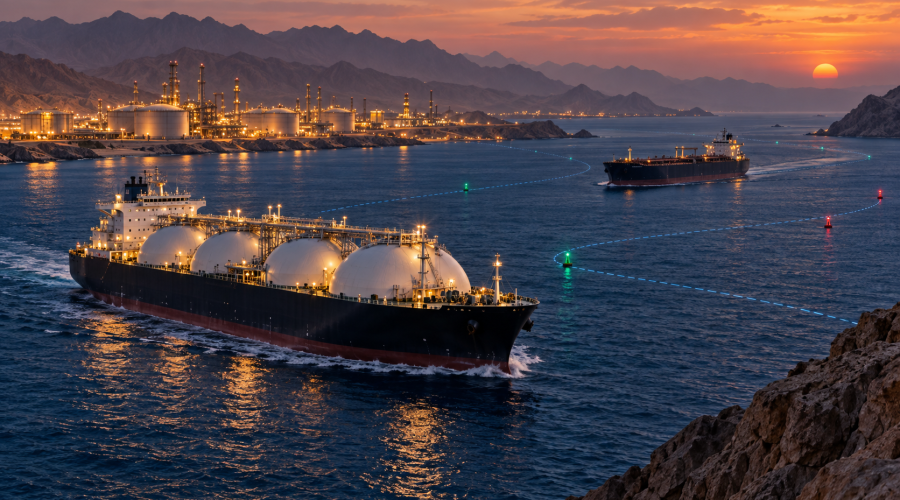
Several LNG tankers connected to Qatar crossed Hormuz during September, after August passed without any visible crossings. Their movements offer evidence of limited renewed activity, but they do not indicate a full restoration of Qatar’s usual export operations.
Ship-tracking information from Kpler and LSEG showed the GasLog Skagen off Sri Lanka on Sunday with LNG loaded at Qatar’s Ras Laffan terminal. The vessel had last been detected inside the Gulf on 20 September.
Other recent voyages included Al Ghashamiya, which delivered a Qatari LNG shipment to India last week, and Shandong Redwood, which transported LNG to Pakistan. Al Daayen exited Hormuz with a cargo intended for China, while the empty Qatar-linked Al Mafyar was observed entering the waterway on 22 September.
The precise number of transits remains uncertain. Some ships disable tracking equipment while passing through Hormuz, leaving gaps in publicly visible vessel data and making it harder to establish the full scale of maritime activity.
Qatar faces a particular vulnerability because every LNG carrier departing the country must travel through the Strait of Hormuz. Unlike some oil exporters, Qatar has no alternative export route for its LNG.
During the first six months of the conflict, Qatar shipped just 18 LNG cargoes, compared with 509 over the same period a year earlier, ICIS data showed. The scale of that decline illustrates how strongly the conflict has affected a supplier that normally serves customers across Europe and Asia.
European and Asian buyers face continued delivery suspensions
QatarEnergy has extended delivery suspensions for selected customers in Europe and Asia, underlining that the appearance of a handful of tanker movements has not resolved the wider supply disruption.
Italian energy company Edison received a fresh notice from QatarEnergy extending force majeure through early December. Six further LNG deliveries planned for Italy’s Adriatic LNG terminal will not arrive, taking Edison’s missed shipments since April to 35.
Edison has replaced 23 of those cargoes, chiefly with gas sourced from the United States. Its long-term agreement with QatarEnergy runs for 25 years and provides 6.4 billion cubic metres of gas annually, equivalent to roughly 10% of Italy’s overall gas consumption.
Customers in Pakistan and Bangladesh have also been informed that suspended deliveries will continue through November. Force majeure is a contractual mechanism that permits a company to pause obligations when events outside its control prevent performance.
Damage at Ras Laffan limits Qatar’s capacity
Risks to Qatar’s LNG system extend beyond shipping access. Attacks on the Ras Laffan complex damaged two LNG production units, reducing the country’s production capacity by about 17%.
Energy Minister Saad Sherida Al-Kaabi said repairs to the damaged units would require about three years. He also indicated that Qatar’s 12 unaffected units could resume normal activity within weeks once safe, predictable passage through Hormuz is restored.
Al-Kaabi has dismissed the idea of building a pipeline that would bypass the strait as economically impractical. Such a project would require gas to be piped to a new facility outside Qatar, converted there into LNG and then loaded aboard tankers, adding major infrastructure requirements to an already complex export chain.
For energy buyers, September’s increase in oil exports provides some evidence that Gulf supply routes can function at a reduced level. Yet the continuing cargo cancellations, damaged LNG facilities and uncertain vessel traffic show that the region’s energy trade remains far from stable. A durable recovery will depend not only on more ships entering Hormuz, but also on regular and secure navigation through the strait.
Related Reading
Frequently Asked Questions
What is Middle East oil exports rise as LNG?
Middle East oil exports rise as LNG is the main topic of this guide. The article explains the context, practical details, and next steps readers should understand.
Why does Middle East oil exports rise as LNG matter?
Middle East oil exports rise as LNG matters because readers are looking for a useful answer, not just a short summary. Good content should match search intent and help them decide what to do next.