Europe’s wind expansion brings a new challenge: what happens when turbines retire?
Usagevpn.com – Europe added 8.8 GW of new wind capacity during the first six months of 2026, setting the region on course for a record year. The increase represents a 30 per cent rise from the same period a year earlier. WindEurope says that amount of capacity can supply electricity for roughly seven million European homes and avoid fossil-fuel imports comparable to 25 liquefied natural gas tankers each year.
The rapid build-out also highlights a longer-term issue for the sector. Every wind turbine has a finite working life, and the industry must prepare for the materials left behind when its earliest large projects are dismantled.
Most of a turbine is not especially difficult to recover. Steel, copper, aluminium and concrete account for as much as 90 per cent of its total mass and can generally enter established recycling systems. The blades present the far greater technical obstacle.
Why turbine blades are difficult to process
Built to withstand decades of rotating in demanding weather, blades typically measure between 50 and 100 metres long and can remain in service for up to 25 years. Their resilience comes from multiple tightly bonded layers: glass fibre, carbon fibre, epoxy resin, balsa wood, metals and different fillers.
That blend makes conventional recycling far more complicated than it is for a steel tower or copper wiring. Separating fibres and other useful components from the resin requires specialist treatment, which can consume substantial energy and reduce the quality or commercial value of the recovered material.
“Separating the composite materials from the resin requires specialised processes, often involving high temperatures or other energy-intensive treatment methods,” says Eva Julius-Philipp, Director of Environment and Sustainability of Business Area Wind at Vattenfall. “In some cases, these processes can affect the quality and value of the recovered materials, making large-scale recycling more challenging.”
Vattenfall introduced a ban in 2021 on sending blades, nacelle covers and nose cones to landfill. The Swedish energy company has since explored ways to keep those large composite pieces in use with limited additional processing.
From turbine parts to homes and city structures
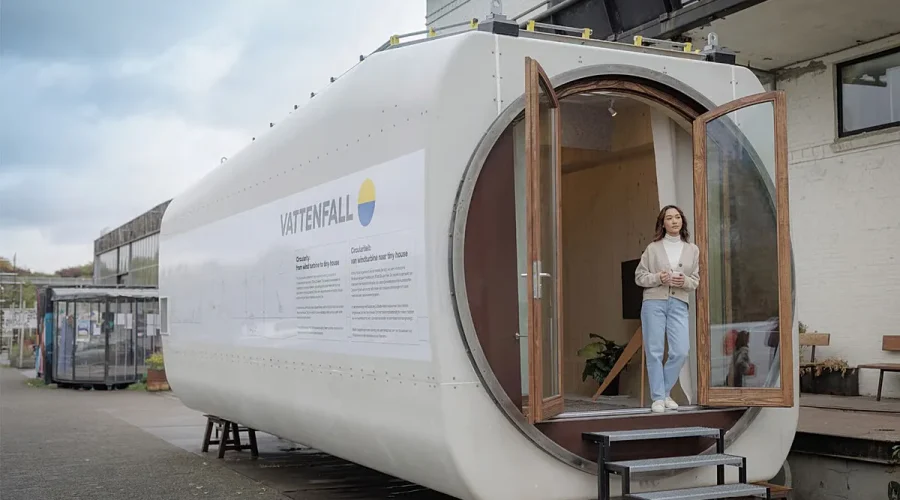
One of the company’s most visible experiments transformed a retired nacelle cover into a small home. Nacelle covers sit at the top of a turbine tower, protecting the machinery and electrical equipment inside. In collaboration with the design studio Superuse, Vattenfall converted one formerly used on a wind tower in Austria into a compact living space.
The structure is four metres wide, 10 metres long and three metres high. It now contains a kitchen, bathroom and living area, supported by a heat pump, solar panels and a solar water heater. The project appeared at Dutch Design Week in 2024 as an example of reuse designed to avoid the heavier energy and emissions burden of intensive material processing.
Retired blades are also finding second lives in construction. After Denmark’s Nørre Økse Sø onshore wind farm was decommissioned in 2023, all 57 of its blades were repurposed as façade elements for a multistorey car park in Lund. Their size and structural strength have prompted further ideas, including supports for solar panels and even alpine skis.
“Projects such as the Tiny House, blade-based building projects and recycled skis are not yet a large-scale solution, however they are intended to help us gain experience, develop new applications and stimulate the market for circular solutions,” Julius-Philipp says.
For operators, keeping existing parts in service through refurbishment or reuse is the preferred route when safety permits it. Extending a component’s useful life can preserve more of the value already embedded in its materials and manufacturing.
Recycling methods still need scale
When reuse is not viable, Vattenfall is pursuing several recycling paths as part of a goal to achieve full circularity for blade composites by 2030. Mechanical processing can reduce blade material to composite flakes or fillers for other products. Pyrolysis, a thermal method, can recover fibres and other secondary materials.
Other end-of-life options include energy recovery and cement co-processing where high-value material recycling is unavailable. Yet the challenge is not simply technological. Blades do not leave service in a constant, predictable stream, making it harder for recycling businesses to invest in facilities and operate them economically.
“Decommissioned blades do not become available in a steady and predictable flow, which makes it harder for recycling solutions to scale economically,” Julius-Philipp says.
That pattern may change as the first generation of major European wind farms approaches the end of its operating life. More retired blades will increase the pressure to develop treatment routes that can handle large volumes without excessive costs or energy use.
National bans and a wider European question
The European Union has not imposed a bloc-wide prohibition on landfilling decommissioned turbine blades. Austria, Finland, Germany and the Netherlands have binding national restrictions in place, while WindEurope is urging Brussels to establish a legal requirement for every member state.
A consistent framework could help create demand for recovered materials, improve planning for recyclers and encourage investment in reuse systems. It would also make circularity part of the wind sector’s infrastructure rather than an occasional design experiment.
“What is needed now is a regulatory framework that enables circular value chains and secondary raw materials to scale,” Julius-Philipp says.
Wind power’s contribution to cleaner electricity depends not only on installing new turbines, but also on managing their eventual retirement responsibly. The tiny house, car-park façade and recycled-ski projects are early demonstrations of what can be done. The next task is to turn such examples into practical, affordable systems capable of handling the growing number of turbines that will one day come down.
Related Reading
Frequently Asked Questions
What is From tiny houses to skis?
From tiny houses to skis is the main topic of this guide. The article explains the context, practical details, and next steps readers should understand.
Why does From tiny houses to skis matter?
From tiny houses to skis matters because readers are looking for a useful answer, not just a short summary. Good content should match search intent and help them decide what to do next.