Lagarde Warns Against Plan to Cancel French Debt Held by Central Bank
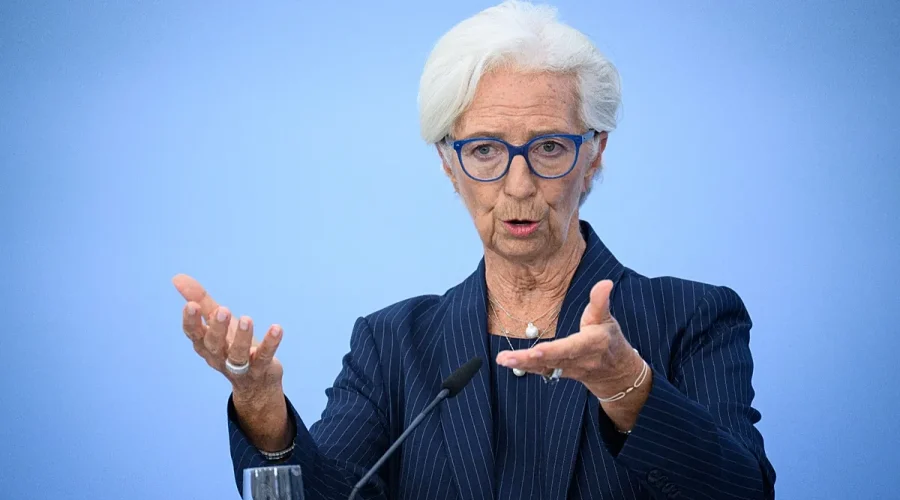
Usagevpn.com – European Central Bank President Christine Lagarde has strongly opposed Jean-Luc Mélenchon’s proposal to erase part of France’s public debt, arguing that such a move would conflict with European Union rules and undermine a core principle of monetary policy.
Speaking on Thursday after the ECB announced a further rise in its key interest rates, Lagarde said the idea advanced by the left-wing French presidential candidate was “really not a good idea.” She also stressed that cancelling sovereign debt held by a national central bank would represent a “clear violation of the treaty” governing the European Union.
The intervention places the issue of public debt, central-bank independence and investor confidence more prominently in France’s developing presidential campaign. France is scheduled to elect its next president in April next year, and Mélenchon has again put debt cancellation at the centre of his economic message.
What Mélenchon is proposing
The leader of La France Insoumise, or LFI, wants France to cancel the share of its debt currently held by the Banque de France. That portion amounts to about 18% of the country’s outstanding debt.
His argument has returned repeatedly since it was first raised during the COVID-19 pandemic, when governments across Europe expanded public spending in response to the health and economic crisis. Mélenchon also promoted the plan during his 2022 presidential campaign.
In August, he revived the proposal while campaigning, describing the process in deliberately vivid terms.
You just have to go to the Banque de France, take the debt securities and throw them into the fire.
The proposal concerns government bonds purchased through central-bank operations. Although a national central bank may hold such securities, the Eurosystem operates under a legal framework intended to prevent governments from using central banks to finance public spending directly. Lagarde’s remarks highlighted that this framework is not simply a technical matter: it is a treaty-based safeguard designed to preserve the independence of monetary authorities.
Why the ECB objects
Debt cancellation may sound like a straightforward reduction in a government’s liabilities, but the ECB’s objection rests on the consequences for the wider financial system. Government bonds are commitments to repay investors and institutions. Writing off debt held within the central-bank system would raise questions about how public finances, central-bank balance sheets and the euro area’s monetary rules are treated.
Lagarde’s reference to a treaty violation points to the restrictions placed on monetary financing in the EU. Those restrictions are intended to ensure that elected governments remain responsible for their fiscal choices while central banks retain the ability to pursue price stability without political direction.
For readers following the debate, the distinction is important. A government can decide on taxation, spending and borrowing through its political institutions, while central banks set monetary policy for the currency area. Blurring those roles could affect confidence in both the rules governing the euro and the institutions responsible for applying them.
The criticism came on the same day that the ECB raised its key interest rates again. Higher rates typically make borrowing more expensive across the economy, including for governments refinancing debt, households seeking loans and businesses funding investment. That backdrop gives additional weight to the argument over how France should manage its public finances.
French critics focus on trust
Mélenchon’s proposal has already drawn sharp opposition within France. Philippe Aghion, the winner of the 2025 Nobel Prize in Economics, called the idea “catastrophic.”
Prime Minister Sébastien Lecornu also rejected the plan, saying it would damage the country’s most valuable asset: trust.
It would “destroy France’s most important asset”, namely “trust”.
That concern reflects the central role of credibility in government borrowing. States depend on lenders’ confidence that debt obligations will be honoured under predictable rules. Any suggestion that debt could simply be cancelled can become politically powerful as a slogan, but critics contend that it risks increasing uncertainty around the country’s financial commitments.
Supporters of more radical debt policies have argued that exceptional circumstances, including the pandemic-era crisis, justify reconsidering how public debt is handled. Opponents respond that the legal and institutional costs would be severe, particularly for a country operating within the euro area’s shared monetary system.
A campaign issue with growing political relevance
The return of the debt-cancellation proposal comes as Mélenchon seeks to strengthen his position ahead of next year’s presidential vote. A recent Toluna-Harris Interactive poll put his support at roughly 16%, compared with 12% in April, giving him a credible prospect of reaching the second-round run-off.
That rise in support means his economic platform is likely to receive greater scrutiny in the months ahead. The debate is no longer limited to an abstract disagreement over public debt; it has become part of a broader contest over France’s economic direction, its relationship with EU rules and the limits of national action inside the euro area.
Lagarde’s comments make the ECB’s position unmistakable. For the central bank, cancelling French debt held by the Banque de France would not be a permissible shortcut for easing the country’s financial burden, but a breach of the legal order underpinning the European monetary system.
Related Reading
Frequently Asked Questions
What is ECB chief Christine Lagarde rejects Mélenchon?
ECB chief Christine Lagarde rejects Mélenchon is the main topic of this guide. The article explains the context, practical details, and next steps readers should understand.
Why does ECB chief Christine Lagarde rejects Mélenchon matter?
ECB chief Christine Lagarde rejects Mélenchon matters because readers are looking for a useful answer, not just a short summary. Good content should match search intent and help them decide what to do next.