Moldova’s EU Bid Advances Faster Than Brussels Can Easily Track
Usagevpn.com – Moldova’s drive toward European Union membership is moving at a pace that has forced the European Commission to redirect staff and expertise toward Chișinău’s accession work. The government’s rapid implementation of reforms has created an unusual challenge: EU institutions must now ensure they have enough capacity to assess whether each change meets the bloc’s standards.
EU enlargement officials are handling several candidate countries at once, but Moldova has emerged as one of the most active reformers. The Commission is therefore shifting existing internal resources toward the countries progressing most quickly, with Moldova among the clearest examples.
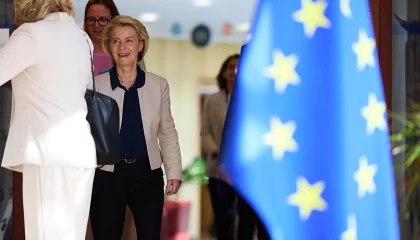
“Moldova’s impressive record of EU reforms is paying off. I had a good call with new Prime Minister Vasile Tofan during which we discussed the next steps on Moldova’s EU accession path,” Enlargement Commissioner Marta Kos wrote on X on Tuesday.
Reforms driven by political momentum
Since Maia Sandu became president in 2020, Moldova has pursued a strongly pro-European direction. Her administration established a government committed to EU integration and supported by a comfortable parliamentary majority, giving officials room to advance changes required for accession.
For Moldova, the reform agenda is not only a technical exercise. It is central to the country’s effort to strengthen institutions, align policies with EU rules and establish a more secure long-term place in Europe. Progress must still be scrutinised by the Commission, which assesses whether reforms are being carried out effectively rather than simply adopted on paper.
“The reforms that we are undertaking in the last five years are really unprecedented,” Cristina Gherasimov, Moldova’s Deputy Prime Minister for European Integration, told journalists during a ministerial meeting on Friday.
“Our formula for these reforms to be successful is the political will and the determination of our people to work strongly in favour of the current window of opportunity that exists in the European Union,” she said.
The Commission’s task is to keep pace with that ambition. Candidate countries proceed through a detailed examination of laws, institutions and implementation, requiring specialists who can evaluate areas ranging from governance and the rule of law to economic policy. A fast-moving applicant can therefore create additional pressure on an enlargement department already stretched across multiple accession files.
Ukraine and Moldova remain politically connected
Moldova’s technical advances are taking place alongside a more complicated political reality. Its EU path remains closely connected to Ukraine’s, even though the two countries face very different conditions.
Both states entered the accession process in 2022, only days after Russia began its full-scale invasion of Ukraine. EU leaders formally agreed to open membership negotiations with Kyiv and Chișinău together in December 2023.
That parallel route has continued through the practice often described as “coupling,” in which two applicants’ progress is informally linked. Such grouping can be useful later in the accession process because EU member states may approve one treaty covering more than one joining country. Romania and Bulgaria entered the EU together in 2007 under that approach.
In Moldova’s case, the political logic behind the connection is rooted in regional security. Russian forces have long been present in the breakaway Transnistria region. When the war in neighbouring Ukraine began in 2022, Moldova found itself geographically close to the conflict while Russian troops were already stationed on territory internationally recognised as Moldovan.
Ukraine also considers the prospect of EU membership a vital strategic anchor beyond Russia’s influence. Supporters of Kyiv’s accession, particularly the Baltic states, have argued that Moldova moving substantially ahead while Ukraine is held up by bilateral disputes could carry an unwelcome political message.
Hungary’s role in slowing Kyiv’s negotiations
Ukraine’s accession agenda has continued to develop, gaining additional momentum after Prime Minister Serhii Koretskyi took office in July. Yet the country’s war effort and strained public finances remain major burdens on its wider membership bid.
For two years, negotiations were blocked by Hungary under Viktor Orbán. The dispute focused on the treatment of Hungary’s minority community in Ukraine’s eastern Transcarpathia region. A change in Budapest’s political leadership came after Péter Magyar’s Tisza party removed Orbán from power in April, opening space for Hungary and Ukraine to discuss the outstanding bilateral issues.
Hungary withdrew its objection to opening the first negotiation cluster in June, and the second of six clusters began in July. Since then, however, Budapest has again slowed progress. More than a decade of anti-Ukraine rhetoric during Orbán’s time in office has made swift movement difficult for many Hungarians to accept.
The disagreement is between Hungary and Ukraine, but Moldova is affected because the two accession tracks are still politically paired. This means that Chișinău can continue working on the substance of reforms while facing limits on how independently its formal negotiation process can move.
Economic expectations and the path ahead
The International Monetary Fund on Tuesday examined the possible economic gains from EU membership for the Western Balkans and Moldova. Ukraine was not included because of its far larger economy and the continuing military conflict.
For Moldova, the immediate priority is to maintain reform quality while Brussels builds the capacity to evaluate the changes. Fast progress can help demonstrate that the country is ready for further steps, but accession remains a lengthy process requiring agreement among EU member states as well as sustained domestic implementation.
The central tension is now clear: Moldova’s reform programme is progressing faster than the Commission’s existing enlargement resources were designed to handle, while the political calendar remains shaped by Ukraine’s more difficult circumstances. The country’s technical route toward membership can continue, but its formal advance will remain intertwined with broader European security and diplomacy.
Related Reading
Frequently Asked Questions
What is EU Commission scrambles to keep pace?
EU Commission scrambles to keep pace is the main topic of this guide. The article explains the context, practical details, and next steps readers should understand.
Why does EU Commission scrambles to keep pace matter?
EU Commission scrambles to keep pace matters because readers are looking for a useful answer, not just a short summary. Good content should match search intent and help them decide what to do next.