Malaysia Declares Air Quality Emergency as Haze Peaks
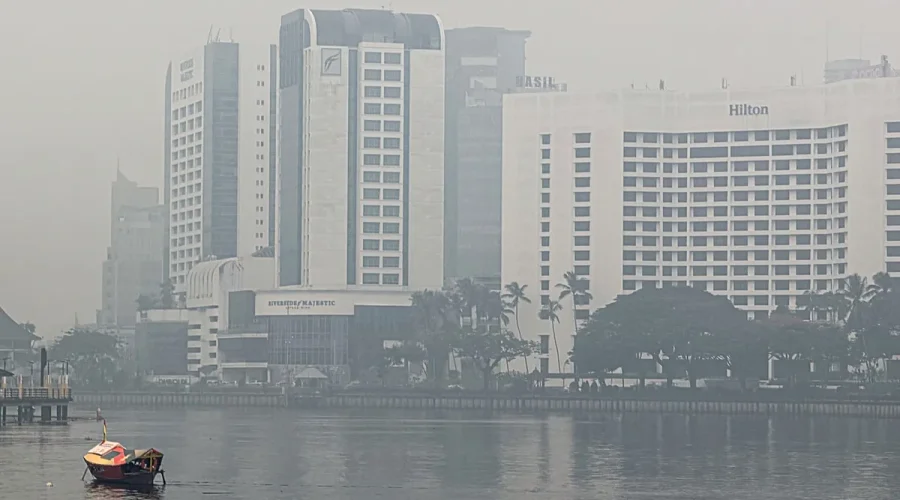
Usagevpn.com – Malaysia declares air quality emergency in the Borneo state of Sarawak after transboundary smoke from Indonesian peat and forest fires drove pollution readings past the national danger threshold. The formal proclamation, confirmed by Prime Minister Anwar Ibrahim’s office on Friday, covers the town of Serian and marks one of the sharpest public-health disruptions the region has faced in recent dry seasons.
What triggered the proclamation
Serian, a farming community of roughly 90,000 people sitting close to the Kalimantan border, logged an Air Pollutant Index of 521 on Friday — far above the emergency ceiling set by Malaysia’s environment ministry. The state capital, Kuching, also recorded a hazardous reading of 311 the same day, confirming that the smoke plume blankets a wide corridor rather than a single district. Royal assent for the proclamation was granted by Sultan Ibrahim Iskandar, unlocking additional executive powers to manage the crisis.
Under existing protocols, readings above 500 can trigger suspensions of nonessential outdoor work, while schools shut once the index crosses 200. Thousands of children in Serian and neighbouring areas have already missed days of classes. Officials stressed that the measures are standard public-health interventions, though they carry real economic costs for a community whose livelihoods hinge on agriculture and whose households have limited capacity to seal out fine particulate matter.
Health stakes and the broader regional picture
The Air Pollutant Index blends particulate matter, nitrogen dioxide, sulphur dioxide, ozone, carbon monoxide, and ammonia into a single figure. Sustained exposure above 500 elevates short-term mortality risk and can aggravate asthma, provoke bronchitis episodes, and strain cardiovascular function — effects that fall hardest on children, the elderly, and residents with pre-existing lung conditions.
This year’s episode has outpaced the seasonal norm. Elevated fire activity across several Indonesian provinces, Kalimantan chief among them, combined with extended dry weather, produced a sustained smoke plume over parts of Borneo. Satellite imagery released Friday by Indonesia’s Forestry Ministry identified 717 hot spots nationwide attributed to forest fires since 1 August, with 103 active in the preceding 24 hours alone.
Indonesian authorities have deployed firefighting assets and attempted cloud-seeding operations. On the enforcement side, police announced Friday that 112 individuals across ten provinces on Sumatra and Borneo have been detained, suspected of deliberately igniting forest and peatland fires. Most are local farmers who burn land at lower cost than mechanical clearing — a practice that has persisted for decades despite repeated bans. Pipit Subiyanto, a senior official at Indonesia’s National Police criminal investigation agency, outlined the scale of the ongoing probe:
Authorities are investigating 167 cases involving the deliberate burning of some 4,700 hectares of land across nine provinces.
In a parallel regulatory step, Indonesia suspended the business licences of five companies over alleged fires within their Kalimantan concessions, extending accountability beyond individual farmers to corporate landholders.
Frequently asked questions
What does the emergency proclamation actually change for residents of Serian? It authorises the state government to suspend nonessential outdoor work, enforce school closures, and coordinate emergency medical resources without waiting for case-by-case approvals. Day-to-day guidance — wearing masks outdoors, keeping windows sealed, limiting physical exertion — remains in force regardless of the proclamation.
How long will the haze last? Duration depends on rainfall onset in Kalimantan and the rate at which Indonesian authorities extinguish active hot spots. With 103 hot spots still burning in the 24 hours before Friday’s satellite pass, officials cautioned that conditions could deteriorate before improving.
Who is most at risk, and what should they do? Children, older adults, and people with asthma or cardiovascular disease face the greatest short-term danger. Health authorities advise staying indoors with windows closed, using air purifiers where available, and seeking medical attention if breathing difficulty or chest tightness develops.
Is this a new problem for Malaysia? No. Transboundary haze recurs each dry season as smoke from Indonesian forest and peat-land burning drifts into parts of Malaysia, Brunei, and Singapore. Sarawak, on Borneo’s western edge, has historically recorded the worst readings within Malaysia, and multiple districts across the state logged hazardous levels in recent days.