Nepal Buries Hundreds of Unidentified Dead as Flood Toll Tops 1,000
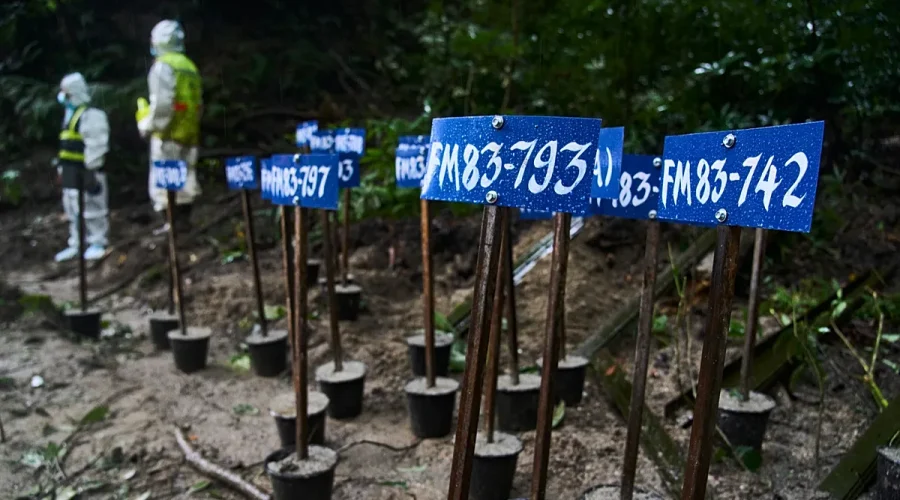
Usagevpn.com – In mass graves across Nepal, workers have interred hundreds of bodies whose identities remain unknown, a grim necessity born of overwhelmed mortuaries and the sheer scale of destruction. The practice, carried out after DNA samples were collected from the remains, has ignited fierce backlash from the country’s predominantly Hindu population, who say the government has disregaged centuries-old burial rites. The controversy has deepened an already raw national grief one week after a catastrophic glacial outburst tore through border villages on 26 August.
The confirmed death count stood at 1,066 as of Tuesday evening — 1,050 in Nepal and 16 in China — while 4,462 people were still listed as missing, split between 3,916 Nepali nationals and 546 Chinese citizens. Emergency crews had already recovered more than 1,000 bodies from the debris field, yet the missing tally dwarfs the recovered figure by a factor of four.
Grief Without a Body
For families who have exhausted every avenue of search, the absence of a corpse has forced a painful choice: perform a symbolic last rite without knowing where the deceased lies. In one such ceremony, Dolma Newar Tamang stood beside her weeping son to conduct a ritual meant to release her husband’s spirit from the earthly plane. He had been traveling toward China when the wall of ice-cold water, boulders, and shattered timber surged down the mountain corridor along the China-Nepal border.
“We had to do this to set his soul free, so that he is at peace and happy wherever he is,” Tamang said.
She described watching the disaster unfold on television, then dialing her husband’s number again and again. Each ring went unanswered.
“I saw the news and called him. I called repeatedly, but he never picked up.”
Digging Through Hydropower Tunnels
Despite the overwhelming odds, rescue operations have not ceased. Teams continue to excavate, drill, and blast through sludge-choked tunnels belonging to hydropower installations scattered across the affected valleys. So far, only bodies have been pulled from those passages, but officials maintain that pockets of trapped survivors cannot yet be ruled out. Nepal’s Foreign Minister Shisir Khanal told interviewers that he clings to the possibility that some of the thousands still unaccounted for may be breathing somewhere beneath the rubble.
“Miracles do happen,” he said. “At this point, I do not want to completely give up hope.”
A Climate Warning Written in Ice
Prime Minister Balendra Shah framed the catastrophe as a harbinger of what lies ahead for the entire Himalayan belt. In a public social-media post, he called the event “a serious indication that the risks we face in the Himalayan region are increasing alongside climate change,” and added that both the drivers of warming and the burden of disaster response are shared globally.
“Climate change is a global contribution, and disaster response is also a global responsibility,” he wrote.
Peer-reviewed research corroborates his warning. The Himalayas — the tallest mountain system on Earth — are warming faster than the global average, accelerating the retreat of the glaciers that feed the region’s rivers. Those ice fields supply drinking water and irrigation to roughly 240 million people living in the highland zones themselves, and they sustain the hydrological cycle for an additional 1.65 billion inhabitants of the South and Southeast Asian river basins downstream. A single glacial collapse of the magnitude seen on 26 August can transform a mountain stream into a torrent capable of erasing entire settlements within minutes.
An Economy Already at Its Limit
Nepal, a largely agrarian nation of approximately 30 million, has contributed a negligible share of the cumulative greenhouse-gas emissions now destabilizing the climate system, yet it sits squarely in the path of the consequences. The government in Kathmandu has cautioned that reconstruction bills could reach into the billions of dollars, a sum that strains a budget already stretched thin by limited fiscal capacity. International aid pledges have begun to arrive, but the gap between need and available resources remains vast.
Religious Tension Over Mass Graves
The practical exigency of burying unidentified remains before decomposition made identification impossible has collided with deeply held Hindu funerary traditions, which prescribe specific rites, timings, and handling of the dead. Community leaders and grieving families have accused authorities of treating the dead as logistical units rather than as souls requiring ritual passage. The tension has added a layer of public anger to what was already a national trauma, and it is likely to shape how Nepal plans future disaster-response protocols.
As the autumn rains begin to ease and search windows narrow, the question facing Nepali families shifts from “where are they?” to “how do we remember them?” The answer, for now, is written in symbolic flames, in unanswered phone calls, and in the silence of tunnels still being pried open, one blast at a time.
Related Reading
Frequently Asked Questions
What is Mass burials of unidentified victims continue?
Mass burials of unidentified victims continue is the main topic of this guide. The article explains the context, practical details, and next steps readers should understand.
Why does Mass burials of unidentified victims continue matter?
Mass burials of unidentified victims continue matters because readers are looking for a useful answer, not just a short summary. Good content should match search intent and help them decide what to do next.