Apple’s Leadership Shifts: John Ternus Inherits a $4.6 Trillion Empire at Its Most Fragile Moment
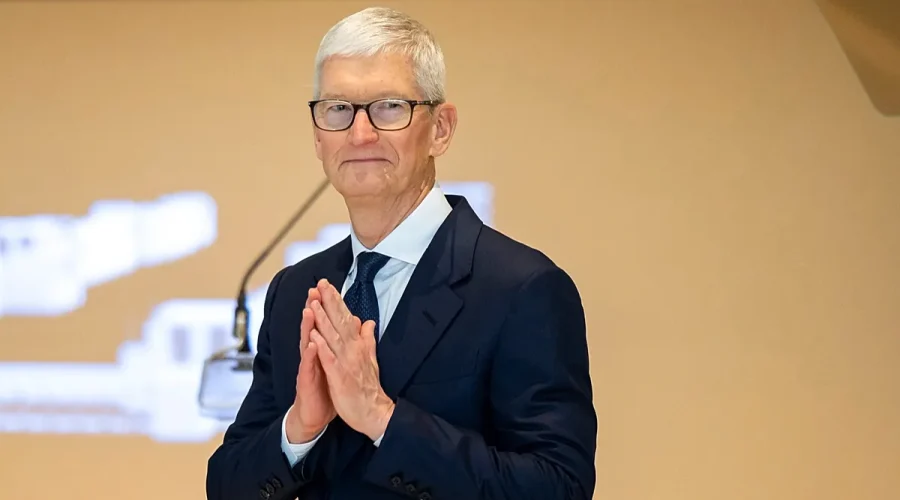
Usagevpn.com – For fifteen years, one name defined Apple’s corporate identity at the top. That era closed on Tuesday when John Ternus assumed the role of chief executive officer, ending Tim Cook’s long tenure as the company’s public face and strategic architect. The handover marks the most significant leadership change in Apple’s history since Steve Jobs stepped down in 2011, and it arrives at a moment when the Cupertino-based giant is confronting existential questions about its future relevance in computing.
A Legacy Measured in Trillions
Cook’s stewardship reshaped the scale of what a consumer technology company could become. When he took over the reins, Apple’s market capitalization sat below $350 billion. By the time he relinquished day-to-day control, the figure had climbed to approximately $4.6 trillion — roughly €4 trillion — making the company one of the most valuable enterprises ever assembled. Over that span, Cook oversaw the expansion of the iPhone into a global cultural artifact, the launch of the Apple Watch and AirPods ecosystems, and the development of spatial computing hardware in the form of the Apple Vision Pro. His tenure placed him among the most consequential executives in the history of the technology sector, not merely for revenue growth but for how he positioned Apple as a lifestyle brand inseparable from daily routines.
Even as he steps back from the CEO title, Cook is expected to remain closely involved as executive chairman. That arrangement signals Apple’s intent to preserve institutional memory and continuity of relationships that took decades to build — particularly those with political leaders in Washington.
The AI Reckoning
The timing of the transition could hardly be more consequential. Artificial intelligence has unleashed what many industry analysts describe as the most disruptive technological upheaval since the original iPhone redefined mobile computing in 2007. Apple, however, has struggled to translate its enormous engineering resources into competitive AI products. Nearly two years ago, the company announced a suite of generative-AI features intended to keep its ecosystem at the frontier. Delivery has been uneven, with delays and scaled-back capabilities drawing criticism from both investors and consumers accustomed to rapid iteration from rivals.
Earlier this year, Apple unveiled a new generation of AI advances, including substantial upgrades to its Siri voice assistant. The messaging emphasized privacy protections and practical, everyday utility — a deliberate contrast to the more aggressive, data-hungry approaches of competitors. Whether that positioning resonates with users who increasingly expect conversational AI to handle complex tasks remains an open question that Ternus must answer quickly.
Stepping Outside the Hardware Lab
Ternus’s career at Apple has been rooted in hardware engineering. He led development teams behind products that became cultural touchstones: the Apple Watch, the AirPods line, and the Apple Vision Pro headset. His expertise lies in sensor fusion, industrial design, and the physical integration of computing into wearable form factors. The CEO role, by contrast, demands fluency in geopolitics, capital allocation, regulatory negotiation, and public diplomacy — disciplines far removed from a circuit board.
Among the most immediate pressures will be supply-chain management. Apple’s manufacturing footprint stretches across South and East Asia, with assembly operations in China, component sourcing in South Korea and Japan, and packaging facilities in India. Navigating that web while maintaining margins and delivery timelines is already a formidable task under normal conditions. Add tariff volatility and trade-policy uncertainty, and the complexity multiplies.
The Washington Factor
No discussion of Apple’s leadership transition is complete without addressing its relationship with the White House. US President Donald Trump publicly praised Cook on the day of the handover, a gesture that underscored how deeply the two men’s professional paths had intertwined during Cook’s tenure. Cook cultivated that relationship while steering Apple through a period of aggressive trade and tariff policy aimed at Asian manufacturing hubs — precisely the regions where Apple’s supply chain is most concentrated.
Analysts expect Cook’s continued presence as executive chairman to serve as a bridge, ensuring that the personal rapport built over years does not evaporate with the change in title. For Ternus, who has historically operated behind the scenes, the prospect of becoming the primary corporate interlocutor for a sitting president represents perhaps the steepest learning curve of his career.
What Comes Next
Ternus’s first major public test as CEO arrives within days. Next week, he will headline the launch event for the latest iPhone generation at Apple’s headquarters in Cupertino, California. The event will be watched by millions of consumers, thousands of journalists, and a Wall Street that is already pricing in expectations about AI capabilities, camera performance, and pricing strategy. How he frames the product narrative — whether he leans into the privacy-first AI story, emphasizes hardware innovation, or attempts to reposition the brand around a new identity — will set the tone for his entire tenure.
The question hanging over Apple’s boardroom is no longer whether the company can build impressive technology. It can, and it has, for decades. The question is whether its new leader can translate that capability into market dominance in an era where software intelligence, not silicon alone, determines who sets the pace. Ternus inherits a company of extraordinary scale and extraordinary vulnerability. The shoes, as the old saying goes, are indeed large. Whether he can fill them will define the next chapter of the most valuable technology brand on Earth.
Related Reading
Frequently Asked Questions
What is End of the Cook era?
End of the Cook era is the main topic of this guide. The article explains the context, practical details, and next steps readers should understand.
Why does End of the Cook era matter?
End of the Cook era matters because readers are looking for a useful answer, not just a short summary. Good content should match search intent and help them decide what to do next.