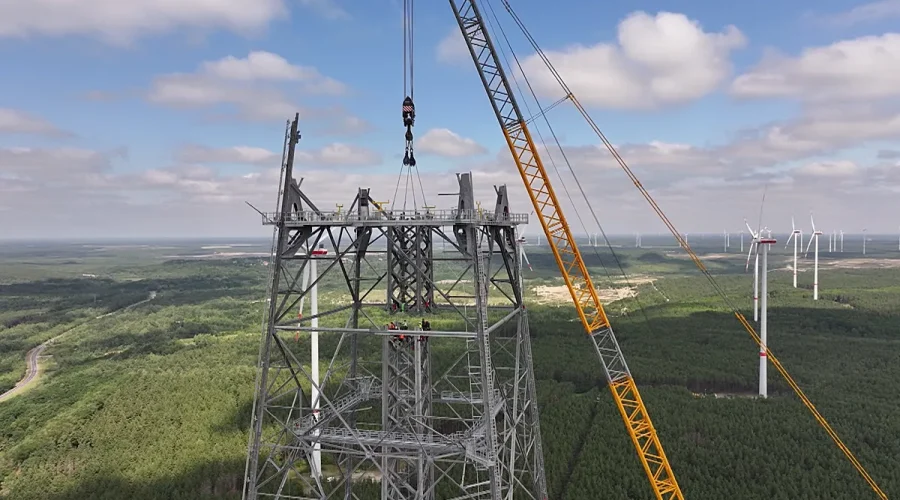
A 160-Metre Steel Tower Rises Over Germany’s Coal Graveyard
Usagevpn.com – In the flat, scarred terrain of eastern Germany, a yellow crane the size of a small building groans as it swings a multi-tonne steel segment skyward. Workers in harnesses, perched roughly 160 metres above the ground, guide the piece into alignment with the rest of a lattice tower that dwarfs every conventional wind turbine in the surrounding fields. The scene plays out in Klettwitz, a small settlement in the Lusatia region, where for decades the earth was torn open by bucket-wheel excavators stripping lignite from the ground. Those machines have left vast open pits and towering spoil heaps that still define the local topography. Today, however, the landscape is being rewritten once more — this time by rows of photovoltaic panels and wind turbines planted across the very mounds of waste rock that once marked the industry’s footprint.
From Coal to Wind: Lusatia’s Second Transition
Lusatia was, for most of the twentieth century, the engine room of German lignite extraction. The fuel powered much of the country’s electricity grid, but at enormous environmental cost: greenhouse emissions, land subsidence, and the displacement of villages. Germany’s Energiewende — the national programme to phase out fossil fuels and pivot toward renewables — has turned the region’s economic identity upside down. The open-cast pits that once swallowed entire communities are now being reclaimed as renewable-energy sites. Solar arrays glint on the spoil heaps; wind turbines dot the ridgelines. The transformation is not merely symbolic. It represents a concrete attempt to convert a region’s industrial infrastructure into a platform for decarbonisation.
Among the newest additions to this post-mining landscape is a structure that sets itself apart from every other turbine in the area: the GICON high-altitude wind power plant. Still under construction at the time of reporting, it already towers over the conventional machines nearby, its steel struts climbing well beyond the typical 100-to-130-metre hub height of standard utility-scale turbines.
The Physics Behind the Height
The engineering rationale is straightforward. Wind speed increases with altitude above the surface, and turbulence decreases. A rotor spinning at 160 metres encounters a stronger, steadier airflow than one at 80 metres, translating directly into greater kinetic energy available for conversion. The result, as the company’s founder explains, is a dramatic step-up in power output relative to ground-level machines.
“Because the wind blows stronger and more steadily the further I get from the Earth’s surface,” Jochen Großmann, who founded GICON, told reporters on site while a crew of high-altitude climbers worked up and down the steel struts. “That’s why wind turbines have become taller and taller – because there’s so much wind up there that they generate more than double the output of the turbines standing here in the surrounding area.”
Großmann’s vision goes beyond simply making one taller turbine. He proposes a two-tier arrangement: retrofit existing wind farms so that a high-altitude machine stands alongside each conventional unit, effectively harvesting the wind at two different elevations from the same footprint.
“Retrofitting existing wind farms with taller windmills alongside regular ones give us two tiers of high-altitude windmills, and allows us to triple the yield from the same area,” Großmann estimates.
Scaling Up: From One Tower to Thousands
The company’s roadmap is ambitious. GICON intends to have 100 high-altitude windmills operational by the early 2030s. Within a few years of that milestone, the stated objective is to scale deployment to 1,000 plants. Großmann frames the German market alone as capable of absorbing roughly 4,000 additional high-altitude turbines through retrofitting of existing installations.
“All the wind farms in Germany would offer the potential for 4,000 additional high-altitude wind turbines,” the GICON-CEO stressed. “Simply by retrofitting existing wind farms. That’s an incredible amount of potential. This also applies to African countries. We’ve had enquiries from Asia. The Chinese are asking about it. I think there’s huge international potential here.”
Why Height Matters for Grid Planning
The implications extend beyond raw megawatt counts. Taller turbines reduce the number of machines needed to meet a given capacity target, easing siting constraints in already crowded wind corridors. They also shift the energy harvest to an altitude where wind resources are less variable seasonally, potentially smoothing output profiles and reducing the need for short-term storage or backup generation. For grid operators in Germany, where wind penetration already exceeds 20 percent of annual electricity demand, any technology that increases capacity factor without expanding land footprint is of considerable interest.
The construction itself demands specialised logistics. Europe’s largest and most powerful crane was mobilised to lift the tower segments into position — a task requiring precise coordination between ground crews and the climbers working at altitude. Each segment, weighing many tonnes, must be slotted into the lattice with millimetre tolerance before bolting and welding lock the structure in place.
A Post-Coal Landscape Finds New Purpose
Klettwitz’s transformation from lignite extraction hub to renewable-energy node mirrors a broader pattern across former coal regions in Germany, Poland, and beyond. The physical scars of mining remain, but the economic logic is being inverted: the same flat, open terrain that once hosted excavators now hosts rotors and panels. The GICON project, if it scales as planned, would add a further layer to that inversion — turning the vertical dimension of the atmosphere into an additional resource axis for a community still learning to live without coal.
Related Reading
Frequently Asked Questions
What is Skyrocketing windmills?
Skyrocketing windmills is the main topic of this guide. The article explains the context, practical details, and next steps readers should understand.
Why does Skyrocketing windmills matter?
Skyrocketing windmills matters because readers are looking for a useful answer, not just a short summary. Good content should match search intent and help them decide what to do next.