Granada’s Tremors Reopen an Old Question: How Close Is Spain to Its Next Great Quake?
Usagevpn.com – Within ten days of the first tremor registering on 14 August, Spain’s southern interior had already endured more than a thousand seismic events. Two of those events reached magnitude 4.8, shallow enough to send shockwaves rippling across more than 500 towns and villages stretching from Andalusia into Murcia, Castilla-La Mancha, and the Madrid metropolitan area. By 24 August, the National Geographic Institute (IGN) had logged 1,075 felt tremors in the sequence. The episode has thrust a question back into public conversation: after centuries of relatively quiet seismic history, is the Iberian Peninsula on the verge of another catastrophic earthquake?
A Record of Destruction Written in Stone
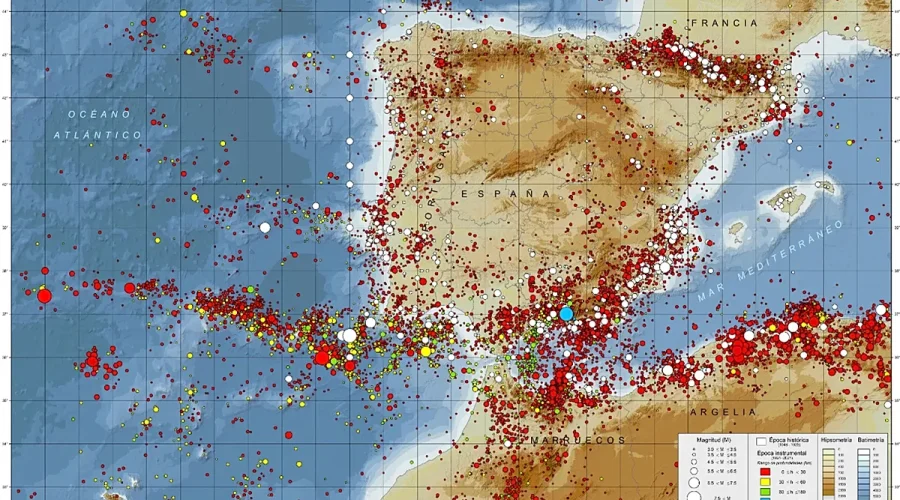
Spain’s seismic past is far more violent than most residents of its cities would assume. The Arenas del Rey earthquake of 1884, estimated at magnitude 6.5, struck the coast south of Valencia and killed between 750 and 900 people while shaking more than 100 population centres. Nearly two centuries earlier, in 1829, Torrevieja experienced a tremor estimated at magnitude 6.6. In 1954, a magnitude-7.8 event was recorded near Dúrcal, though its enormous depth of roughly 650 kilometres meant the surface felt comparatively little. More recently, the 2011 Lorca earthquake — modest at magnitude 5.1 — still claimed nine lives, a reminder that even moderate events carry lethal potential when they strike populated areas with vulnerable structures.
What the Geologists Say About Timing
Some commentators have seized on the roughly 140-year gap since the 1884 event as evidence that another major quake is overdue. Raúl Pérez López, emergency geologist at the Spanish Geological and Mining Institute (IGME-CSIC), pushes back on that reading. In conversation with Euronews, he explained the statistical trap:
“We can divide the elapsed time by the number of earthquakes and say: every 100 years Spain experiences a major earthquake, because that is what the statistics tell us.”
Yet seismicity does not tick along in evenly spaced intervals. Two centuries might pass in relative silence, followed by two major events in quick succession. Pérez López is blunt about the limits of forecasting:
“Even though we have gone 140 years without an earthquake, we do not know whether it is going to happen soon or in a long time.”
What is certain, he notes, is that tectonic energy keeps accumulating. Spain sits at the convergence zone where the African and Eurasian plates press against one another. Every year that passes without a major release adds to the stored strain in the crust. That rising probability does not translate into imminence, however:
“There are faults that can trigger earthquakes, but we do not know whether it will be today, tomorrow or in 50 years’ time. We have no way of knowing.”
Where the Faults Lie
The IGME has mapped more than 200 active faults across the country. The corridor of greatest concern runs along the Mediterranean coastline, from Valencia westward to Cádiz, where fault density and a long catalogue of destructive events overlap. Pérez López cautions, though, that significant shaking is not exclusive to that belt. The Pyrenees, the Catalan mountain ranges, and intraplate fault systems around Granada and Albacete all carry the capacity to generate damaging tremors. Magnitude-5 events are plausible on several of these structures; in isolated cases, magnitude-6 shaking is within the range of what the geology permits.
“The occurrence of earthquakes with a magnitude above 4 in the south and southeast of Spain is nothing unusual.”
The Myth of Global Synchrony
When major tremors strike several continents within the same news cycle, public imagination tends to weave them into a single narrative. Pérez López is careful to separate coincidence from causation. Recent large earthquakes in various countries may feel connected to a lay observer, but from a scientific standpoint no such linkage exists. Each event is driven by its own local fault geometry and stress history.
Prevention Over Prediction
Because no instrument can forecast the next rupture, the geologist points to hazard mapping and building regulation as the practical safeguards. Long-term seismic hazard maps estimate how much ground motion a given area might experience over decades, allowing engineers and planners to calibrate construction standards to that level of threat. The lethality of an earthquake, he stresses, is governed not solely by magnitude but by depth, by proximity to populated zones, and above all by how the built environment responds to shaking:
“What kills people in earthquakes is the seismic intensity and the response of buildings.”
He draws on recent events in Venezuela and Colombia to illustrate the point: tremors of comparable magnitude produced vastly different casualty figures because the geological setting, depth, and structural vulnerability of the affected areas differed sharply. The lesson for Spain is that retrofitting older housing stock, enforcing modern seismic codes in new construction, and maintaining clear evacuation corridors around critical infrastructure are the levers that actually reduce loss of life.
The Granada sequence of August 2026 will fade from headlines within weeks. The faults beneath the peninsula, however, continue to accumulate strain in silence. Spain’s preparedness — its codes, its maps, its public awareness — will determine whether the next major event is remembered as a tragedy or as a test survived.
Related Reading
Frequently Asked Questions
What is Is Spain facing another major earthquake?
Is Spain facing another major earthquake is the main topic of this guide. The article explains the context, practical details, and next steps readers should understand.
Why does Is Spain facing another major earthquake matter?
Is Spain facing another major earthquake matters because readers are looking for a useful answer, not just a short summary. Good content should match search intent and help them decide what to do next.