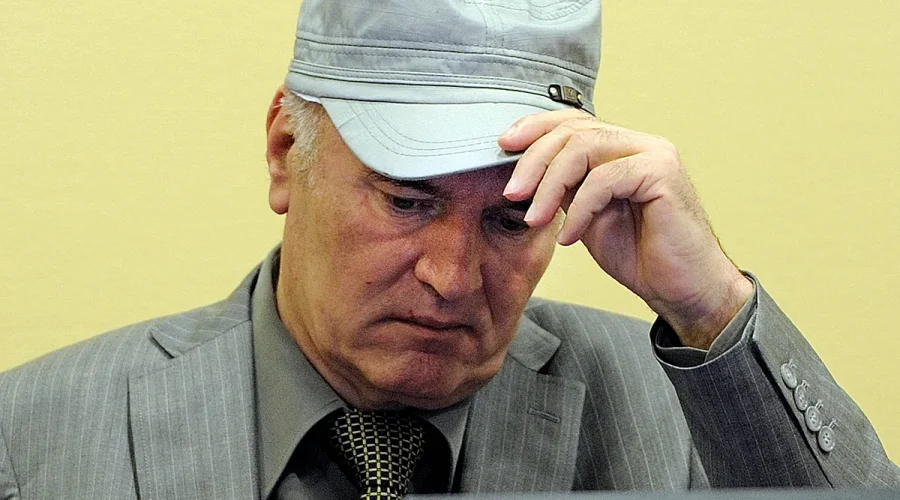
Ratko Mladić, the “Butcher of Bosnia,” Dead at 84 in Dutch Custody
Usagevpn.com – The man widely regarded as the single most notorious war criminal of the Balkan conflicts of the 1990s has died. Ratko Mladić, the former commander of Bosnian Serb forces who spent more than a decade behind bars after being convicted of genocide and other atrocities, passed away at age 84 in a hospital attached to his prison in The Hague. Serbian state broadcaster RTS confirmed the death. His passing closes a chapter that stretched across three decades of Balkan history — from the collapse of Yugoslavia through a decade-long manhunt to a life sentence at the International Criminal Tribunal for the former Yugoslavia (ICTY).
A Career Built on Command
Mladić was no outsider to the Yugoslav military machine. A career officer who had already seen combat in neighbouring Croatia during its own war of independence, he rose to lead the Main Staff of the Bosnian Serb army after Bosnian Serb leaders — propped up by Belgrade under Slobodan Milošević — carved out a parallel state within Bosnia following that country’s declaration of independence in early 1992. Slovenia and Croatia had broken away from Yugoslavia just months earlier; Bosnia followed, and the resulting fragmentation ignited a war that would kill roughly 100,000 people and displace hundreds of thousands more.
Under Mladić’s operational direction, Bosnian Serb units pursued a strategy of ethnic cleansing across as much of the country’s territory as they could seize, targeting the two other major communities — Bosniaks and Croats. The most sustained expression of that strategy was the siege of Sarajevo, which stretched from early 1992 until the war’s end in late 1995. It remains the longest encirclement of a capital city in modern military history. Bosnian Serb positions on the hills ringing the city delivered a relentless barrage of artillery fire and sniper shots aimed at civilians for more than three years.
Evidence presented at trial also established that Mladić ordered the firebombing of Sarajevo’s National and University Library in August 1992. The Austro-Hungarian-era structure in the city’s Old Town held approximately 1.5 million volumes, including more than 155,000 rare books and manuscripts — a cultural loss that scholars have compared to the burning of the Library of Alexandria.
Unscrambled Orders
During the siege, Mladić issued commands through a military radio network without bothering to encrypt the signal. Sarajevo police intercepted and recorded the transmissions. Those tapes, later entered into evidence at the ICTY, captured the commander directing his artillery with blunt specificity.
“Turn toward Velešići, there are no Serbs there.”
In another recorded exchange, he told his gunmen to “scatter their brains” — an instruction that, as political analyst Dragan Bursać has noted, appears designed to instil terror in the civilian population.
“That was a classic case of starving out a city, with the aim of erasing and destroying it. In a sadistic way, he saw the city as a crown jewel if it were to fall into the hands of the Bosnian Serb army, something even he wouldn’t have known what to do with.”
The siege was formally lifted in February 1996, after which Bosnian Serb-held neighbourhoods were reintegrated into Bosnia. In those districts, Mladić’s units carried out campaigns of persecution, terror, and forced displacement that continued well after the guns fell silent.
Srebrenica: The Worst Atrocity Since World War II
The defining moment of Mladić’s military career — and the centrepiece of his conviction — came in July 1995, when his forces overran the UN-protected enclave of Srebrenica in eastern Bosnia. The town had been designated an internationally backed safe haven for its residents and surrounding villages. Mladić reportedly declared that “the time has come … for revenge against Turks in these regions,” a reference to centuries of Ottoman rule over Bosnia that ended in 1878. He routinely framed the atrocities of his troops as payback for that medieval domination.
In the week that followed, Bosnian Serb units under his command separated 8,372 men and boys from the civilian population, executed them summarily, and bulldozed their bodies into mass graves. The killing spree is recognised as the worst genocide on European soil since the end of the Second World War. Mladić was convicted of genocide for those summary executions and sentenced to life in prison by the ICTY.
In a striking contrast captured on camera during the same period, Mladić was filmed by a television crew distributing sweets to Bosniak children, patting one on the head and reassuring them that everything would be all right.
Fifteen Years on the Run
The ICTY issued its first indictment against Mladić in July 1995. He nonetheless retained his post as Commander of the Main Staff until November 1996, when he was formally relieved of duty. From that point forward, he became a fugitive. For fifteen years he hid — or was hidden — with the assistance of contacts inside Serbia’s intelligence services and military apparatus. After Milošević’s own downfall and eventual surrender to the tribunal, that network of protection slowly eroded. In 2011, Mladić was finally apprehended at the home of a relative in Serbia and transferred to The Hague, where he stood trial and received his life sentence.
A Death Without Repentance
Throughout his trial, Mladić conducted himself with what observers described as bullish defiance, never offering an apology or expressing remorse for the deaths attributed to his command. Dragan Bursać, author and political analyst, summed up the public memory of the man:
“Mladić worked openly and systematically toward the destruction of an entire people. He will remain on record as someone who had not a trace of remorse, who was predominantly a coward whenever force wasn’t standing behind him, and who died the way he lived.”
His death in a Dutch prison hospital leaves behind a legacy inseparable from the suffering of Bosniak and Croat communities across Bosnia-Herzegovina, from the empty shelves of Sarajevo’s destroyed library, and from the mass graves still being exhumed in the forests around Srebrenica. For families of the more than 8,000 victims, the passing of the man convicted of their genocide offers no closure — only the finality of a life sentence that will now never be served.
Related Reading
Frequently Asked Questions
What is Convicted Bosnian Serb war criminal Ratko?
Convicted Bosnian Serb war criminal Ratko is the main topic of this guide. The article explains the context, practical details, and next steps readers should understand.
Why does Convicted Bosnian Serb war criminal Ratko matter?
Convicted Bosnian Serb war criminal Ratko matters because readers are looking for a useful answer, not just a short summary. Good content should match search intent and help them decide what to do next.