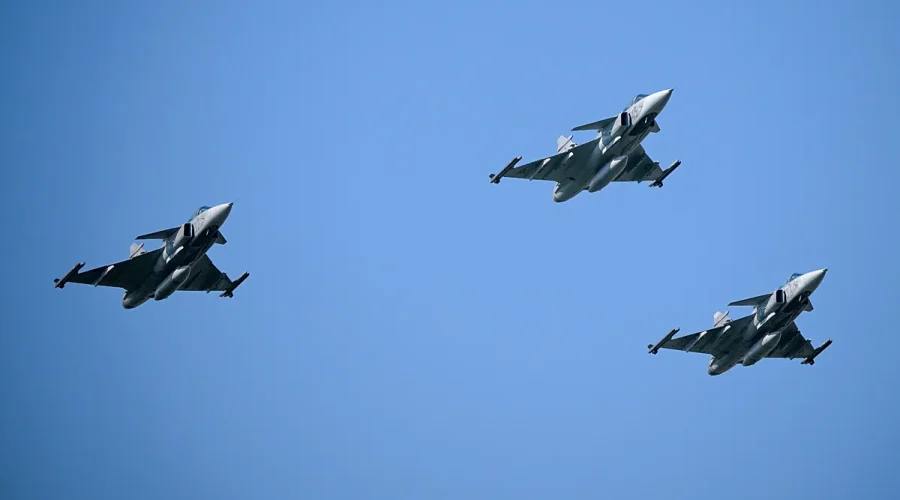
Gripen Jet Goes Down Near Szolnok; Pilot Ejects Safely
Usagevpn.com – A Hungarian military aircraft touched down in an uncontrolled manner in the flat agricultural terrain surrounding Szolnok late on Monday morning, prompting an immediate emergency response and a formal inquiry into what caused the loss. The pilot escaped the burning airframe via ejection seat and was transported to a nearby hospital by ambulance. No civilian casualties were recorded, a fact officials attributed to the pilot’s deliberate decision to steer the crippled machine onto military-owned ground before pulling the ejection handle.
Prime Minister Péter Magyar broke the news to the public within minutes of the incident, posting a brief statement on his personal Facebook page. In it, he confirmed the crash, noted that the cause remained undetermined, and announced that a full investigation had been launched.
“For reasons that are not yet known, a Gripen fighter jet of the Hungarian Defence Forces crashed a few minutes ago near Szolnok. The pilot successfully ejected. An investigation is under way, and the defence minister is on his way to the scene.”
Defence Minister Romulusz Ruszin-Szendi followed up shortly thereafter with additional operational details. He confirmed that the pilot had been airlifted — by road ambulance, given the proximity of the crash site to medical facilities — and that no other persons, whether military or civilian, sustained injuries. The minister emphasized that the pilot had taken every available action to direct the aircraft onto a military installation before ejecting, thereby minimizing the risk to surrounding communities.
The Gripen Fleet in Hungarian Service
The aircraft involved belongs to the Saab JAS 39 Gripen family, a lightweight multirole fighter developed by the Swedish company Saab and now operated by several European air forces. Hungary acquired its batch of Gripens as part of a long-running modernization programme aimed at replacing ageing Soviet-era MiG-21 and MiG-29 types that had formed the backbone of the country’s air combat capability since the Cold War era.
As of this incident, the Hungarian Defence Forces maintain a total of fourteen Gripen jets. These aircraft are based at the airfield at Kecskemét, roughly thirty kilometres south of Szolnok, which serves as the principal operational hub for the country’s fighter aviation. The Szolnok area itself hosts additional military infrastructure, including an air base that supports training, logistics, and rapid-response missions for the broader Hungarian armed forces.
International Commitments and Recent Deployments
The Hungarian Gripen squadron does not remain confined to domestic skies. The jets participate regularly in NATO and EU-led operations, contributing to air policing, surveillance, and escort tasks across the alliance’s operational theatre. Most recently, during the second half of last year, Hungarian Gripens were tasked with helping safeguard the airspace of the Baltic states — Estonia, Latvia, and Lithuania — a mission that placed them in close proximity to Russian military aviation and underscored the strategic weight Hungary now carries within the alliance’s eastern flank.
The loss of one aircraft from a fleet of fourteen represents a meaningful reduction in available sortie capacity, particularly while the type is still being integrated into allied rotation schedules. Until the investigation concludes and any necessary maintenance or replacement measures are completed, the remaining thirteen airframes will shoulder the full operational tempo, including any ongoing or upcoming international deployments.
What Happens Next
A formal accident investigation is now underway, with the defence minister personally travelling to the crash site to oversee initial evidence collection. Standard procedure will include examination of the wreckage, retrieval of flight-data and cockpit-voice recorders, review of maintenance logs, and interviews with ground-crew and mission-planning personnel. Findings are expected to determine whether the cause was mechanical failure, pilot error, external interference, or a combination of factors.
For the residents of Szolnok and the surrounding Csongrád-Csanád-Békés county, the incident will likely prompt renewed attention to flight-corridor safety and to the environmental footprint of military aviation in an area already accustomed to regular jet passes. Local authorities have not yet announced any additional public-briefing schedule beyond the statements already issued by the prime minister and the defence minister.
The Hungarian government has not indicated whether the crashed airframe will be written off or whether a replacement unit will be procured. With the Gripen programme still in its operational maturity phase for Hungary, the outcome of the investigation will carry implications both for domestic force structure and for Budapest’s ability to meet its commitments to allied partners in the Baltic and broader European theatre.
Related Reading
Frequently Asked Questions
What is Hungarian air force Gripen fighter jet crashes?
Hungarian air force Gripen fighter jet crashes is the main topic of this guide. The article explains the context, practical details, and next steps readers should understand.
Why does Hungarian air force Gripen fighter jet crashes matter?
Hungarian air force Gripen fighter jet crashes matters because readers are looking for a useful answer, not just a short summary. Good content should match search intent and help them decide what to do next.