Unitree’s Robot Dogs and Humanoids Send Shares Skyrocketing Past 600% in Historic Market Debut
Usagevpn.com – The Hangzhou-based robotics firm that turned the internet upside down with clips of its machines rollerblading, executing backflips, and serving as backup dancers for pop stars has now delivered an equally spectacular performance on the stock exchange. Unitree, widely regarded as the largest humanoid robot manufacturer on the planet, watched its shares climb more than 600 percent above the offering price on the first day of public trading, before easing back to a gain of roughly 500 percent by the close.
From Viral Clips to Wall Street-Grade Demand
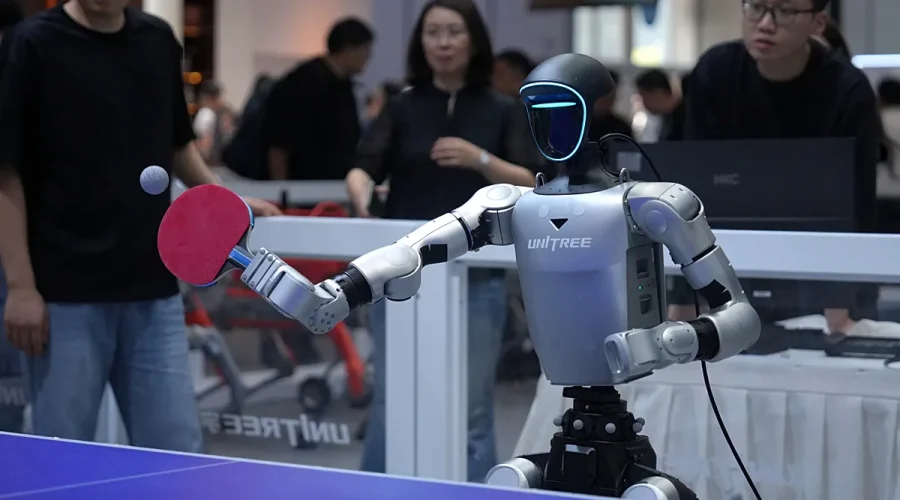
The company’s global fame was built not on white papers or trade-show booths but on short-form video content showing its robots performing martial arts routines, playing table tennis, vaulting over obstacles, and skating on inline skates. Those clips accumulated billions of views and made Unitree a household name well before any investor ever saw a prospectus. That cultural cachet translated directly into extraordinary buying pressure once the shares began trading.
The initial public offering was priced at approximately 150.8 yuan (€19.3) per share. By Wednesday’s session, the ticker had touched 1,100 yuan (€140.6), representing a surge exceeding 600 percent. The frenzy was driven overwhelmingly by Chinese retail investors. Allocation data showed that demand from non-professional buyers outstripped available supply by thousands of times, a ratio that underscores just how deeply embedded the company has become in domestic consumer imagination.
Wang Xingxing, who founded Unitree and continues to serve as chief executive, retains roughly one-fifth of the company’s equity, giving him both a substantial financial stake and decisive operational control as the firm scales its public-market ambitions.
A Cost Structure Built in Hangzhou
Unitree’s competitive edge rests on a straightforward industrial logic: proximity to dense, vertically integrated supply chains in Hangzhou keeps component and assembly costs far below what Western rivals must pay. The result is a catalogue of robot dogs and budget-tier humanoids priced at a small fraction of comparable American products. That affordability, combined with aggressive marketing built around eye-catching demonstrations, has allowed the company to ship at volumes that place it ahead of several major US and European competitors still working through lower production counts.
The commercial payoff arrived earlier than analysts expected. Unitree turned a profit well before most early-stage robotics startups have managed to do so, a milestone that strengthens its balance sheet as it scales manufacturing and R&D simultaneously.
China’s Strategic Bet on Physical AI
Beijing treats robotics as a pillar of national industrial policy, motivated in part by a rapidly shrinking working-age population. The government views autonomous machines as a structural answer to labour shortages across manufacturing, logistics, and elder-care sectors. Within that framework, humanoid platforms occupy a special position because they serve as physical substrates for what researchers call “physical AI” — systems that learn by interacting with the real world rather than purely through simulation.
When a robot walks, grips an object, or recovers from a stumble, it generates rich sensory and proprioceptive data that feeds back into perception models, reaction-time algorithms, and training loops for increasingly capable foundation models. Each unit deployed in the field therefore accelerates the entire software stack, creating a compounding advantage that pure simulation cannot replicate.
Market Size and the Competitive Field
Goldman Sachs projects the global humanoid-robot market will reach $38 billion (€32.7 billion) by 2035, a figure that has drawn sustained investor appetite for pure-play robotics equities. At present, Unitree and China’s UBTECH Robotics stand among the very few listed companies whose core business is humanoid robot design and manufacture. Meanwhile, conglomerates such as Tesla, Xiaomi, and Hyundai Motor maintain internal humanoid-robot divisions, though those units remain embedded within broader corporate structures rather than trading independently.
The pipeline of additional listings is not empty. Chinese firms including Leju Robotics and Deep Robotics have signalled intentions to seek public-market access in the near term, suggesting the sector’s equity representation will broaden considerably over the coming years.
Geopolitical Friction and the Pentagon Question
Not every market welcomes Unitree’s expansion with open arms. Washington has maintained a deliberately cautious posture toward importing or deploying foreign-made humanoid and quadruped robots, citing national-security considerations. The US Department of Defence has placed Unitree on its roster of Chinese military-linked companies, describing the firm as
a “contributor to the Chinese defence industrial base.”
The company has pushed back on that characterisation, insisting its robots are designed and sold exclusively for civilian applications. Whether that distinction holds under sustained regulatory scrutiny remains an open question, and it will shape how readily Western enterprises and governments can source, integrate, or compete against Unitree hardware in the years ahead.
For now, the market has spoken with unusual enthusiasm. A company that made headlines by teaching machines to rollerblade has now made headlines by teaching its own share price to do a backflip — and investors, at least for the opening session, appeared willing to watch.
Related Reading
Frequently Asked Questions
What is Unitree s viral dancing rollerblading robots?
Unitree s viral dancing rollerblading robots is the main topic of this guide. The article explains the context, practical details, and next steps readers should understand.
Why does Unitree s viral dancing rollerblading robots matter?
Unitree s viral dancing rollerblading robots matters because readers are looking for a useful answer, not just a short summary. Good content should match search intent and help them decide what to do next.