Washington’s Latest Sanctions on ICC Officials Prompt Unified European Pushback
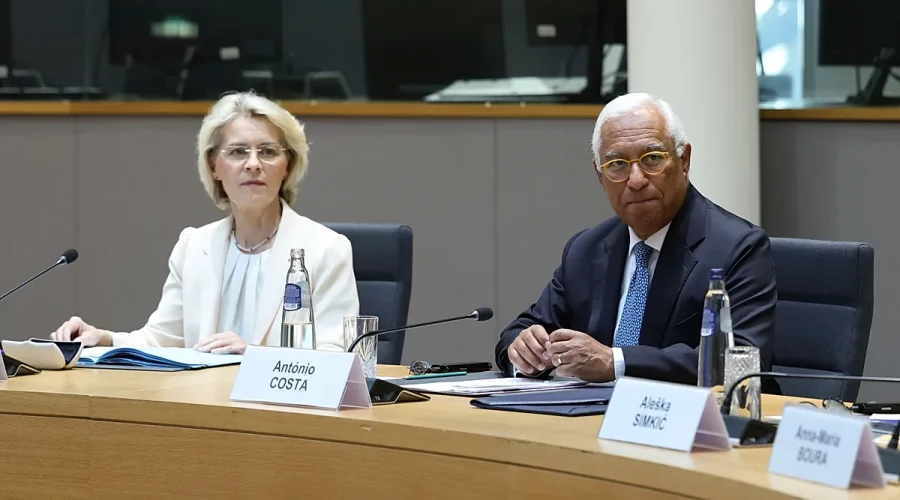
Usagevpn.com – The United States has moved to impose financial penalties on two senior figures at the International Criminal Court, triggering an immediate and coordinated response from Europe’s top institutions. The action, announced by Secretary of State Marco Rubio on Tuesday, targets the court’s president, Japan’s Tomoko Akane, and Senegalese senior lawyer Abdoulaye Seye, who had been assigned to investigate alleged war crimes committed by Israel during its military campaign in Gaza. Within hours, European Commission President Ursula von der Leyen and Council President António Costa issued a joint statement affirming their full backing for the Hague-based tribunal.
“The ICC helps deliver justice to the victims of some of the world’s most horrific crimes,” the two EU leaders wrote. “To carry out this essential work, its judges and officials must be able to act independently and without external pressure.”
Washington’s Justification
Rubio framed the sanctions as a necessary correction of what he characterized as judicial overreach. In his public remarks, the Secretary of State called the tribunal a
“corrupt and fatally politicised supranational court that has maliciously abused its authority and exceeded its mandate.”
He further stated that the United States would “not tolerate its assault on state sovereignty” and accused both Akane and Seye of pursuing prosecutions against officials from governments that had never accepted the court’s jurisdiction. Neither the United States nor Israel holds membership in the ICC, though Palestine has been a member state since 2015, granting the tribunal authority to examine alleged crimes committed on Palestinian territory.
A Pattern of Hostility
The Tuesday measures represent the most recent escalation in a sustained campaign by the Trump administration to undermine the institution. Washington has already placed sanctions on as many as eleven senior court officials, including former chief prosecutor Karim Khan. Rubio has previously spoken publicly of his desire to “dismantle” the court “brick by brick” and has indicated he would press member states to withdraw from the Rome Statute, the treaty that established the tribunal in 1998.
That pressure has borne fruit in recent months. Venezuela and Chad announced their intentions to exit the institution, while Hungary’s former government under Viktor Orbán also declared its plan to leave before the decision was reversed following Prime Minister Péter Magyar’s decisive electoral victory in April. All twenty-seven EU member states remain ICC members, making the European bloc the court’s single largest regional constituency.
National Reactions Across Europe
The Netherlands, which hosts the court’s permanent seat in The Hague, reacted sharply. Foreign Minister Tom Berendsen stated on Wednesday that his government “disapproves” of the sanctions. Berlin echoed the sentiment through a government spokesperson, who affirmed that Germany “stands by the ICC” and noted the court
“has held accountable those guilty of the gravest crimes” and is “fulfilling its mandate exactly as intended.”
The ICC itself characterized the sanctions as a “flagrant attack” on its independence, underscoring the institutional stakes of what the court views as an unprecedented external interference with its judicial process.
The Netanyahu Warrant and European Ambivalence
Despite the unified institutional response, the court’s outstanding arrest warrant for Israeli Prime Minister Benjamin Netanyahu continues to generate inconsistent signals from European capitals. France, Germany, and Italy have each declined to commit publicly to executing the warrant should Netanyahu set foot on their soil, a posture that critics argue weakens the practical force of the tribunal’s decisions. This ambivalence complicates the broader European message of solidarity and raises questions about whether political convenience is quietly overriding legal obligations under the Rome Statute.
Parliamentary Calls for Stronger Action
On Wednesday, senior members of the European Parliament urged the bloc to go beyond rhetorical condemnation. Iratze García, president of the Socialists and Democrats group, called for activation of the so-called Blocking Statute — a legal mechanism that would render it unlawful for EU-based companies and banks to comply with extraterritorial US sanctions. Such a step would place European financial institutions in direct conflict with Washington’s enforcement apparatus, a move that carries significant economic and diplomatic weight.
Human Cost: Life Under Sanctions
The practical consequences of US sanctions reach well beyond diplomatic posturing. French judge Nicolas Guillou told Euronews earlier this year that the absence of European alternatives for essential services meant the restrictions imposed on him would resemble “true civil death” for a younger European professional. For judges and staff whose salaries, banking relationships, and travel depend on dollar-linked systems, the sanctions function as a form of economic isolation that can impair the court’s ability to recruit and retain qualified personnel.
The episode underscores a structural vulnerability: the ICC operates within a global financial architecture dominated by the US dollar, meaning that unilateral American penalties can reach into the daily operations of an international judicial body without requiring any multilateral approval. Whether European institutions translate their stated solidarity into concrete legal and financial countermeasures will determine whether the court retains the operational independence its founders intended, or whether it becomes progressively dependent on the goodwill of the very states whose conduct it is tasked with examining.
Related Reading
Frequently Asked Questions
What is EU leaders rally behind International Criminal?
EU leaders rally behind International Criminal is the main topic of this guide. The article explains the context, practical details, and next steps readers should understand.
Why does EU leaders rally behind International Criminal matter?
EU leaders rally behind International Criminal matters because readers are looking for a useful answer, not just a short summary. Good content should match search intent and help them decide what to do next.