Ukraine’s Odesa Region Faces Second Train Strike in Single Day
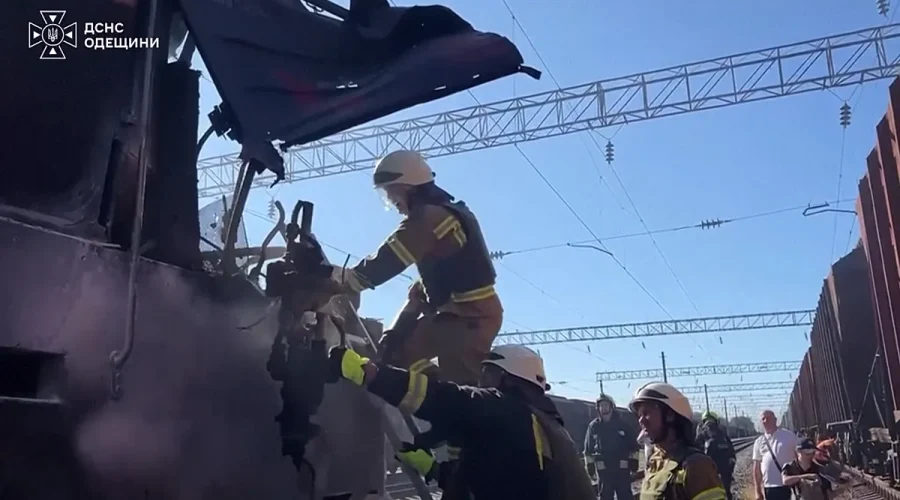
Usagevpn.com – A Russian drone attack on a passenger train in Ukraine’s Odesa region claimed two lives on Thursday, marking the second such assault on rail transport within hours. The initial strike targeted a train carrying 340 passengers, while a subsequent attack hit another service with approximately 500 people aboard, wounding a child. The victims of the first attack were identified as the train’s machinist and his assistant, according to Oleksandr Pertsovskyi, chief executive of Ukrainian Railways. He shared the details in a Facebook post describing how Russian forces deployed a jet-powered drone to destroy an ordinary passenger locomotive.
Ukrainian President Volodymyr Zelenskyy addressed the incident on social media platform X, emphasizing the civilian nature of the target. “Today in the Odesa region, the Russians once again destroyed an ordinary passenger train locomotive with a jet-powered drone. There were 340 people on the train,” he wrote. The president added that whoever controlled the drone “certainly could not have been unaware that the target was entirely civilian.”
Escalating Attacks on Civilian Infrastructure
The train strikes represent part of a broader Russian strategy to disrupt Ukrainian logistics while increasingly targeting civilian infrastructure. Kyiv has noted that passenger trains have become recurring targets in this campaign.
Local media outlets reported that Russia also directed attacks against port infrastructure in the Izmail district of the Odesa region during the same period. Overnight into Thursday, Russian forces launched a total of 133 drones at Ukrainian positions, striking fifteen different locations across the country.
Record Civilian Casualties in July
A United Nations report released Thursday revealed that civilian deaths in Ukraine reached their highest level since May 2022, during the opening months of Russia’s full-scale invasion. The UN Human Rights Monitoring Mission documented significant increases in both fatalities and injuries compared to previous periods.
“At least 437 civilians were killed and 2,610 injured in Ukraine in July, a 30 percent increase compared with the previous month and a 70 percent increase compared with July 2025,” the mission stated in its Thursday announcement.
The organization noted that the death toll represents the highest recorded figure since May 2022. Since the invasion began, the UN has verified 16,874 civilian deaths, though officials acknowledge the actual number likely exceeds this figure due to difficulties confirming casualties in Russian-occupied territories.
Kyiv emerged as one of the most severely affected urban centers. The UN recorded at least 54 civilian fatalities in the Ukrainian capital during July alone, describing it as “one of the hardest hit cities” in the country.
Both Sides Intensify Long-Range Operations
Military analysts observe that both Ukraine and Russia have substantially escalated their long-range attacks throughout 2026, contributing to the spike in civilian casualties. Ukraine has particularly focused its efforts on disrupting Russian critical and military infrastructure in recent months.
Near-daily drone strikes targeting Russian oil facilities have generated fuel shortages, diminished Russia’s refining capacity, and created unease among the Russian public. On Thursday, Ukrainian media reported a fire at the Gazprom Neftohim Salavat oil refinery in Bashkortostan, one of Russia’s largest processing plants. A separate blaze broke out at a Wildberries distribution hub in the vicinity.
Wildberries, Russia’s premier online retailer, represents a crucial component of Moscow’s wartime economic infrastructure. The dual fires underscore the vulnerability of Russian logistics networks to Ukrainian aerial campaigns.
International Support Reaches New Heights
Russia’s deployment of ballistic missiles has proven challenging for Ukrainian air defenses, prompting Zelenskyy to request additional systems from international partners. The president warned that the country faces a critical shortage of defensive capabilities.
Despite prolonged funding gaps, military assistance to Ukraine achieved its highest level since February 2025, when the United States suspended financial support. Data from the Kiel Institute indicates that new European Union funding drove this increase.
In June, Kyiv received €7.2 billion in military allocations, representing the third-largest monthly donor contribution since Russia’s full-scale invasion commenced in February 2022. The EU’s €90 billion loan program, designed to address Ukraine’s budgetary and defense requirements through 2026 and 2027, forms the foundation of this support.
Beyond the EU loan, individual member states contributed substantial sums: Germany provided €700 million, Denmark allocated €600 million, and the Netherlands contributed €500 million to bolster Ukraine’s military capabilities. These combined efforts reflect growing international commitment to supporting Ukrainian sovereignty amid intensifying hostilities.
Related Reading
Frequently Asked Questions
What is Russian forces strike second passenger train?
Russian forces strike second passenger train is the main topic of this guide. The article explains the context, practical details, and next steps readers should understand.
Why does Russian forces strike second passenger train matter?
Russian forces strike second passenger train matters because readers are looking for a useful answer, not just a short summary. Good content should match search intent and help them decide what to do next.