Agri-PV: A New Chapter for European Agriculture and Renewable Energy
Where Tradition Meets Innovation in Bavaria
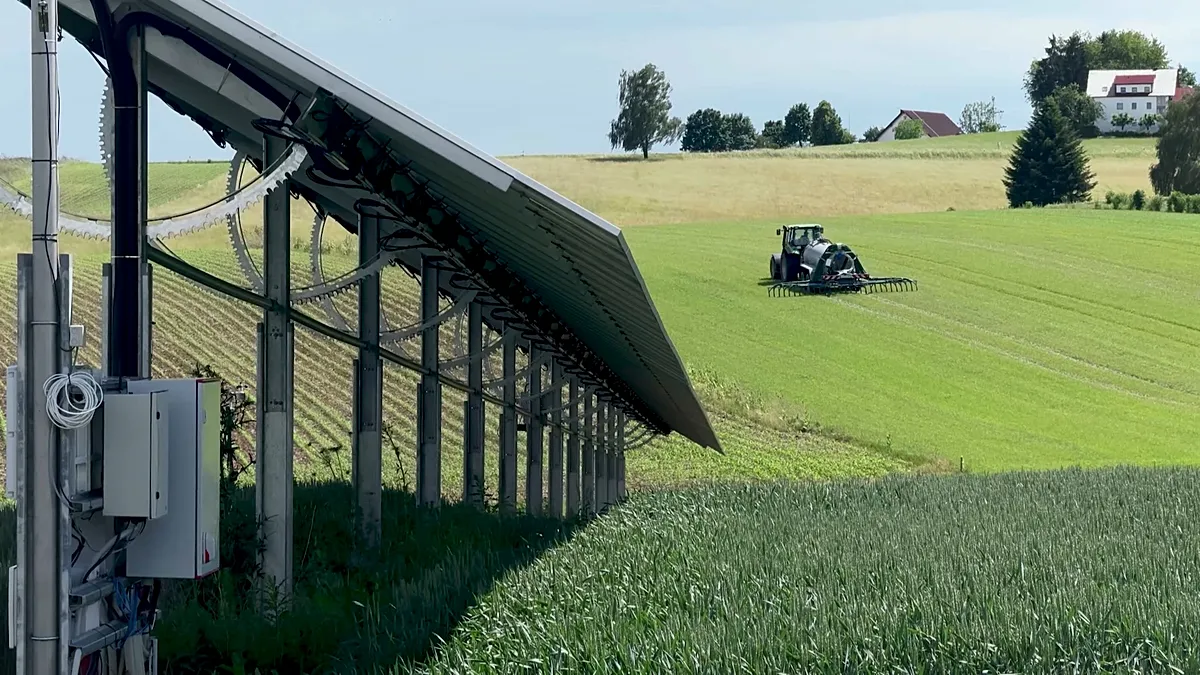
Saving Europe s farmland – Our story begins at a family farm in Grasbrunn, a quiet village situated on the outskirts of Munich. Here, Georg Bockmaier carries on a multigenerational legacy of cultivating potatoes and cereals, following in the footsteps of both his father and grandfather. Yet this agricultural setting is currently undergoing a remarkable transformation. Heavy machinery has arrived on the scene, and a construction team from Slovakia is busy erecting an agricultural photovoltaic installation on the fields adjacent to the Bockmaier property. This sophisticated setup incorporates an advanced solar tracking system designed to maximize energy capture throughout the day.
Bavaria, the southern German region where this farm is located, has earned recognition as a genuine hotspot for entrepreneurial ventures, particularly those focused on innovative smart farming technologies. Among these emerging companies stands Feld.energy, a start-up that has captured significant attention in the agricultural sector. Established just two years ago, this ambitious enterprise has experienced rapid expansion, attracting more than 800 farmers who have chosen to partner with them. Together, these stakeholders are deploying agri-PV systems across approximately 900 hectares of land.
Coexistence: Farming and Solar Power Side by Side
One might wonder whether this development signals the end of traditional agriculture in the region. Will the Bavarian countryside become blanketed with solar panels, rendering farming impossible? Georg Bockmaier offers a reassuring perspective on this matter. He explains that this represents an entirely new possibility rather than a replacement of existing practices.
“That’s something new, I can go on with farming. If I take my combine harvester with a cutting width of 6.60 or even 7.50 metres, I get through the rows of panels without any problem. We can also position the PV-panels vertically.”
This flexibility in panel orientation demonstrates the thoughtful engineering behind these installations. Farmers need not sacrifice their daily operations or adapt their equipment significantly. The vertical positioning option proves particularly valuable for regions with varying crop heights and seasonal changes.
A Vision for European Expansion
Nikolai Voitiouk-Blum, who serves as Feld.energy’s vice president overseeing operations, articulates a clear roadmap for the company’s future. Speaking about their objectives, he emphasizes that the organization has defined priorities for the coming years. Their ambitions extend well beyond Bavaria’s borders.
“Our vision for the next four years is clear. We want to expand into other European countries, such as Italy, so that we can bring one gigawatt of PV-capacity online, the equivalent of an entire nuclear power plant.”
This target of one gigawatt represents a substantial achievement in renewable energy production. To put this figure into perspective, it matches the output capacity of a single nuclear facility, yet it generates electricity without producing radioactive waste or requiring the same infrastructure investments. The expansion into Italy and potentially other European nations reflects the growing recognition that agri-PV technology offers solutions applicable across diverse climates and agricultural landscapes.
The Broader Significance of Agri-PV
The development of agricultural photovoltaic systems addresses multiple challenges facing modern Europe simultaneously. Food security remains a priority as climate patterns shift and arable land becomes increasingly valuable. At the same time, the transition toward renewable energy sources has accelerated across the continent. By combining these two objectives, agri-PV installations allow farmers to generate additional revenue streams while contributing to decarbonization efforts.
The involvement of international teams, such as the Slovak construction crew working in Bavaria, illustrates the cross-border nature of this movement. Knowledge and expertise flow freely between European nations, creating a collaborative ecosystem that benefits all participants. For farmers like Bockmaier, this represents not merely an installation of solar panels but an investment in the future of their operations and the communities they serve.
As Feld.energy continues its growth trajectory, the model it has developed in Bavaria may well serve as a template for agricultural regions throughout Europe. The combination of proven farming traditions with cutting-edge renewable technology demonstrates that progress need not come at the expense of heritage. Instead, the two can reinforce each other, creating resilient systems capable of meeting the demands of both present and future generations.