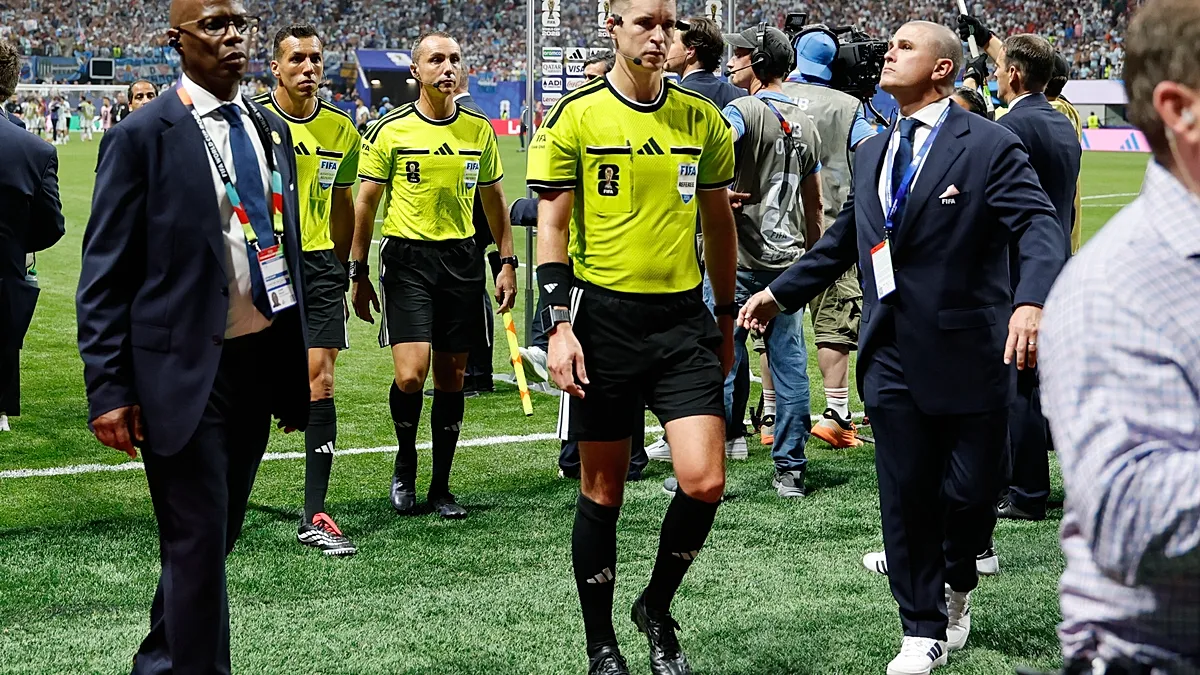
Examining Unfounded Accusations Against French Referee Following Egypt’s World Cup Departure
Fact check – As the 2026 FIFA World Cup approaches its conclusion, lingering controversies from earlier stages continue to fuel misleading narratives and incorrect imagery across digital platforms. Egypt’s elimination from the competition on July 7 has sparked an unprecedented wave of unsubstantiated social media allegations directed at French official François Letexier. The controversy originated following Argentina’s dramatic 3-2 victory over Egypt, a contest marked by numerous questionable calls that ultimately favored the South American side after they overcame an initial two-goal deficit.
The Match Decisions That Sparked Outcry
Following the conclusion of play, Egypt’s Football Association submitted an official grievance to FIFA, lodging accusations that Letexier and his officiating crew committed “serious refereeing mistakes” during the crucial encounter. Two particular incidents drew significant attention from Egyptian supporters and media outlets. The first involved an Egyptian goal that was subsequently overturned by the video assistant referee, following a decision that midfielder Marwan Attia had committed a foul by stepping on Lisandro Martinez’s foot. The second concerned widespread belief that Mohamed Salah had been brought down inside the Argentina penalty area, occurring moments before the South American nation secured their 3-2 lead.
In response to these perceived injustices, Egyptian officials formally requested that Letexier be removed from duty for the remainder of the tournament. What began as legitimate sporting criticism quickly evolved into more expansive conspiracy theories circulating across social media platforms.
Investigating the Wikipedia Claims
Among the most prominent theories, some users asserted without verification that Letexier’s supposed Jewish heritage indicated Israeli influence over the match result. Others leveraged this claim as proof that FIFA had orchestrated the tournament to benefit Argentina. The Cube, Euronews’ dedicated fact-checking unit, conducted a thorough examination of these allegations.
Multiple posts on X circulated a screenshot purporting to show that Letexier was born into an Orthodox Jewish family, sourced from his Wikipedia biography. These posts collectively accumulated thousands of views across X and TikTok platforms, yet rested on shaky foundations. Wikipedia’s publicly accessible edit history reveals that the statement “François Letexier was born on 23 April 1989 in the Bédée commune of Brittany, northwestern France, into an Orthodox Jewish family” was inserted into his article on July 8, shortly after the Argentina-Egypt fixture concluded.
The edit cited an article from French publication Le Point, yet a careful review of that piece shows it concentrates exclusively on Letexier’s professional trajectory and advancement within French football. The referenced article makes no mention whatsoever of his religious affiliation, ethnic origins, or familial background. Furthermore, no additional credible journalism has emerged to substantiate this particular claim regarding Letexier’s heritage.
Additional Fabricated Assertions
Beyond the religious heritage claim, other baseless modifications appeared on Letexier’s Wikipedia page following the contentious match. The platform’s revision log documents that users inserted assertions that the referee had been “paid by Argentina and FIFA” and that the round-of-16 contest against Egypt had been predetermined. Both of these modifications were subsequently withdrawn, though screenshots captured before the deletions enabled the false information to proliferate rapidly across networks.
Compounding these Wikipedia alterations, additional social media users propagated further unverified assertions about Letexier. One particularly viral post, accumulating over two million views, alleged that “authorities investigated François Letexier’s bank account and discovered that in the last 24 hours he received a mysterious payment of more than $500,000” prior to the match. These assertions circulated across X in French, Spanish, and English languages, yet provided no evidentiary source to support them.
The Cube’s investigation uncovered no corresponding statements from FIFA, French governmental bodies, or any recognized news organization to validate this financial claim.
Official Responses and Broader Context
Another widely shared assertion on X suggested that Letexier had been removed from the tournament following Egypt’s formal complaint. While FIFA confirmed receipt of the Egyptian grievance, no official declaration has been issued regarding any investigation into Letexier and his officiating team.
Addressing the controversy publicly, Pierluigi Collina, FIFA’s head of referees, defended the match officials against accusations of bias. He explained that “constructive discussion about decisions will always be part of football, but unfounded allegations have no place in our sport.” Collina further emphasized that “Nobody can question the integrity of the FIFA World Cup match officials.”
These accusations against Letexier represent a larger narrative and collection of conspiracy theories suggesting FIFA demonstrates favoritism toward Argentina, accompanied by assertions that the football governing body fails to apply its regulations uniformly. This situation also fits within a broader pattern of World Cup misinformation: AI-generated photographs, fabricated video content, and false claims carrying racist undertones have disseminated extensively online throughout the tournament, affecting both teams and individual players following contentious matches.