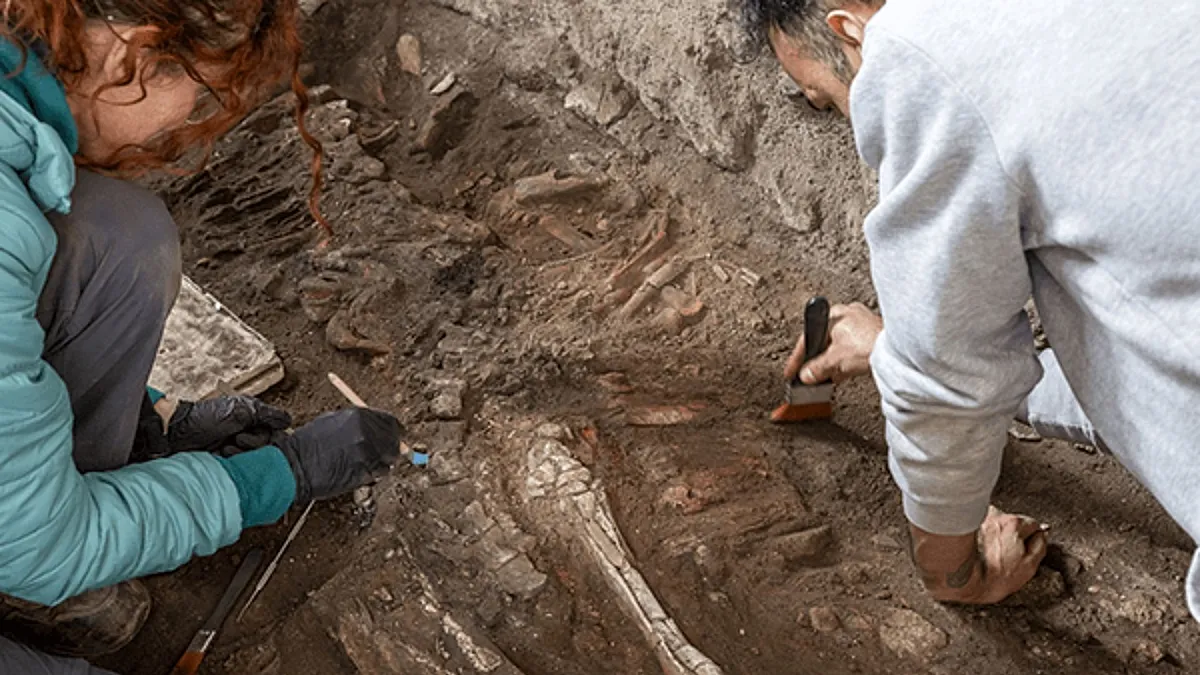
Pompeii Excavations Unearth Equid Skeleton at House of the Chaste Lovers
Pompeii excavations reveal equid skeleton at House – Recent archaeological digs in the bakery section of the House of the Chaste Lovers complex in Pompeii have uncovered the remains of an equid, adding new layers to the understanding of the ancient city’s daily operations. The discovery, made by a team of researchers, highlights the site’s potential to reveal not only human history but also the roles of animals in Roman society. This find comes amid ongoing efforts to explore the intricate details of life in Pompeii, which was buried under volcanic ash in AD 79.
The Insula of the Chaste Lovers: A Hub of Ancient Industry
The House of the Chaste Lovers, part of the broader Insula of the Chaste Lovers, is a critical excavation site in Pompeii. Known for its well-preserved structures, the complex includes a bakery oven, storage rooms, and workspaces, all of which were integral to the production of bread—a staple of Roman diets. The site also features the owner’s residence, offering a glimpse into the living conditions of the individuals who once inhabited it. Named after a famous fresco discovered in a triclinium, a dining room, the complex reflects the cultural and economic significance of the area during the time of its occupation.
Among the most intriguing aspects of the site are the stables that adjoin the bakery. These stables, previously found to house equids used for milling and transporting grain, now include a newly uncovered skeleton. The presence of these animals underscores the interconnectedness of Pompeii’s urban infrastructure and its reliance on domesticated creatures for daily tasks. The preservation of such remains is rare, allowing archaeologists to study the physical conditions of the animals and their interactions with the environment during the catastrophic eruption of Mount Vesuvius.
“For a long time, Pompeii has primarily represented the beauty of its frescoes and the opportunity to study the material culture of antiquity,” said Gabriel Zuchtriegel, director of the Pompeii Archaeological Park. “In reality, it is much more than that: it offers the possibility of learning about the human lives that were cut short by the eruption, as highlighted by the recent exhibition of the victims’ casts here in Pompeii, but also about the lives of animals.”
Insights into Animal Behavior and Eruption Impact
The equid skeleton, believed to be that of a horse or donkey, provides a unique opportunity to examine how animals responded to the sudden devastation of the Vesuvius eruption. Researchers suggest that the skeleton’s location within the bakery area may indicate its role in the production process, possibly as a work animal. By analyzing the remains, scientists hope to determine the species, age, and health of the equid, as well as any signs of stress or adaptation in the days leading up to the disaster.
The exceptional preservation of the site has enabled experts to reconstruct the complex dynamics of life in Pompeii. From the way bread was made to the movements of animals within the city, every detail contributes to a broader picture of ancient Roman society. The bakery’s structure, with its oven and storage facilities, suggests a highly organized system for food production. The equid skeleton, along with other animal remains, adds a new dimension to this understanding, revealing the interdependence between humans and animals in maintaining the city’s economy.
Initial studies of the recovered remains have already provided valuable data. However, ongoing laboratory analyses are expected to offer deeper insights. These studies will examine the physical state of the equid, potential traces of its last moments, and its relationship to the surrounding structures. The interdisciplinary nature of the project ensures that findings are contextualized across multiple fields, including archaeozoology, archaeobotany, and anthropology. Specialists from the Applied Research Laboratory have been instrumental in this collaborative effort, bringing advanced techniques to bear on the excavation.
Historical Significance and Future Discoveries
Pompeii’s preservation under volcanic ash has created a time capsule of daily life, with the House of the Chaste Lovers serving as a prime example. The site’s comprehensive layout, from its residential quarters to its industrial facilities, offers a rare opportunity to study the full spectrum of activities in a Roman urban setting. The equid skeleton is just one of many discoveries that continue to enrich this understanding, shedding light on the practical and economic functions of the complex.
The ongoing excavation marks the first phase of a larger investigation into the site’s history. As researchers delve deeper, they anticipate uncovering more artifacts that will further illuminate the lives of those who lived and worked in Pompeii. The collaboration between archaeologists and experts from the Applied Research Laboratory has been crucial in this process, combining traditional excavation methods with modern scientific analysis. This synergy has allowed for a more nuanced interpretation of the site’s history, revealing not only what was preserved but also what was lost.
Experts emphasize that the discovery of the equid skeleton is a testament to the site’s remarkable state of preservation. The volcanic ash, which sealed the city in a moment of time, has protected the remains from decay, offering an unprecedented view of Pompeii’s past. This preservation has also enabled the study of animal remains in relation to human activities, such as the transportation of goods and the milling of grain. The findings may contribute to a better understanding of the eruption’s impact on both people and animals, highlighting the interconnected challenges they faced.
As the excavation continues, the potential for further discoveries remains high. The initial phase has already yielded significant results, and the next steps will involve a more detailed examination of the equid’s role in the bakery’s operations. These analyses could provide insights into the daily routines of Pompeii’s inhabitants, the economic systems that sustained them, and the broader context of life in the ancient city. The collaboration between different disciplines ensures that the study of the site will be thorough and comprehensive, offering a multifaceted view of Roman society.