Oil Prices Slip as US-Iran Talks Alleviate Supply Concerns
Oil prices slip as progress in US – Global oil markets experienced a decline on Tuesday, with Brent crude falling 0.91% to $79.12 per barrel and US West Texas Intermediate (WTI) crude dropping 0.70% to $75.32 per barrel. The drop in prices followed early trading activity that showed a shift in investor mood, driven by positive developments in ongoing negotiations between the United States and Iran. The talks, mediated by Qatar and Pakistan, had reached a significant milestone as the first phase concluded with “encouraging progress,” according to reports.
Key Agreements in US-Iran Negotiations
Recent discussions between US and Iranian officials have led to a signed memorandum of understanding, which outlines critical steps toward resolving the long-standing conflict. The agreement includes a timeline to finalize a comprehensive deal within 60 days, a commitment to halt hostilities on “all fronts,” such as in Lebanon, and the promise to restore access to the Strait of Hormuz. These measures aim to stabilize oil supply chains, which had been a focal point of global market anxiety.
The Strait of Hormuz, a vital chokepoint for international oil trade, has been a source of concern due to its strategic importance. Its reopening is expected to ease fears of potential disruptions, which had previously driven up prices. Analysts noted that the agreement’s framework could serve as a foundation for broader diplomatic efforts, though challenges remain in translating this progress into a binding final agreement.
European Market Movements
European stock markets opened with mixed performance on Monday, reflecting cautious investor behavior. France’s CAC 40 index dipped 0.07% to 8,415.50 points, while Germany’s DAX index edged up 0.25% to 25,048.54. London’s FTSE 100 maintained a steady course, rising slightly by 0.03% to 10,367.66. The regional markets appeared to balance optimism from the Middle East talks with lingering economic uncertainties in other parts of the world.
Meanwhile, US futures contracts saw a modest decline, signaling a degree of caution among traders. The sentiment in Europe was influenced by both the oil price trends and broader geopolitical factors, as investors assessed the implications of the negotiations on global energy security.
Asian Markets Respond with Volatility
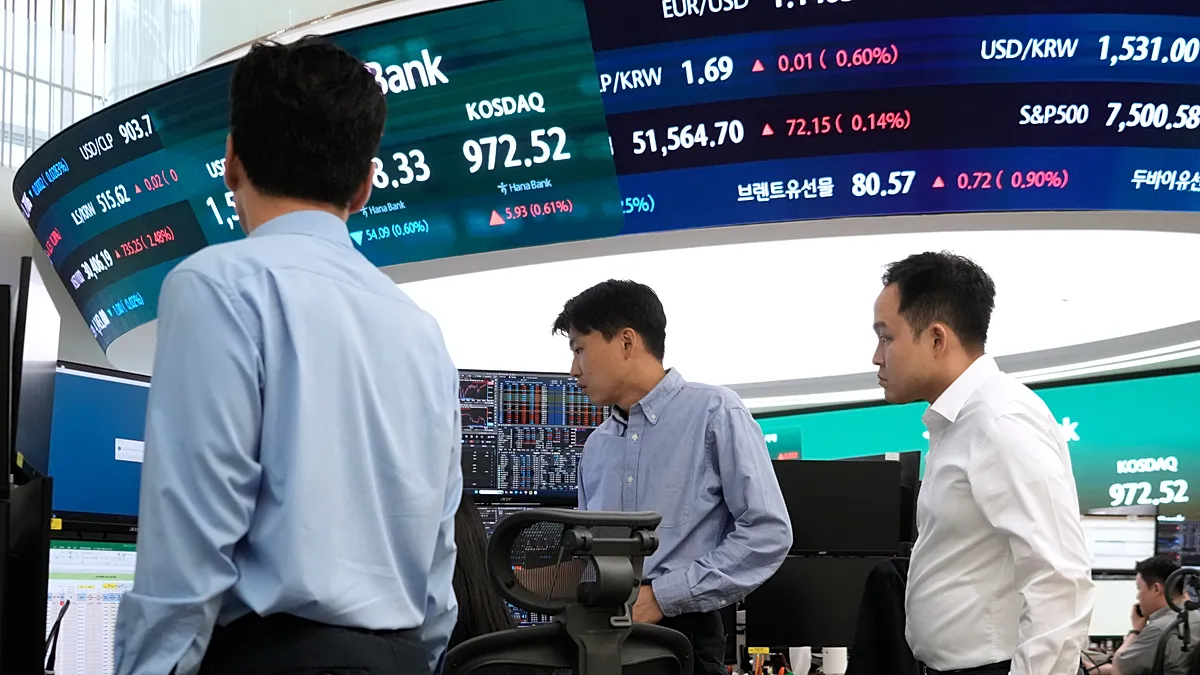
Asian stock markets exhibited varied reactions overnight, with Tokyo’s Nikkei 225 index surging 1.6% to 72,364.82. This sharp increase followed a brief intraday peak of 72,831.73, marking a new record high. The rally was fueled by enthusiasm for technology stocks, which benefited from the growing interest in artificial intelligence (AI) across global industries.
Japan’s SoftBank Group, a key player in the AI sector, saw its shares rise 2.4%, while chip equipment manufacturer Tokyo Electron climbed 2.3%. These gains underscored the positive impact of the AI boom on investor confidence. Similarly, South Korea’s Kospi index gained 0.4% to 9,084.37, with AI-related companies leading the charge. Memory chip giant SK Hynix reported a substantial 4.7% increase, highlighting the sector’s resilience and growth potential.
The regional markets’ performance also reflected broader trends in technology-driven investments. As AI innovations continue to reshape industries, stock exchanges in Asia are positioning themselves as hubs for tech-related opportunities. However, the optimism in tech stocks contrasts with the caution seen in energy markets, where the outcome of the US-Iran talks remains a key determinant.
Investor Sentiment and Market Outlook
Neil Newman, a managing director at Astris Advisory Japan, remarked on the day’s market dynamics, stating, “We’re seeing another strong market today.” He emphasized that while the positive news from the negotiations had boosted sentiment, some investors were wary of overextending their bets, particularly given the ongoing tensions in the Middle East.
“Especially with what’s going on in the Middle East, the Japanese market is probably getting a little stretched,” Newman added. His comments highlighted the delicate balance between market optimism and regional risks, which could influence future price movements.
Meanwhile, Hong Kong’s Hang Seng index retreated 1% to 23,690.86, while the Shanghai Composite Index inched up 0.2% to 4,098.01. These contrasting trends underscore the complexity of global market reactions, where regional events and global economic indicators intersect to shape investor behavior.
The US-Iran talks have created a ripple effect across multiple financial markets, from oil to equities. While the reduction in crude prices suggests a temporary easing of supply-related worries, the long-term success of the negotiations will depend on the ability to address deeper geopolitical and economic challenges. For now, the markets are reacting to the progress made, with Asia showing more resilience to the AI-driven optimism than Europe, which remains cautious in its approach.
As the agreement moves forward, the focus will shift to its implementation. The timeline for a final deal within 60 days will be crucial in determining whether the current momentum sustains or wavers. Investors are likely to monitor developments closely, as any setbacks in the talks could reignite concerns over oil supply stability and global energy prices.
Overall, the mixed signals across markets reflect the interconnected nature of global finance, where a single diplomatic breakthrough can have widespread implications. The oil price decline, while modest, signals that market participants are beginning to factor in the potential for resolution, even as they remain vigilant about risks that could prolong the uncertainty.