Giorgia Meloni Defends Herself Against Trump’s Unsubstantiated Allegations
Giorgia Meloni fires back at Trump – In a recent public exchange, Italian Prime Minister Giorgia Meloni has defended herself against accusations made by US President Donald Trump regarding their meeting at the G7 summit in France. The controversy centers around Trump’s assertion that she had “begged” for a photograph with him, a claim Meloni dismissed as entirely fabricated. The dispute has sparked a broader discussion about the dynamics of international diplomacy and the role of personal interactions in political alliances.
Trump’s Remarks at the G7 Summit
During the G7 summit in France, Trump made comments that Meloni has since labeled as “completely made-up.” In a video shared on social media, she expressed her shock at the former president’s remarks, stating that the allegations were not only misleading but also inconsistent with the facts. “I don’t know why the President of the United States behaves this way with his own allies,” Meloni said, emphasizing the tension between their expectations and the accusations.
“Donald Trump and I are people with fairly strong characters; we are two individuals who strongly defend our national interest,” Meloni explained in a press statement. This statement underscores her belief in maintaining a firm stance on Italy’s priorities, even when engaging with leaders from other nations.
According to reports, Trump told Italian journalist Daniele Compatangelo that Meloni was “probably happy I talked to her” and that he “didn’t have to talk to her.” He added, “She begged me to take a picture with her. She wanted a picture with me so badly. I wouldn’t have taken it, but I felt sorry for her.” These comments, which have been widely circulated, suggest a narrative of Meloni seeking personal favor during a high-profile diplomatic event.
Strained Relations Between Italy and the US
The relationship between Italy and the United States has grown increasingly tense in recent months. This has been fueled by Rome’s decision to withhold support for US military operations in Iran and Trump’s public criticism of Pope Leo XIV. Meloni’s response to Trump’s allegations appears to be part of a larger effort to assert Italy’s independence in foreign policy and to challenge the notion that her actions are driven by personal ambition rather than strategic necessity.
While the G7 summit provided a platform for Meloni to address the accusations, the broader context of their political disagreements has been a point of contention. The Italian government’s refusal to align fully with US military actions in Iran has been seen by some as a deliberate move to distance itself from American influence, particularly under Trump’s administration. This decision, combined with his public jabs at the Pope, has created a rift that Meloni is now seeking to mend through her verbal defense.
“We don’t need to clear the air when we disagree on something, because in the end each of us obviously understands the other’s point of view,” Meloni added. “So we simply went back to talking about what needs to be done with the same ease as the last time we met before this occasion.” This highlights her confidence in the resilience of their partnership, despite the recent friction.
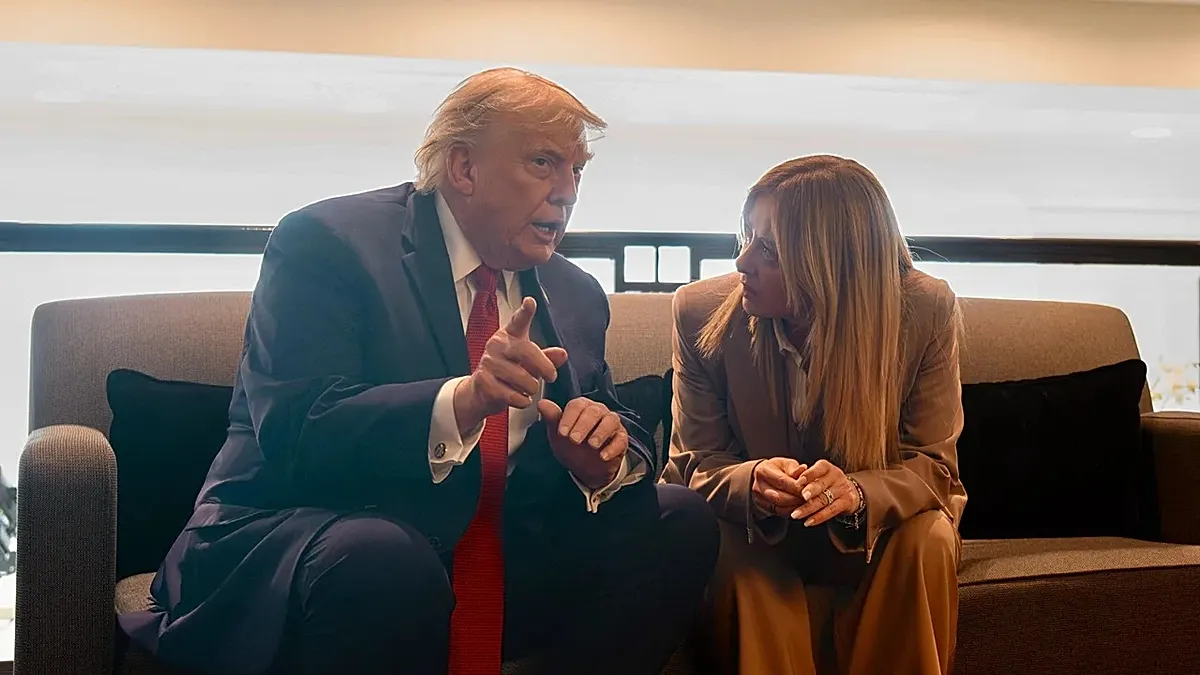
Collaboration between the two leaders had been a key focus during the G7 summit, which addressed a range of global issues including economic policy, climate change, and international security. The meeting between Meloni and Trump was held during a session on artificial intelligence, a topic that has become increasingly significant in shaping the future of global economies. The prime minister’s office released two photographs of their interaction, capturing the moment as a symbol of their continued cooperation.
Media and Public Perception
The media has played a crucial role in amplifying the tension between the two leaders. Video footage of the meeting, which shows Meloni and Trump exchanging handshakes, has been used to counter the narrative of personal disagreement. These images aim to project a sense of unity and mutual respect, even as the verbal exchange between them has sparked debate.
While Trump’s comments have been met with skepticism, they have also resonated with some of his supporters, who view them as a reflection of his candid style of leadership. Meloni’s response, on the other hand, has been praised by critics who argue that she has defended Italy’s sovereignty with clarity and conviction. The incident has become a case study in how leaders navigate personal and political conflicts on the world stage.
Giorgia Meloni’s leadership style, characterized by assertiveness and a strong focus on national interests, has been a defining feature of her tenure. Her reaction to Trump’s allegations demonstrates her commitment to maintaining a principled position in international relations. By framing the situation as a matter of national character, she has positioned herself as a leader who prioritizes Italy’s voice over personal dynamics.
The G7 summit, which brought together leaders from seven major economies, was a critical opportunity for Meloni to assert her leadership and address the implications of Trump’s remarks. The summit’s agenda included discussions on global trade, technological innovation, and climate commitments, all of which require strong diplomatic engagement. Meloni’s ability to respond to Trump’s criticisms while staying focused on these broader objectives highlights her strategic approach to international diplomacy.
As the debate over Trump’s allegations continues, the incident serves as a reminder of the complexities of cross-border political relationships. While personal interactions can sometimes influence diplomatic outcomes, they also provide a platform for leaders to express their views on larger geopolitical issues. Meloni’s response has been seen by some as a necessary step in reinforcing her government’s position on issues of mutual importance, such as the role of Italy in global affairs.
The prime minister’s office has taken steps to ensure that the public remains informed about the events of their meeting. By releasing photographs and videos of the encounter, they have provided visual evidence that supports their narrative. This media strategy is a common practice in modern politics, where the presentation of facts can be as important as the facts themselves. The images of Meloni and Trump shaking hands are intended to convey a sense of camaraderie, despite the verbal disagreements that followed.
In conclusion, the exchange between Meloni and Trump has highlighted the challenges of maintaining diplomatic harmony in a polarized international environment. While the accusations of “begging” for a photo may seem trivial, they reflect deeper ideological and strategic differences. Meloni’s firm rebuttal underscores her determination to uphold Italy’s interests, even in the face of criticism from a powerful ally. As the political landscape continues to evolve, the incident will likely remain a point of reference in discussions about leadership and international relations.