
US submarine sank an Iranian warship in international waters marking a first since WWII
US Submarine Sank Iranian Warship in International Waters, First Since WWII
On Wednesday, US Secretary of Defense Pete Hegseth announced that a US submarine had destroyed an Iranian warship in international waters, resulting in the deaths of over 80 crew members. Sri Lankan authorities, who initiated a rescue operation, reported the incident as a significant event. The Iranian government confirmed the vessel, named Iris Dena, was targeted and pledged retaliation, calling the action an “atrocity.”
“An American submarine sunk an Iranian warship that thought it was safe in international waters,” Hegseth stated during a Pentagon press briefing. “Instead, it was struck by a torpedo.”
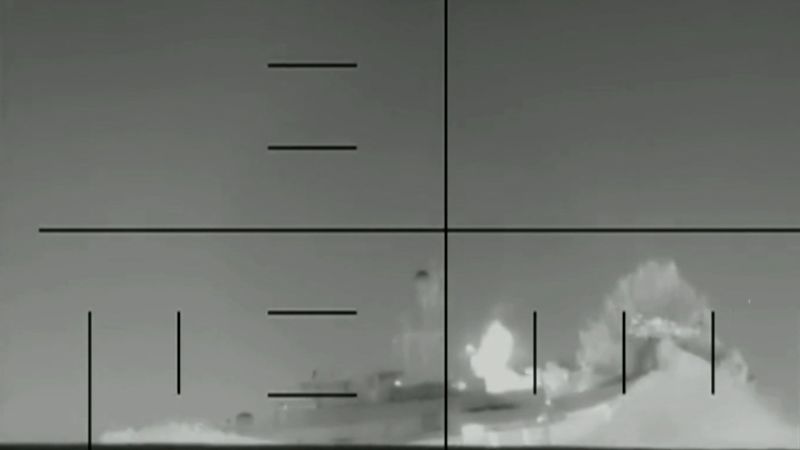
The Pentagon shared footage of the attack, capturing a dramatic explosion at the ship’s rear and images of the vessel descending into the water. Sri Lanka’s foreign minister, Vijitha Herath, detailed the response to the emergency signal. “We received the distress call at 5:08 a.m. and knew the Iris Dena was in danger,” Herath explained to parliament. “By 6 a.m., we deployed boats and coordinated with the Air Force for rescue efforts.”
As of now, Sri Lankan officials have recovered 87 bodies, with an additional 32 survivors rescued. Iran’s foreign minister, Abbas Araghchi, noted that 130 individuals were on board at the time of the distress call. “The US has committed an atrocity at sea, 2,000 miles from Iran’s coast,” Araghchi said on X. “Mark my words: The US will regret this precedent.”
Historical Precedents
Adm. Brad Cooper, head of US Central Command, highlighted the scale of the attack. “The US has damaged more than 17 Iranian vessels, including the most operational submarine,” he stated in a video message. Gen. Dan Caine, Joint Chiefs chairman, emphasized the significance of the event. “This marks the first time a US attack submarine used a torpedo to sink a combat ship since 1945,” he said.
The US Navy clarified that the 1945 incident involved the USS Torsk, which sank multiple Japanese ships. Torpedoes were later used from aircraft rather than in direct combat. In 1951, a US squadron targeted a South Korean dam with torpedoes to halt enemy advances. A 1999 mission saw a submarine successfully sink an oil tanker after other methods failed.
Iranian Naval Context
The IRIS Dena had recently departed an eastern Indian port following its participation in an international naval conference hosted by India in February. “The Iranian Navy’s IRIS Dena was welcomed into Visakhapatnam,” India’s Eastern Naval Command noted in a social media post. An Iranian delegation had marched in a parade at the port city, with a US admiral in attendance, though no US ships were deployed.
Sushant Singh, a South Asian Studies lecturer at Yale, criticized the attack’s impact on India’s standing. “The sinking of the IRIS Dena, just hours after it left Indian waters, undermines New Delhi’s regional influence,” he said. Singh pointed out the ship’s route: “It was moving through an area of India’s strategic reach, not a war zone.”
India’s key priorities include safeguarding maritime trade routes, avoiding entanglement in US-Iran tensions, and preventing kinetic attacks near its borders. Singh argued these goals were compromised by the US action. India has not yet issued a public statement, and CNN is seeking comments from its foreign ministry and navy.