EU Summit Kicks Off as Ukraine’s Zelenskyy Engages in Strategic Discussions
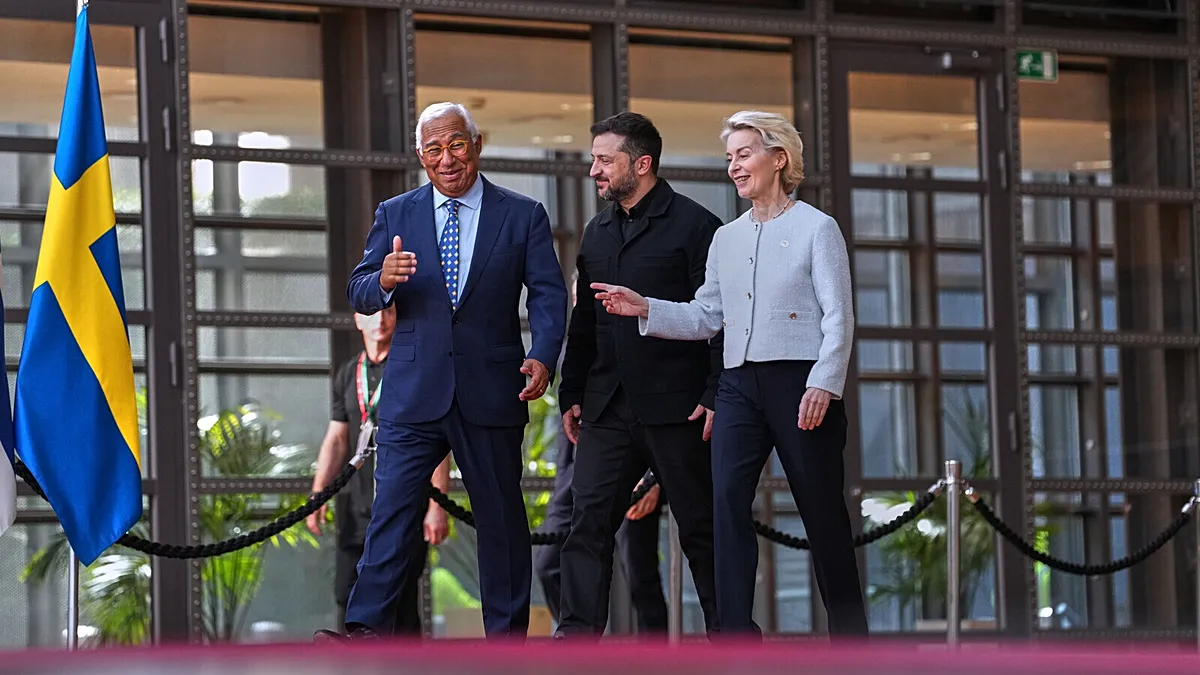
Zelenskyy joins EU leaders as Costa – The European Council summit in Brussels is currently in progress, with Ukrainian President Volodymyr Zelenskyy participating alongside European leaders. As the event unfolded, European Council President António Costa emphasized the growing sense of unity among nations following recent G7 engagements in Evian-les-Bains, France. This newfound cohesion has been credited with fostering a more robust approach to pressing Russia into negotiations, according to Costa. The summit has become a pivotal moment for addressing both the ongoing conflict and Ukraine’s aspirations for EU membership.
Pathways to Peace and Membership Talks
Zelenskyy’s attendance at the summit underscores his active role in shaping Ukraine’s future within the European Union. Speaking as he arrived, Costa praised the “new momentum” in diplomatic efforts aimed at securing a lasting peace in Ukraine. This sentiment aligns with the broader European strategy to leverage transatlantic cooperation to pressure Russia into dialogue. While Moscow remains steadfast in its demands, the EU is preparing to initiate direct talks, signaling a shift from earlier defensive postures to a more proactive engagement.
The summit also serves as a platform for advancing Ukraine’s accession process. Zelenskyy has called on the EU to accelerate the remaining five stages of membership negotiations, which were paused after the initial clusters were launched. This move comes as both Ukraine and Moldova began their first phase of discussions on Monday. The European Council’s focus on Ukraine’s integration highlights the continent’s commitment to supporting the country’s sovereignty and security, even as it navigates the complexities of a prolonged war.
Friends of Cohesion Drive Budget Reforms
Parallel to the peace talks, the summit features a critical session involving the “Friends of Cohesion,” a coalition of 16 EU nations advocating for increased financial support in agriculture and regional development. This group, which includes Bulgaria, Croatia, Estonia, Greece, Italy, Latvia, Lithuania, Malta, Poland, Portugal, the Czech Republic, Romania, Slovenia, Slovakia, Spain, and Hungary, convened informally with Italian Prime Minister Giorgia Meloni and Romanian President Nicușor Dan to outline their priorities for the upcoming long-term budget, spanning 2028 to 2034.
The “Friends of Cohesion” have previously called for a substantial boost in funding for these sectors, which historically accounted for about 60% of the EU’s budget. However, the Commission’s proposed framework for the next cycle reduces this share to 44%, reflecting a relative decline in emphasis. Despite this, the group remains determined to secure additional resources, arguing that these funds are essential for Ukraine’s recovery and for maintaining economic stability across the EU.
Cypriot President Dimitris Christofias, who is currently chairing the budget negotiations, unveiled a revised proposal that includes a €32.8 billion cut across all spending lines. This compromise is said to balance the demands of the “Friends of Cohesion” with those of the “Frugal” nations—Germany, the Netherlands, Denmark, Sweden, Finland, and Austria—who advocate for stricter fiscal discipline. The revised text aims to streamline the budget while ensuring critical areas like agriculture and regional development receive adequate attention.
Strategic Shifts and Political Dynamics
The summit’s agenda includes discussions on deepening the European single market, with European Parliament President Roberta Metsola set to engage in an exchange of views. Metsola will later hold a press conference to address key outcomes from the meeting. Meanwhile, Austria’s Chancellor Christian Stocker has highlighted the importance of maintaining dialogue with Russia, though he remains cautious about immediate concessions.
“I stand for conversations and channels that can lead to peace,” Stocker stated. “But I have not yet received a corresponding answer from the Russian side. I do not have the impression that Russia, especially President Putin, wants to come to negotiate a peace resolution. I think it’s too early to consider easing sanctions, because we have to see how this agreement is implemented in practice. However, it is definitely a reason to be careful and optimistic, because it is an improvement on the situation before.”
Stocker also noted the significance of recent developments in the US–Iran peace agreement, calling oil price trends a positive sign. Yet, he cautioned that more work is needed to achieve a sustainable resolution. “There is still a lot to be done,” he added, underscoring the urgency of continued diplomatic efforts.
Meanwhile, Croatian Prime Minister Andrej Plenković expressed hope for a constructive relationship with Hungary’s new leader, Péter Magyar. Both leaders belong to the centre-right European People’s Party (EPP), and Plenković welcomed the political change in Hungary following the April elections that ousted Viktor Orbán after 16 years. “That’s democracy,” Plenković remarked. “We have Péter Magyar now. We respect the will of the Hungarian people.”
Plenković also outlined his expectations for Magyar’s government, emphasizing the need for a cooperative stance on European matters and improved bilateral ties with Croatia. “When it comes to Europe, a constructive approach is what we seek,” he said. “And for our relations, I think a new phase of improvement is on the horizon. We are ready for that.”
War Dynamics and Future Outlook
Finnish Prime Minister Petteri Orpo has identified a clear “turning point” in the war in Ukraine, citing the country’s increasing strength and Russia’s relative decline. Orpo argued that this momentum must be sustained through continued military, economic, and political support. “Ukraine is getting stronger, and Russia is weakening,” he stated. “That’s why my message here is that this strategy needs to be continued. We must keep applying pressure on Russia while ensuring Ukraine receives the resources it needs to prevail.”
As the summit progresses, leaders will likely debate the balance between immediate aid and long-term strategic goals. The discussions may also touch on the role of international allies, with the transatlantic partnership remaining a cornerstone of the EU’s approach. The outcome of these talks will shape not only Ukraine’s path to EU membership but also the broader European response to the war and its economic repercussions.
The event marks a crucial juncture in both diplomatic and fiscal strategies. With Zelenskyy actively participating and the “Friends of Cohesion” pushing for financial reforms, the summit aims to address the multifaceted challenges facing the union. Whether these efforts will translate into tangible progress remains to be seen, but the collective focus on unity and diplomacy signals a renewed commitment to peace and stability in Europe.