UN Chief Visits Haiti Amid Escalating Gang Violence and Displacement Crisis
UN chief visits Haiti as gang – United Nations Secretary-General António Guterres traveled to Haiti to address the growing threat of gang violence, which has displaced over 1.5 million people since the country’s security situation worsened. The visit follows a weekend of intense conflict in Cité Soleil, a densely populated slum, where more than 30 individuals were killed, injured, or missing, according to Cooperative for Peace and Development. This surge in gang-related violence has not only destabilized communities but also deepened fears of a broader humanitarian crisis.
Displacement Reaches 1.5 Million
Recent reports indicate that nearly 1.5 million Haitians have been forced from their homes due to ongoing gang activity, marking a critical turning point in the nation’s resilience. The violence has claimed over 2,300 lives this year, with hundreds more kidnapped. As infrastructure crumbles and daily life becomes unpredictable, the scale of the displacement crisis has drawn urgent international attention. Guterres emphasized the need for coordinated efforts to restore safety and normalcy.
“Gang violence is paralyzing Haiti, its economy, education system, and aid delivery. But the situation can be turned around,” Guterres wrote in a post on X.
Guterres’ visit included a firsthand look at neighborhoods controlled by the Viv Ansanm federation, which the US has designated a foreign terrorist group. The gang’s dominance over 70% of Port-au-Prince has left communities in ruins, with car dealerships destroyed and homes abandoned. Graffiti on a crumbling wall declared, “Down with Viv Ansanm, long live the police,” symbolizing the public’s growing frustration with the violence that has upended their lives.
Humanitarian Impact and Resilience
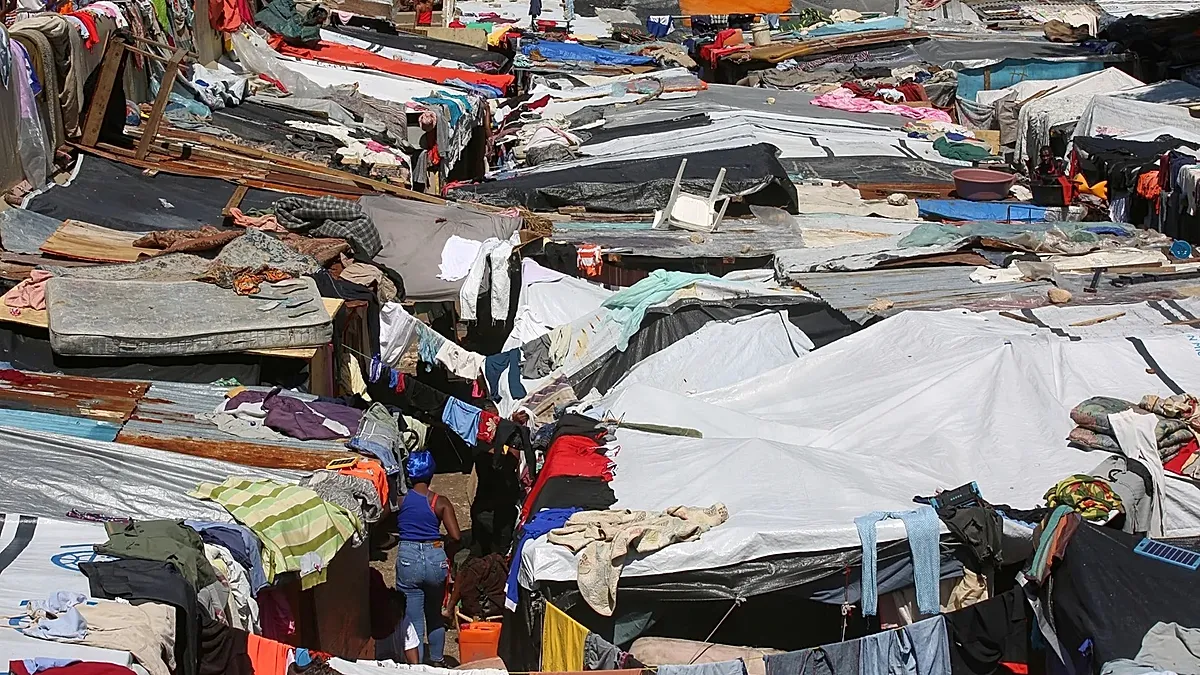
Many displaced Haitians now rely on temporary shelters, with some residing in these spaces for up to four years. Guterres toured a school-turned-refugee camp, where over 1,200 people shared a single daily meal. Despite the harsh conditions, residents clung to hope, though the emotional toll of displacement was evident. “We ask to return to our neighborhood to live better,” said Clifford Lala, a 31-year-old man, highlighting the desperation of those forced to flee their homes.
The challenges of survival in these shelters were underscored by a woman’s account of the lack of privacy. “It’s skin-to-skin and mouth-to-mouth,” she described, emphasizing the struggle to meet even basic needs. Guterres reassured the crowd, vowing support for their plight. Yet, outside the camp, a man’s voice echoed through the hallways, demanding, “We want to go back home!” His frustration reflected the widespread longing for stability amidst the chaos.
Wendy Cejour, 26, who has lived in the shelter for 18 months, echoed similar sentiments. “As long as we’re alive, we have hope,” she said, “but things are difficult.” Her words captured the resilience of displaced families, who continue to endure the consequences of gang violence while awaiting a return to normalcy. The crisis has not only fractured communities but also strained the country’s ability to provide essential services.
International Response and Transition Challenges
Guterres’ visit also focused on the transition to a more secure Haiti, with Prime Minister Alix Didier Fils-Aimé stressing the urgency of restoring order. The nation, home to nearly 12 million people, has yet to elect a president since the assassination of Jovenel Moïse in July 2021. Fils-Aimé highlighted the need for a stable environment to enable the transitional government to fulfill its mandate. “We had a frank conversation about what’s happening in Haiti,” he noted, underscoring the gravity of the situation.
The new gang-suppression force, authorized by the UN Security Council, aims to bolster Haiti’s security forces. This mission replaces the previous Kenyan-led effort, which faced challenges such as underfunding and limited personnel. Contributions from Jamaica, Chad, El Salvador, and Guatemala—each providing fewer than 1,000 troops—signal a global commitment to combating the crisis. However, the success of this initiative hinges on its ability to work alongside Haiti’s National Police and its expanding armed forces, which have seen a notable increase in recruitment.