
Understanding VPN Tunneling Protocols: A Quick Guide
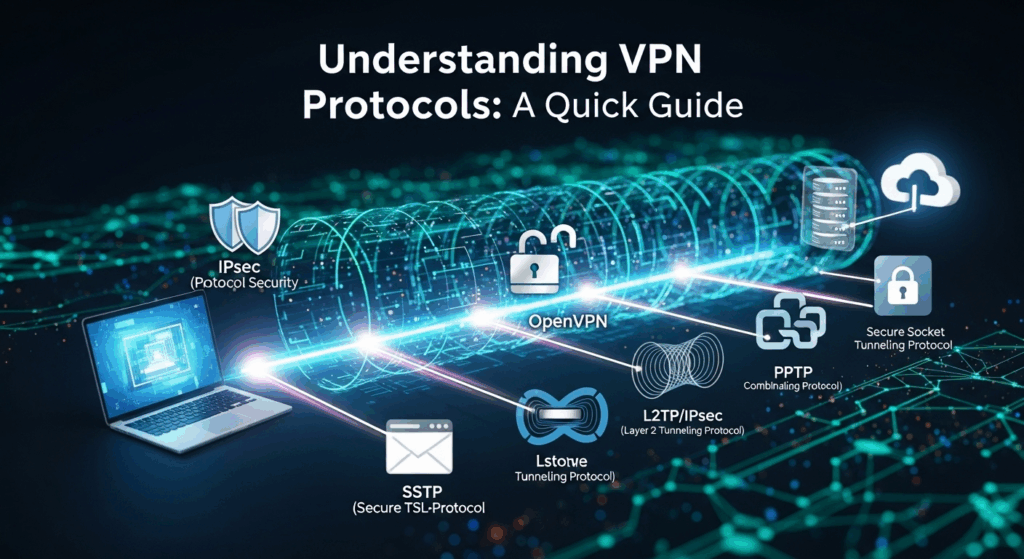
In today's digital landscape, connecting to the internet often feels like navigating a crowded public square. Every action, from checking your bank balance on cafe Wi-Fi to streaming your favorite shows, is potentially exposed to prying eyes. This is where a Virtual Private Network (VPN) becomes your personal digital bodyguard. But what gives a VPN its strength? The answer lies in its underlying technology, specifically its tunneling protocols. For anyone serious about their online privacy and security, understanding VPN tunneling protocols is not just a technical curiosity—it's a crucial step toward taking full control of your digital footprint. These protocols are the engines that power your VPN, dictating its speed, security, and reliability.
What is VPN Tunneling and Why Does it Matter?
At its core, a VPN creates a secure, encrypted connection—a "tunnel"—over a public network like the internet. Think of it this way: your regular internet traffic is like a postcard. Anyone who intercepts it can read its contents. When you use a VPN, that postcard is placed inside a sealed, opaque, armored envelope. No one can see what's inside, who sent it, or its ultimate destination, only that an envelope is being sent. This process of placing one data packet inside another is called encapsulation, and it is the fundamental principle behind VPN tunneling.
The tunnel's purpose is twofold: secrecy and identity masking. First, it encrypts your data, scrambling it into unreadable code that is meaningless to anyone without the correct decryption key. This includes your Internet Service Provider (ISP), hackers on public Wi-Fi, and other third-party snoops. Second, it routes your traffic through a remote server operated by the VPN provider. This replaces your real IP address with the IP address of the VPN server, effectively masking your location and identity and making it incredibly difficult for websites and services to track your real-world location.
Understanding the importance of this process is key to appreciating why different protocols exist. Not all tunnels are built the same. Some are designed for maximum fortification, making them virtually impenetrable but potentially slower. Others are engineered for lightning speed, prioritizing performance for activities like gaming or streaming, sometimes with a slight trade-off in obfuscation features. The specific protocol a VPN uses determines the strength of the encryption, the stability of the connection, and the overall performance, directly impacting your user experience.
The Core Components of a VPN Protocol
While we often refer to names like OpenVPN or WireGuard as a single entity, a VPN protocol is actually a combination of technologies working in concert. It's a suite of rules and instructions that govern how the secure tunnel is established and maintained. The two most critical components are the tunneling protocol itself and the encryption standards it utilizes. These elements define how your device authenticates with the VPN server, how the data is encapsulated, and how it is encrypted to ensure privacy.
The tunneling aspect dictates how the data packets are wrapped and transmitted. This includes managing the connection, ensuring data integrity (that the data isn't tampered with in transit), and handling re-connections if the network drops. Different protocols use different methods. For example, some protocols work better on unreliable mobile networks because they are designed to re-establish a lost connection quickly, while others are better at disguising VPN traffic to look like regular internet traffic, helping to bypass restrictive firewalls.
Simultaneously, the encryption cipher is the cryptographic algorithm that scrambles and unscrambles your data. The current industry standard is AES (Advanced Encryption Standard), particularly AES-256, which is considered military-grade and virtually unbreakable by brute-force attacks. Protocols also involve authentication—the process of verifying that you are communicating with a legitimate VPN server and not an impostor. This is often handled by digital certificates and cryptographic handshakes. The synergy between the tunneling method, encryption strength, and authentication process defines a protocol's overall security and performance profile.
A Deep Dive into Common VPN Tunneling Protocols
The world of VPNs is populated by a variety of protocols, each with its own history, strengths, and weaknesses. Over the years, some have become obsolete, while new ones have emerged to meet modern demands for speed and security. A top-tier VPN service will typically offer a choice of several protocols, allowing users to select the best one for their specific needs. Let's explore the most common and important protocols you are likely to encounter.
OpenVPN: The Versatile Veteran
OpenVPN has long been considered the gold standard in the VPN industry, and for good reason. It is an open-source protocol, which means its code is publicly available for anyone to inspect for vulnerabilities. This transparency has led to a global community of security experts continuously vetting and strengthening its code, making it one of the most trusted and battle-tested protocols available today. Its high level of configurability is another major asset, allowing it to be tailored for various purposes.
One of OpenVPN's key strengths is its ability to run over two different transport layer protocols: TCP (Transmission Control Protocol) and UDP (User Datagram Protocol). TCP is a connection-oriented protocol that guarantees all data arrives in the correct order, making it extremely reliable but slightly slower. UDP, on the other hand, is faster as it sends data without waiting for confirmation, which is ideal for streaming and gaming where a minor loss of a data packet is less critical than maintaining high speed. This flexibility, combined with its strong AES-256 encryption, makes OpenVPN a powerful all-rounder. Its only notable downsides are its relatively large codebase, which can make it slightly slower than newer protocols, and a more complex manual setup process for those not using a provider's app.
WireGuard®: The Modern Contender
WireGuard is the exciting newcomer that has taken the VPN world by storm. It was designed from the ground up to be a leaner, faster, and simpler alternative to older protocols like OpenVPN and IPsec. Its most touted feature is its remarkably small codebase—around 4,000 lines of code compared to the hundreds of thousands for OpenVPN or IPsec. This simplicity makes it far easier to audit for security vulnerabilities and results in a much smaller attack surface.
The primary benefit of WireGuard is its exceptional performance. It establishes connections almost instantly and delivers throughput speeds that often surpass all other protocols, making it a fantastic choice for 4K streaming, online gaming, and large-file downloads. It uses state-of-the-art cryptography, including ChaCha20 for encryption, which is considered just as secure as AES-256 but is faster on a wider range of modern hardware. The main historical concern with WireGuard was its default handling of user IP addresses, which could pose a privacy risk. However, reputable VPN providers have implemented their own solutions to mitigate this, such as using a double-NAT system, making it a secure and blazing-fast option for everyday users.
IKEv2/IPsec: The Mobile Champion
IKEv2, which stands for Internet Key Exchange version 2, is a protocol that is almost always paired with IPsec (Internet Protocol Security). Developed jointly by Microsoft and Cisco, IKEv2/IPsec is highly regarded for its stability and reliability, especially on mobile devices. Its most significant feature is its support for the Mobility and Multihoming Protocol (MOBIKE), which allows the VPN to maintain a stable connection even when a user switches between networks, such as moving from a Wi-Fi connection to a cellular data network.
This resilience makes IKEv2/IPsec the go-to protocol for smartphone and tablet users who are frequently on the move. It is generally very fast and secure, often utilizing strong encryption ciphers like AES-256. Many operating systems, including iOS, macOS, and Windows, have native support for IKEv2, which can simplify the setup process. However, it is not as widely supported on other platforms as OpenVPN, and because it primarily uses UDP port 500, it can sometimes be blocked by firewalls or network administrators more easily than protocols that can use TCP port 443 (the standard for HTTPS traffic).
L2TP/IPsec: The Decent but Dated Duo
L2TP (Layer 2 Tunneling Protocol) is a protocol that does not offer any encryption on its own. For this reason, it is almost always implemented with the IPsec suite to provide security. L2TP/IPsec was once a very popular choice and is built-in on a vast array of devices and operating systems, making it easy to configure without third-party software. It was seen as an improvement over the older and now-insecure PPTP protocol.
However, L2TP/IPsec has largely been superseded by more modern protocols. Its primary drawback is its speed; it encapsulates data twice, which adds overhead and results in slower performance compared to OpenVPN, IKEv2, and especially WireGuard. More troublingly, documents leaked by Edward Snowden suggested that L2TP/IPsec may have been deliberately weakened or compromised by the NSA. While there is no definitive public proof of a "backdoor," the mere suspicion has led many security-conscious users and providers to move away from it. It's generally considered a fallback option when more secure protocols are not available.
SSTP and PPTP: Legacy Protocols to Approach with Caution

Two other protocols you may encounter are SSTP and PPTP. SSTP (Secure Socket Tunneling Protocol) is a proprietary protocol owned by Microsoft. Its main advantage is its ability to bypass most firewalls because it uses TCP port 443, the same port used by secure web traffic (HTTPS). This makes it look like regular SSL/TLS traffic, so it is rarely blocked. However, being a proprietary, closed-source protocol means it cannot be independently audited by the security community, which is a significant drawback for privacy advocates.
Finally, there is PPTP (Point-to-Point Tunneling Protocol). PPTP is one of the oldest VPN protocols, dating back to the 1990s. While it is very fast and easy to set up, it should be avoided at all costs. It is plagued by numerous known and severe security vulnerabilities that have been well-documented for over a decade. It can be cracked with relative ease using widely available tools. No reputable VPN provider should recommend its use for any purpose, and it is mentioned here purely as a historical footnote and a warning.
Choosing the Right VPN Protocol for Your Needs
With several viable options available, how do you decide which one to use? The best protocol for you depends entirely on your priorities and what you plan to do online. For most users, the "Automatic" or "Recommended" setting in their VPN app is the best choice, as the software is programmed to select the optimal protocol based on your network conditions. However, knowing how to switch manually gives you greater control.
The choice often comes down to a trade-off between speed, security, and stability. If your primary goal is the highest level of security and privacy, OpenVPN is a fantastic, time-tested choice. If you're a gamer, streamer, or torrent user who needs the fastest connection possible without compromising on security, WireGuard is likely your best bet. If you're a frequent traveler or mobile user who needs a stable connection that won't drop when you switch from Wi-Fi to cellular, IKEv2/IPsec is an excellent and reliable option.
The table below provides a quick comparison of the top modern VPN protocols to help guide your decision.
| Protocol | Speed | Security | Stability | Best For |
|---|---|---|---|---|
| OpenVPN | Good | Excellent | Very High | All-purpose security, bypassing firewalls (with TCP) |
| WireGuard | Excellent | Excellent | High | Streaming, gaming, speed-intensive tasks |
| IKEv2/IPsec | Very Good | Very High | Excellent | Mobile devices, users switching between networks |
| L2TP/IPsec | Fair | Good | Good | Legacy devices where others aren't available |
| SSTP | Good | Good | High | Bypassing firewalls on Windows devices |
Ultimately, the protocol is only one part of the equation. The trustworthiness and policies of your VPN provider are just as, if not more, important. A provider that uses the most secure protocol in the world is useless if they log your activity. Always choose a reputable VPN with a strict, audited no-logs policy and a proven track record of protecting user privacy.
The Future of VPN Protocols and Digital Privacy
The digital privacy landscape is in a constant state of flux, and VPN protocols are evolving to meet new challenges. The meteoric rise and widespread adoption of WireGuard by major VPN providers signal a clear industry trend: a demand for faster, more efficient, and more secure cryptographic solutions. The days of clunky, slow connections are numbered, as users now expect their VPN to run seamlessly in the background without any noticeable impact on their internet experience.
Looking further ahead, the next great challenge is the dawn of quantum computing. While still largely theoretical, a powerful quantum computer could potentially break a lot of the encryption we rely on today, including AES. In response, cryptographers are already developing post-quantum cryptography (PQC) algorithms that are resistant to attacks from both classical and quantum computers. We can expect to see future versions of protocols, or entirely new protocols, that incorporate these next-generation ciphers to "quantum-proof" our data and ensure long-term digital privacy.
The fundamental need for privacy and security is not going away. As our lives become more intertwined with the digital world, the technologies that protect us must become more sophisticated. The continued development of open-source, independently audited, and cryptographically advanced tunneling protocols will be at the forefront of the fight to keep the internet a free, open, and private space for everyone.
Frequently Asked Questions about VPN Protocols
Q: Which VPN protocol is the fastest?
A: Generally, WireGuard is the fastest VPN protocol available today. Its modern design, lightweight codebase, and efficient cryptography lead to significantly higher throughput and lower latency compared to older protocols like OpenVPN and IKEv2/IPsec. This makes it ideal for activities like high-definition streaming, online gaming, and video conferencing.
Q: What is the most secure VPN protocol?
A: Both OpenVPN and WireGuard are considered top-tier in terms of security. OpenVPN has the advantage of being battle-tested for over two decades and benefits from its open-source transparency. WireGuard uses newer, state-of-the-art cryptography and has a much smaller attack surface, making it easier to secure. When implemented correctly by a reputable VPN provider, both offer exceptionally strong security. The "most secure" can depend on the specific implementation and configuration.
Q: Can my ISP see that I'm using a VPN?
A: Your ISP can typically see that you are connected to a VPN, but they cannot see the content of your traffic. They will see encrypted data flowing between your device and the VPN server's IP address, but what websites you visit, what files you download, or what messages you send will be completely hidden. Some protocols, like OpenVPN running on TCP port 443, can make VPN traffic look like normal HTTPS traffic, making it harder to detect and block.
Q: Should I manually change my VPN protocol?
A: For most users, it's best to stick with the "Automatic" or "Recommended" setting in your VPN provider's application. The app is designed to choose the best protocol for your specific network conditions to balance speed and security. However, if you are experiencing issues (e.g., slow speeds or connection drops) or have a specific goal in mind (e.g., trying to bypass a restrictive firewall), manually switching to a different protocol is a great troubleshooting step and a useful option to have.
Conclusion
VPN tunneling protocols are the unsung heroes of online privacy. They are the sophisticated engines that create a secure and private channel for your data, shielding you from surveillance and cyber threats. While the technical details can seem complex, understanding the fundamental differences between protocols like the highly secure OpenVPN, the blazing-fast WireGuard, and the mobile-friendly IKEv2/IPsec empowers you to make informed decisions about your digital security. The protocol you choose can have a real impact on your VPN's speed, stability, and ability to bypass restrictions.
Ultimately, the best VPN experience is a combination of robust protocols and a trustworthy VPN provider. By choosing a service that offers modern, secure protocols and is transparent about its privacy practices, you ensure that your digital life remains exactly as it should be: yours.
***
Summary
Understanding VPN tunneling protocols is essential for anyone looking to maximize their online security and privacy. These protocols are the set of rules that create a secure, encrypted "tunnel" for your internet data, hiding it from ISPs, hackers, and other third parties. This article provides a comprehensive guide to the most common protocols, explaining their functions, strengths, and weaknesses.
The main protocols covered include:
- OpenVPN: The long-standing industry standard, known for its excellent security, open-source transparency, and high degree of configurability.
- WireGuard®: A modern, lightweight protocol celebrated for its exceptional speed and state-of-the-art cryptography, making it ideal for streaming and gaming.
- IKEv2/IPsec: A highly stable and reliable protocol, perfect for mobile users due to its ability to seamlessly switch between networks without dropping the connection.
- Legacy Protocols: Older options like L2TP/IPsec and SSTP are discussed, while the outdated and insecure PPTP is strongly advised against.
The guide emphasizes that the right protocol depends on the user's specific needs, whether it's prioritizing maximum security (OpenVPN), top speed (WireGuard), or mobile stability (IKEv2). While most VPN apps can automatically select the best option, knowing the differences allows for greater user control. The article concludes that a combination of strong protocols and a reputable VPN provider with a strict no-logs policy is the ultimate key to achieving true digital privacy.